
How to Stop Birds and Pests Eating Your Fruit and Veg
A sensible, wildlife-conscious guide to netting, cages and fleece for protecting brassicas, soft fruit and seedlings in a British garden.
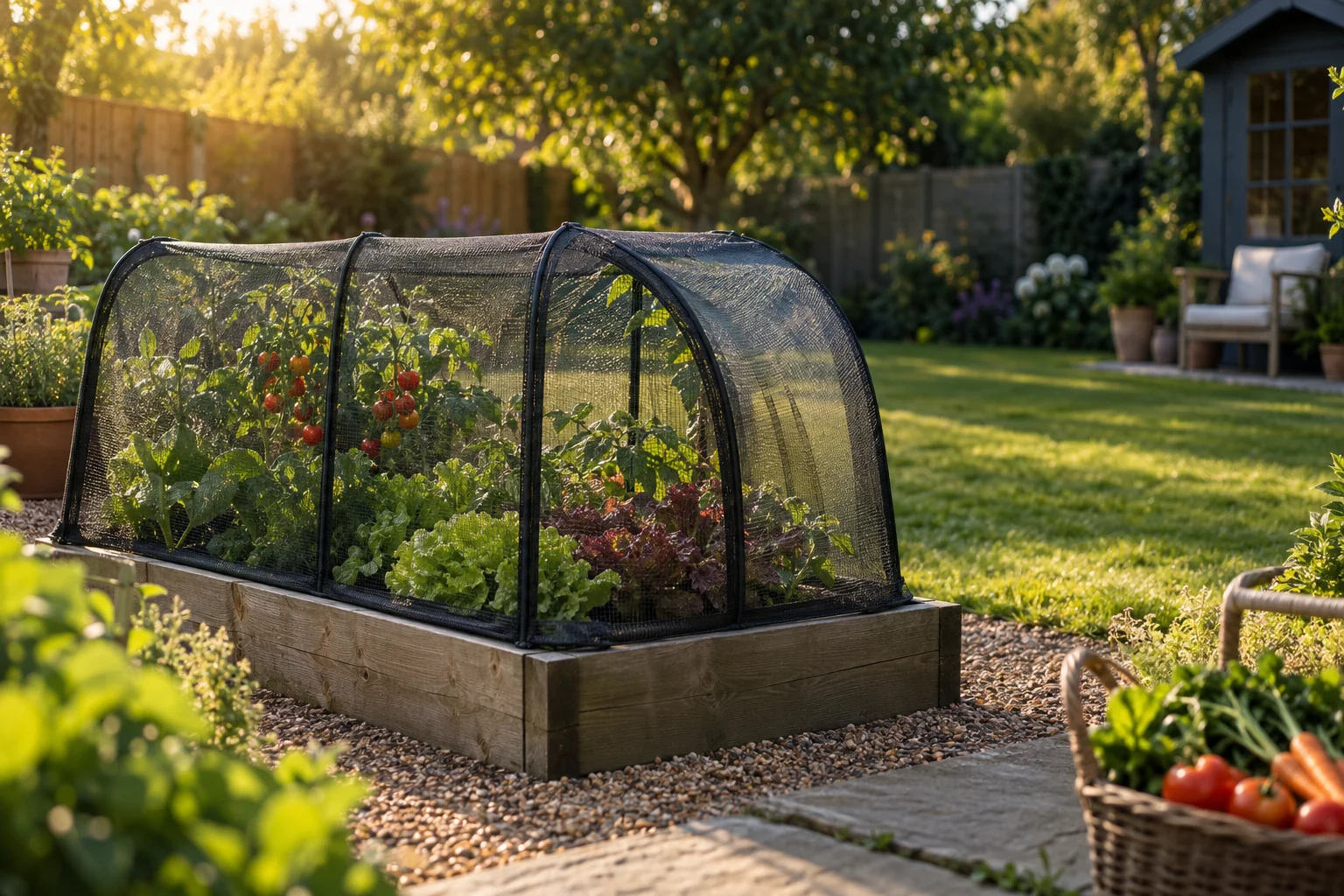
Why Your Crops Keep Disappearing (And What's Really Going On)
It is mid-October, and the productive garden can look deceptively calm. The summer raspberries have finished, the runner beans are winding down, and the brassicas are beginning to look like the dependable backbone of the plot. Then you notice it: a kale leaf reduced to green lace, a broccoli plant with its centre pecked out, or a row of young winter salad seedlings that seems to have become somebody else's buffet.
There is a particular sort of annoyance reserved for this moment. You have watered, weeded, fed and checked the weather forecast with the concentration of a minor civil servant. A pigeon arrives, gives your carefully raised cabbage the once-over, and behaves as though it has booked a table.
The first useful step is to stop treating all crop damage as one problem. Birds, butterflies, aphids, slugs and mammals do not require the same answer. A loose net thrown over a brassica bed may discourage a hungry bird but leave gaps for cabbage white butterflies. A sheet of fleece can shelter seedlings and reduce insect access, but it is not a permanent answer for a tall fruit bush. The best protection is nearly always physical, fitted properly and matched to the crop in front of you.
Wood pigeons are among the most obvious culprits around brassicas. They are fond of the tender growth on cabbages, kale, broccoli, cauliflower and sprouts, especially when other food is scarce. Blackbirds and other fruit-loving visitors can strip strawberries, currants and other soft fruit with startling efficiency. They are not being malicious, obviously. They are simply very good at finding the ripest berry five minutes before you do.
Cabbage white butterflies are a different sort of problem. The adult butterfly itself is harmless to your harvest, but the eggs it lays on brassica foliage hatch into caterpillars that can make rapid work of leaves. Aphids often gather on soft young growth and seedlings. Slugs and snails tend to work quietly, which feels unfair; at least pigeons have the decency to be seen doing it.
The vulnerable period is longer than many gardeners expect. Brassicas can need protection from spring until autumn, whilst soft fruit is most exposed from late May through to August. Seedlings are at risk in almost every month that you are raising them. Right now, in October, it is worth protecting overwintering brassicas, young salad, broad bean seedlings and any newly planted crops that have not yet had time to toughen up.
Start with the evidence
Before buying or deploying anything, inspect the damage. Large torn leaves and pecked centres point towards birds; chewed holes and caterpillars suggest cabbage whites; sticky, curled growth suggests aphids. A cover works best when it is solving the problem you actually have, rather than the one you had a bad dream about after planting out.
The Four Pillars of Crop Protection: An At-a-Glance Breakdown
There are four main tools in the home grower's protection kit: bird netting, fine butterfly mesh, horticultural fleece and a walk-in fruit cage. They overlap a little, but they are not interchangeable. Think of them as different coats for different weather, except the weather has wings and an appetite for your kale.
Bird netting is the broad, open mesh used over fruit beds, bushes and cages. A 20 mm × 20 mm mesh is commonly used as bird protection and as roof netting on fruit cages. Its job is straightforward: create a physical barrier between birds and the crop whilst allowing rain, light and air to reach the plants. It is a useful option over strawberries and soft fruit, provided it is supported rather than simply draped tightly across ripening plants.
Fine mesh or butterfly netting is the brassica specialist. The 7 mm mesh format is designed to prevent cabbage white butterflies from laying eggs on crops such as cabbages, sprouts, cauliflower, broccoli and kale. It can also act as a barrier to birds, squirrels and rodents. Quality woven polyethylene mesh can offer 100% light passage and 95% air passage, two very useful figures when you are covering a crop for much of the season rather than for a weekend.
Horticultural fleece is softer and more adaptable. Made from non-woven polypropylene, it can be draped over vulnerable plants or used over hoops. It protects against wind, hail, frost and pests, whilst remaining breathable and water-permeable. It is particularly useful for seedlings, early sowings and short periods of unsettled weather. In October it is a handy extra layer for tender young plants, but do not leave it on indefinitely without lifting it to inspect what is happening beneath.
Walk-in fruit cages are the long-term solution for gardeners with a dedicated soft-fruit area. They have a framework, netted sides and roof, and enough headroom to let you prune, pick and weed inside. That access matters more than it sounds. A protective system you resent opening is a system you will eventually stop checking, and neglected fruit has an astonishing ability to hide just when it is ripe.
The fitting matters as much as the material. A cover with an open edge is an invitation, not a barrier. Peg, weigh down or bury the lower edge where appropriate, and make sure a frame, hoop or cane does not create a convenient gap at either end.
Bird Netting Deep Dive: Protecting Soft Fruit Without Trapping Wildlife
Bird netting is familiar because it is versatile. A generous piece can cover a strawberry bed, be clipped to a simple frame around currants, or form part of a larger fruit cage. The standard 20 mm × 20 mm format is intended to exclude birds whilst remaining open enough for light, rain and air. It is particularly useful when the crop is nearly ready to pick and birds have begun taking an entirely unreasonable professional interest.
The better examples are made from HDPE, or high-density polyethylene, monofilament. At 37 g/m², this style of netting is light enough to handle without turning installation into a wrestling match, yet substantial enough for repeated use. Double-stitch mono-thread construction strengthens the fabric and helps it stand up to the annual cycle of being stretched, folded, stored, rediscovered in spring and discovered to be tangled around something it has never met before.
A stated lifespan of up to 10 years is possible with double-stitched, UV-stabilised netting, but it is not automatic. Sunlight, wind, sharp canes, foxes, lawnmower accidents and enthusiastic storage all have their say. Treat netting as garden equipment, not disposable wrapping. Remove it once the crop has finished, shake out leaves, check for holes and store it dry. One careful habit at the end of summer can save a surprising amount of irritation next May.
There is, however, a serious caveat. Coarse bird netting can pose a risk to wildlife if it is loose, sagging or left unattended. Birds and small mammals can become entangled. The safest approach is to make the netting taut over a proper frame, keep it off the ground where possible, avoid loose folds and inspect it frequently. If you need wildlife-friendly mesh, use a mesh smaller than 5 mm; 2 mm is preferable. That is a different job from conventional 20 mm bird netting, which is why it pays to be specific before you buy.
For a few strawberry plants, individual protective structures or a small supported tunnel are often easier than covering the entire bed with loose material. For a row of currants or a sizeable patch, a frame allows the netting to sit away from foliage and fruit. That space is useful: berries do not get squashed against the mesh, and you can harvest without first having to free a blackcurrant branch from a nylon puzzle.
Use the right mesh for the job
20 mm × 20 mm bird netting is a practical barrier over soft fruit and a standard roof-netting choice for fruit cages. It is not the same product as the fine mesh used to exclude cabbage white butterflies.
UV stabilisation is worth looking for
UV-stabilised HDPE is designed for garden exposure. Combined with double stitching, it supports a claimed lifespan of up to 10 years when cared for properly.
Support and inspect it
Netting should be tensioned over a frame, checked often and removed when it is no longer needed. A neat installation is safer for wildlife and kinder to the gardener trying to harvest.
The wildlife-safe rule
Do not rely on loose, open-mesh netting as a casual drape. If a cover can sag, trail or form a pocket, it can create an entanglement hazard. Build simple support first, pull the material taut second, and make inspection part of the morning garden round.
Fine Mesh and Butterfly Netting: The Brassica Grower's Secret Weapon
For most gardeners growing brassicas, fine mesh is the cover that changes everything. It is not glamorous. Nobody has ever stood at the garden gate and admired a tunnel of mesh in the manner of a perfect rose border. But it is wonderfully effective because it prevents the problem rather than asking you to spot every egg and caterpillar after the event.
A 7 mm mesh is suited to cabbages, Brussels sprouts, cauliflower, broccoli and kale. It is fine enough to stop cabbage white butterflies reaching the leaves to lay eggs, and it can provide a useful barrier against birds, squirrels and rodents too. That broad usefulness is helpful in a small garden, where a single bed may contain kale, sprouting broccoli and a few salad plants, all of which have their own admirers.
The material makes a difference. Fine butterfly mesh is commonly made from ultra high-grade woven polyethylene rather than the more open monofilament structure associated with bird netting. The woven construction has a softer, more fabric-like feel and drapes well over hoops and frames. That makes it easier to create a proper enclosure without putting unnecessary pressure on leaves.
Light and airflow are the two things that make gardeners nervous about any cover. Quite rightly. A brassica patch may spend much of the growing season under mesh, so it must still behave like an outdoor crop. Good 7 mm fine mesh allows 100% light passage and 95% air passage. In practical terms, it does not turn your kale into a crop under a blanket. Rain can reach the soil, sunlight can reach the leaves and moving air helps the bed remain an ordinary garden bed rather than a humid little cave.
It is still worth lifting the mesh regularly. Check the undersides of leaves for any pests that found a way in before the cover went on. Check that a plant has not pushed hard against the fabric. Weed the bed whilst the weeds are small. And do not forget that crops need room to grow; a cover that fitted perfectly when the plants were the size of a postcard may feel rather snug by high summer.
The key timing is to cover early. If you wait until you see adult butterflies working the bed, they may already have laid eggs. Put the mesh over newly planted brassicas and secure every edge. If you are sowing or planting in spring, this is a job for the same day, not an optimistic task for "sometime this weekend". Come next spring, it is one of the most useful routines you can establish.
| Protection type | Best use | What it keeps out | Important limitation |
|---|---|---|---|
| 20 mm bird netting | Soft fruit and fruit-cage roofs | Birds when fitted over a taut frame | Too open for cabbage white exclusion; must not be left loose around wildlife |
| 7 mm fine mesh | Brassicas and mixed edible beds | Cabbage white butterflies, birds, squirrels and rodents | Needs a sealed edge and enough height for the eventual crop |
| Horticultural fleece | Seedlings and temporary weather protection | Many flying pests whilst adding shelter from wind, hail and frost | Best lifted regularly for inspection and watering checks |
| Walk-in fruit cage | Permanent soft-fruit areas | Birds through a complete framed enclosure | Needs space, planning and a larger initial outlay |
Do not uncover brassicas for convenience
Fine mesh only works when it is in place. Lift one side to weed, harvest or inspect, then reseal it immediately. The few minutes saved by leaving an edge loose can undo the whole point of covering the crop.
Horticultural Fleece: Which Weight Does What?
Horticultural fleece is one of those materials that seems faintly unremarkable until you have a cold night, a blast of wind, a tray of emerging seedlings and nowhere sensible to put them. Then it becomes very reassuring indeed. It is made from non-woven polypropylene: spun-bonded fibres form a breathable fabric that lets water through, unlike a sheet of plastic. This is important because plants need air and rain, not a tiny plastic conservatory with no ventilation and a tendency to collect puddles.
The weight is expressed in grams per square metre, usually shortened to gsm. More gsm means a denser material. That does not automatically mean "better"; it means a different balance of protection, handling and light transmission. A lightweight fleece is easier to drape over seedlings and can be useful as an insect barrier. Heavier fleece offers more substance where weather protection is the priority.
At the lightweight end, 17 gsm fleece is widely used for frost protection and seedling cover. An 8 m × 1.5 m SupaGarden frost-protection fleece has been listed at £7.99, making this sort of cover an accessible way to protect a modest row or several containers. A 20 gsm fleece is another common choice, whilst 30 gsm fleece is markedly heavier than many alternatives and provides a more substantial insulating layer. A 10 m × 1 m 30 gsm fleece has been listed at £10.50, and 30 gsm material is also sold by the metre in 1.6 m widths.
For gardeners covering a larger area, bulk fleece can make more sense. An 18 gsm 2 m × 100 m roll has been listed at £39.95. The key is not simply to buy the heaviest material available. Consider what you will actually do with it. A very heavy cover may be useful for a short cold snap, but it is less convenient to lift repeatedly from a salad bed. A lighter fleece is easier to peg down, fold away and redeploy when the forecast looks lively.
In October, fleece earns its place by helping newly planted salads, late sowings and vulnerable seedlings through unsettled weather. It can also add a buffer against wind and hail. On mild days, lift or vent it so that plants are not kept unnecessarily enclosed. Water can pass through fleece, but it is still good practice to check the soil rather than assuming everything beneath is fine. British rain is famously capable of occurring nearby without reaching the bit that needs it.
The chart is simply a visual comparison of material weight: 30 gsm is the heaviest of these three options, 20 gsm sits in the middle and 17 gsm is the lightest. It is not a measure of frost protection, pest control or crop performance, because those outcomes depend heavily on how the fleece is fitted, the weather and the plants beneath it.
Where fleece excels
- Quick cover for seedlings, newly planted crops and exposed rows.
- Breathable, water-permeable non-woven polypropylene construction.
- Useful protection from frost, wind, hail and insect pests.
- Easy to fasten, remove and reuse from season to season.
Where it falls short
- Not a permanent structure for tall fruit bushes or large crops.
- Can be awkward to manage once plants become bulky.
- Needs lifting for regular inspection, harvesting and weeding.
- Loose fleece edges can be lifted by wind if they are not secured.
My own preference is to treat fleece as flexible protection rather than a set-and-forget cover. Keep a clean, folded piece somewhere dry and accessible. When a chilly night or rough spell is forecast, it is much more useful hanging over a bed than still compressed in its packaging at the back of the shed behind three empty compost bags and a wheelbarrow tyre.
Walk-In Fruit Cages: The Premium Investment That Pays for Itself
A walk-in fruit cage is the grown-up answer to a recurring fruit problem. It is not cheap, it is not invisible and it asks you to make a proper decision about where the fruit garden will live. In return, it protects a defined area in a way that is practical to use year after year. If you grow several currants, gooseberries, blueberries, strawberries or other soft fruit, this can be far less frustrating than wrestling with separate nets every season.
The common walk-in height is around 2 m, which is enough to move around comfortably whilst carrying a bowl, pruning tools or the vague sense that you were sure there were more ripe berries yesterday. Standard cage widths can extend to 9 m. An alternative 1.9 m height is also widely used; it is tall enough for most gardeners to work inside, while keeping the structure manageable in an ordinary plot.
Aluminium-framed cages are popular because the framework is durable without becoming excessively heavy. One established specification uses tubing with a 19 mm external diameter, 17.2 mm internal diameter and a 0.9 mm wall thickness. Standard roof netting can be 19 mm bird-proof mesh, with side netting manufactured from a tough extruded composite material. A full enclosure matters: birds are quite capable of finding an overlooked opening, particularly once your fruit is properly sweet.
Assembly is more involved than draping fleece or placing mesh over hoops, but a proper cage normally comes with instructions and a diagram. Give yourself time, choose a calm day and clear the site before you begin. Position it where you can access all sides and where the door can open freely. It is also wise to consider how you will mulch, water, prune and pick inside it. The cage is there to make fruit growing simpler, not to create a permanent escape-room challenge.
There is a 10-year structural guarantee on some aluminium walk-in cages. That is a meaningful distinction from seasonal covers. It does not remove the need to look after netting or check tension, but it supports the case for a cage where fruit production is a long-term feature of the garden rather than an experiment for one summer.
Compact walk-in cage
1.9 m × 2 m × 2 m
Longer fruit row
1.9 m × 2 m × 4 m
Extended fruit row
1.9 m × 2 m × 6 m
Large fruit row
1.9 m × 2 m × 8 m
Enough room to work
Heights of 1.9 m and 2 m are designed for walk-in access, with standard width options reaching up to 9 m for larger fruit areas.
A complete fruit boundary
Roof and side netting provide a more controlled barrier than throwing a loose cover over bushes at the point when fruit is already ripening.
Built for repeated seasons
Aluminium-framed designs can carry a 10-year structural guarantee, making them a credible long-term option for established fruit gardens.
How to Fit Covers Properly, Without Creating a Wildlife Hazard
There is no point pretending that crop protection is entirely carefree. Any barrier needs attention. The good news is that most of the important habits are simple, and they become routine very quickly. The aim is to protect your crop whilst keeping wildlife safe and leaving yourself a reasonably civilised way to get at the plants.
First, use support. Hoops, canes, a purpose-made frame or a cage structure keep netting away from foliage and make it possible to pull it taut. A raised cover does not flatten seedlings, gives brassicas space to grow and makes harvesting far easier. It also reduces loose folds where birds or small animals could become caught.
Second, seal the perimeter. With fine mesh, the lower edge needs to meet the ground securely all the way around. Peg it down, weigh it down or use another reliable method suitable for your bed. Do not assume a small gap is harmless. A cabbage white butterfly does not require a grand entrance. With bird netting, make sure the cover is tensioned and fixed to the frame rather than trailing around the soil.
Third, inspect every day when crops are under netting. This does not have to become a military patrol. As you water or pass through the garden, look for a sagging section, a lifted peg, a trapped leaf, a bird or animal in difficulty, or a crop pressing hard against the cover. Quick intervention is the whole point. If you cannot check a cover regularly, choose a more robust structure or remove it when it is no longer essential.
Finally, take covers off at the right time. Bird netting can be removed once fruit has finished. Fleece should come off when the weather and pest pressure allow. Fine mesh on brassicas may remain in place through the growing season, but it should still be lifted for maintenance. A cover is a tool, not garden wallpaper.
Pollination reminder: if you cover a crop that needs insect pollination to set fruit, plan access accordingly. Brassicas grown for leaves or heads are different from flowering fruiting crops. Protect the crop without accidentally excluding the visitors it needs.
Head-to-Head: Which Solution Is Right for Your Plot?
The best choice depends less on finding the "best" material and more on the scale of your growing. A handful of salad seedlings has very different needs from six mature currant bushes. A small urban garden may benefit from a compact mesh tunnel. A large allotment fruit patch may justify a proper cage. It is perfectly reasonable to use more than one system; most productive gardens do.
Loose bird netting is the lowest-cost starting point, with 20 mm bird netting listed from £1.84 per metre. It is practical over fruit, particularly when mounted on a frame, but it places more responsibility on you to fit and check it safely. Fine butterfly netting is a specialised investment for brassicas. Examples include 5 m × 2 m at £14.99, 4 m × 3 m at £16.99 and 4 m × 5 m at £21.98. It costs more than a casual piece of netting, but it solves a much broader brassica problem.
Fleece is generally the simplest material to deploy because it can be draped and pegged down within minutes. A 17 gsm 8 m × 1.5 m roll at £7.99 is enough to make it a realistic first purchase for a beginner with a small bed. A walk-in cage sits at the other end of the scale: the smallest 1.9 m × 2 m × 2 m option begins at £202.00, but it provides a dedicated, accessible enclosure for a long-term fruit area.
| Method | Choose it if… | Best crops | Seasonal role | What to remember |
|---|---|---|---|---|
| Bird netting | You need flexible bird protection over a framed fruit bed or bush | Strawberries and other soft fruit | Most useful as fruit ripens, generally from late May to August | Keep it taut, supported and checked to reduce wildlife risk |
| Fine butterfly mesh | You grow brassicas and want to prevent cabbage white access | Kale, broccoli, cauliflower, sprouts and cabbages | Useful from spring through autumn | Install early and seal every edge |
| Horticultural fleece | You need rapid, adaptable protection for young plants | Seedlings, salads and recently planted crops | Especially useful during cold, windy or unsettled spells | Lift it to inspect plants and keep edges secure |
| Walk-in fruit cage | You have a permanent soft-fruit area worth protecting each year | Established soft-fruit plantings | A long-term, season-after-season solution | Plan the site and access before building |
For a beginner, I would usually start with fleece for seedlings and fine mesh for a modest brassica bed. These two materials solve a remarkable number of common frustrations without demanding a major rebuild of the garden. Add bird netting once soft fruit begins to feature. Move to a fruit cage when you find yourself buying, fitting and cursing temporary netting around the same bushes every single year. That is generally the garden telling you it is ready for an upgrade.
What to Do Now, Then Through Next Year
October is a good month to improve protection rather than simply react to damage. Look over any brassicas still standing: kale, sprouts, winter cabbage and sprouting broccoli are all worth checking for pigeon attention and caterpillars. If they are exposed, add fine mesh over a supported frame and secure the edges. Check that the bed is weeded before you cover it. Pulling weeds from beneath a cover is not impossible, but neither is assembling flat-pack furniture in a thunderstorm. Both are avoidable.
Clear and store summer bird netting from finished strawberry beds and fruit bushes. Shake it out, inspect for damage and dry it before storage. If you have repeatedly struggled to protect a fruit area, use the quieter months to measure the space and plan a cage. This is much less stressful than trying to make a decision when blackcurrants are ripening and every bird within a postcode has noticed.
Over winter, keep fleece ready for vulnerable young plants and use it selectively when conditions are rough. Check after wind, heavy rain and frost. A cover that has shifted needs resetting promptly. It is also a sensible time to decide where hoops, supports or a future cage will go, whilst the crop beds are relatively open and you can still see the layout clearly.
Come next spring, cover brassicas as soon as they are planted out. Do not wait for butterflies. Use fleece for early seedlings and new plantings when weather protection is helpful. As late spring turns into summer, move your attention to soft fruit. Support bird netting well before berries colour, rather than attempting to fit it around heavy, fruiting plants. The earlier you do the calm work, the less frantic the garden becomes later.
You can use it as a barrier against birds, but 20 mm bird netting does not provide the fine exclusion needed to stop cabbage white butterflies laying eggs. Fine 7 mm mesh is the more suitable choice for brassica protection.
No. Quality 7 mm butterfly mesh allows air and light through, and rain can reach the crop. Lift the cover for maintenance and inspection, not simply because rain is forecast.
Fleece is useful during cold or unsettled conditions, but it should be checked and lifted regularly. Plants still need your attention, and a cover is most effective when it is adjusted to current weather and crop growth.
Never leave coarse netting loose or sagging. Use a frame, keep material taut, secure edges and inspect it frequently. For wildlife-friendly mesh, choose mesh smaller than 5 mm, preferably 2 mm.
The GardenScout verdict
There is no single magic cover for every crop. Fine mesh is the standout choice for brassicas, fleece is the adaptable helper for seedlings and rough weather, and supported bird netting is useful for soft fruit when handled responsibly. If soft fruit is a permanent part of your garden, a walk-in cage is the most orderly long-term answer. Start with the crop, identify the culprit, fit the barrier carefully and check it often. Your vegetables will be happier, the birds will need to find lunch elsewhere, and you may finally get to eat the strawberries you grew.