
Hedge Choices for Privacy: Fast, Evergreen and Wildlife-Friendly
Laurel, yew, hornbeam, beech and mixed native hedging compared for speed, screening, soil, wildlife and the amount of weekend you are prepared to give up to pruning.
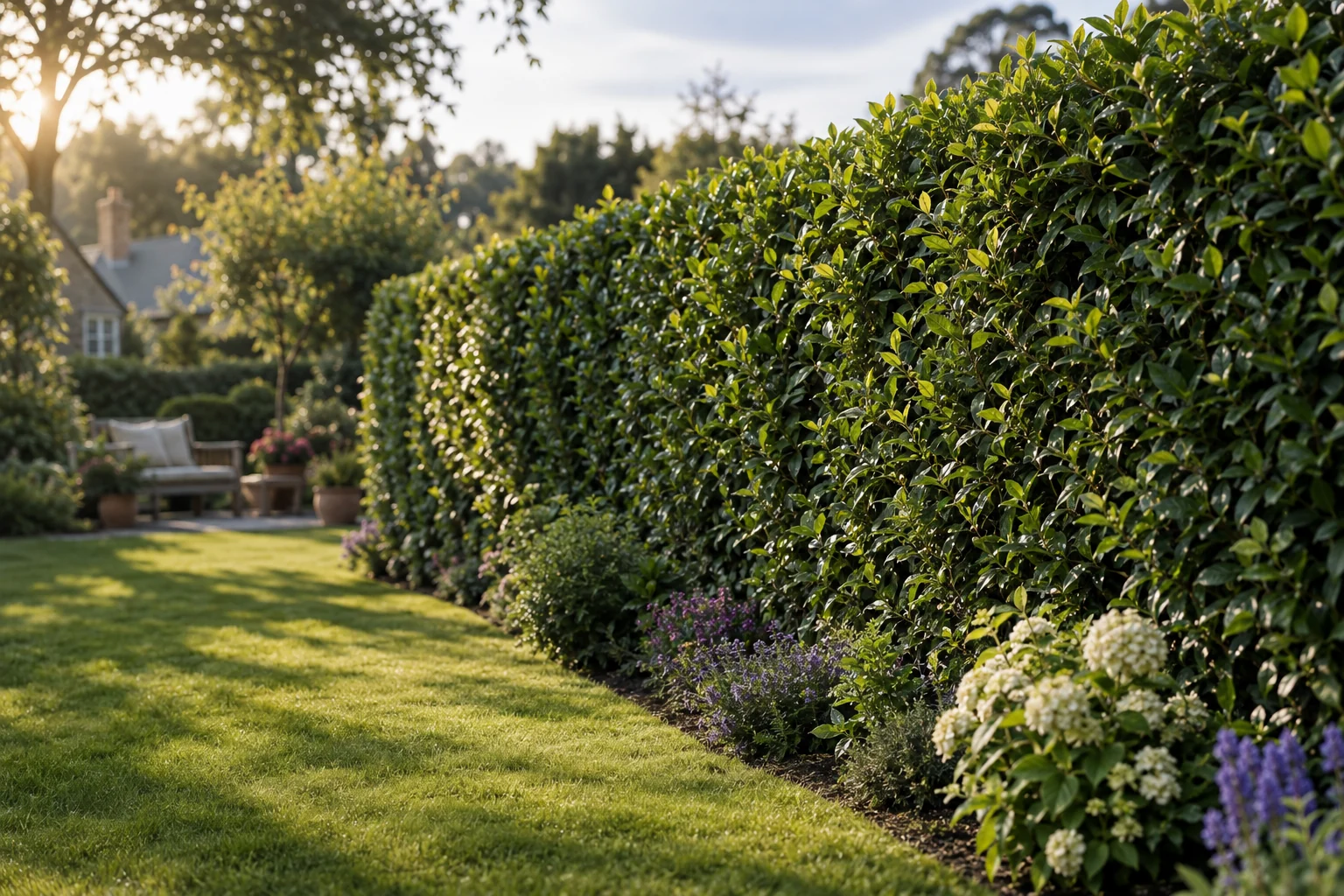
Why Your Boundary Choice Matters More Than You Think
There is a particular moment when every gardener starts thinking about a hedge. It may be when a neighbouring extension suddenly seems rather close. It may be when the washing line becomes a public performance. Or it may simply be that an elderly fence panel has acquired the posture of a tired walrus after a windy night.
The immediate instinct is understandable: plant something tall, green and quick. Privacy, please. Preferably by next Tuesday. Yet a hedge is one of the few decisions in a garden that gets more consequential with every passing year. The right one will settle in, soften hard boundaries, give birds somewhere to disappear into and make the whole plot feel calmer. The wrong one will become a recurring argument with secateurs, neighbours or both.
That is why "best hedge" is a slightly slippery phrase. Laurel is the obvious answer if you want a dense screen at pace. Yew is the patient, formal classic: slow at first, but handsome enough to make you forgive it. Hornbeam and beech occupy the useful middle ground, both offering a surprising degree of winter cover despite being deciduous. Then there is mixed native hedging, which does the most for wildlife and often gives the most character, albeit without behaving like a perfectly pressed green wall.
None is universally better. The useful question is: what does your boundary need to do? If your priority is a swift visual barrier, the answer differs from a hedge for a damp clay garden. If you have a north-facing side passage, that changes things again. And if you want berries, blossom, nesting cover and an excuse to spend more time watching birds than doing jobs, a native mixture earns serious attention.
The sensible starting point
Choose for the site first, then for speed. A vigorous hedge in unsuitable ground is not a shortcut; it is simply an expensive way to create a row of disappointed plants. Decide how much winter screening you need, how formal you want the result to look and how often you are realistically willing to prune.
October is a good time to make that decision. The frantic part of the growing season has eased, the view through the garden is becoming clearer as leaves fall, and bare-root hedging season is approaching. Walk the boundary now. Stand where you sit indoors. Look from the neighbour's side too, if that is possible. Notice wet patches, deep shade and where a mature tree is already claiming the ground. Those details matter far more than a glamorous plant label.
The Five Contenders at a Glance: Specs, Stats and Starting Points
Before we get into the rather more nuanced business of soil and scissors, here is the quick version. Laurel is the sprinter. Yew is the slow-burn investment. Beech and hornbeam are the useful, leafy compromise options, whilst mixed native hedging is the wildlife-first choice with a less uniform personality.
Up to 60–90cm yearly
20–30cm yearly
30–40cm yearly
30–40cm yearly
Mixed character
Laurel needs care
Laurel, whether cherry laurel or Portuguese laurel, is highly adaptable and dense. Cherry laurel can grow up to 60cm a year, whilst English laurel can manage up to 90cm in favourable conditions. That is useful if the main problem is being visible from the patio. It does, however, arrive with large leaves and a very definite opinion about your pruning schedule.
Yew is fully hardy, shade tolerant and evergreen, with fine foliage that clips into a remarkably neat surface. It grows only around 20–30cm a year. This is either its great flaw or its great charm, depending on whether you want a screen this decade or a hedge that will eventually look as though it has always belonged there.
Hornbeam and beech both grow at around 30–40cm a year and are often compared for good reason. They are deciduous, but retain many dry leaves through winter once established as a clipped hedge. Hornbeam is the better choice for heavy, wet and clay soils. Beech is happier in well-drained ground with reasonably consistent moisture, including chalk, loam and lighter soils.
Mixed native hedging is less about one plant winning and more about several plants doing different jobs. A typical blend can include 70% hawthorn, with beech, holly, guelder rose, wild rose, hazelnut and sloeberry making up the balance. The result changes through the year. It flowers, fruits, drops leaves, catches frost and looks alive rather than regimented. Some people want exactly that. Others want a green rectangle. Both are valid.
Speed Demons vs Slow Burners: Growth Rate Reality Check
Growth rates are the figures everyone looks for, and quite right too. If privacy is urgent, "eventually" is not always much comfort. But it helps to read those figures as a guide to potential rather than a promise printed on a seed packet. A healthy hedge planted in a suitable place will make good use of its natural pace. A hedge planted into hostile conditions will sit there considering its life choices.
The big headline is simple: English laurel can grow up to 90cm a year in optimal conditions. Cherry laurel can grow up to 60cm a year. Yew, by comparison, makes around 20–30cm a year. That places the fastest laurel at roughly three times yew's annual gain. Hornbeam and beech are in the middle, both at around 30–40cm a year.
Put into practical terms, a laurel hedge starting at around 60cm might produce a useful 1.8m screen in roughly two to three years where conditions are favourable and plants establish well. Starting with yew at the same size, you are looking more in the region of six to nine years for that height. Hornbeam and beech sit between those extremes, reaching a comparable screening height in approximately four to five years from 60cm bare-root plants.
That makes laurel difficult to ignore for a new-build garden, an overlooked terrace or a boundary where you simply need a visual interruption quickly. A hedge that grows fast also fills gaps quickly, which can be reassuring if you are looking at a bare run of fence and wondering why it seemed like a good idea to buy a house with so much sky.
There is a catch, of course. Fast growth does not finish when your hedge reaches the height you wanted. It keeps going. The hedge that races to create privacy can also race beyond it, becoming wider, taller and more demanding unless you keep it in hand. Laurel is often chosen for its speed, then mildly resented for demonstrating that speed with relentless enthusiasm.
Yew offers the reverse bargain. It asks for patience upfront but makes long-term control easier. This is especially valuable in a small garden, where a hedge needs to stay narrow without becoming a permanently awkward green bulk. It is also why older yew hedges have that composed, almost architectural quality. They have not been in a hurry, and it shows.
Think in seasons, not just centimetres
A hedge's first job after planting is to establish. The annual growth figures describe its potential once it is settled, not a guarantee of instant transformation. Starting with taller plants can bring an earlier visual effect, but a carefully planted smaller hedge can make a very convincing boundary over time.
Beech and hornbeam are sensible choices if you can wait a little longer than you would with laurel but do not want yew's slower timetable. They also offer a lighter, more seasonal appearance. In summer, fresh foliage makes a soft green screen. Through winter, retained dry leaves create cover without turning the boundary into a solid, dark wall.
Mixed native hedging needs a different mindset again. Do not expect a single, identical rate of growth along the line. Hawthorn, hazel, holly, rose and the rest will each make their own contribution. The end result is broader in character and more interesting to wildlife, but it is not a military parade. Frankly, that is rather the point.
Evergreen or Just Nearly? Screening Performance Through the Seasons
Evergreen is often treated as the only sensible answer to privacy. It is certainly the most straightforward answer. When you can see through a hedge in January, its usefulness feels slightly theoretical. Yet beech and hornbeam deserve more credit than they usually get, because both can hold onto their old leaves well into winter when grown as clipped hedges.
This habit is called marcescence, which is a grand word for something you have probably noticed on a winter walk: the tree has finished with its leaves, but the leaves have not entirely finished with the tree. On beech, they are often warm copper or gold-brown. On hornbeam, the effect is generally more muted. They do not give the complete visual block of evergreen foliage, but they make a surprisingly effective soft screen in a garden setting.
| Hedge type | Winter appearance | Screening character | Best suited to |
|---|---|---|---|
| Laurel | Evergreen, glossy foliage all year | Dense and immediate-looking once established | Fast privacy and adaptable planting situations |
| Yew | Evergreen, fine dark foliage all year | Very dense, even and formal | Long-term structure and shade-tolerant positions |
| Hornbeam | Deciduous, often holds dry leaves through winter | Seasonal but useful winter cover | Heavy, wet or clay soil |
| Beech | Deciduous, often retains golden-brown leaves | Seasonal screening with a warm winter look | Well-drained chalk, loam and lighter soils |
| Mixed native hedge | Varies by plant, with holly adding evergreen notes | Naturalistic rather than uniform | Wildlife-rich boundaries and larger informal spaces |
Laurel gives you the most emphatic year-round screen of the fast options. Its foliage is glossy, broad and naturally dense. If the goal is to hide a fence, block a direct line of sight or create a green backdrop behind a seating area, it does that job with little ambiguity. The broad leaves also give it a bold, substantial look. Whether that feels generous or overpowering depends on the scale of the garden.
Yew creates a very different kind of evergreen screen. Its needles are fine, dark and compact, producing a surface that can be clipped with exceptional neatness. Of these five choices, it is arguably the finest plant for a formal hedge. A well-kept yew boundary looks calm in every season and never has the slightly improvised appearance that large, chopped leaves can create.
Large-leaved laurel is best pruned with secateurs when a clean finish matters. Hedge trimmers can cut through individual leaves, leaving rough-looking brown-edged fragments behind. It is not the end of civilisation, but it is noticeable on a hedge close to the house or patio.
Beech and hornbeam have an appeal that is easy to overlook when you are staring at an evergreen catalogue photo. They let more light through in winter, which can be a blessing along the southern edge of a small garden. Their retained leaves still interrupt views, but the hedge feels lighter and more seasonal. In spring, the fresh green growth is one of those small garden moments that never gets old.
Mixed native hedging does not offer a perfectly consistent screen, because that is not its purpose. A mix that includes holly will retain some evergreen presence, whilst hawthorn, hazel, roses and other deciduous plants create layers of twig, leaf, flower and fruit. In a rural or semi-rural setting, it can feel entirely right. Along a busy terrace where you want complete separation from the world, it may feel a touch too open unless planted generously and allowed to develop properly.
What Will It Actually Cost? Pricing From Bare Root to Instant Hedge
The cost of a hedge can vary enormously depending on the plant size you start with. This is where a little patience can make a substantial difference. Bare-root plants are the traditional, economical route for long runs, particularly with beech and hornbeam. Larger specimens cost more but offer a more immediate boundary. There is no clever trick here: you are either paying with time or paying to bring some of that time forward.
Beech is the cheapest confirmed bare-root starting point in this comparison. Plants at 60–90cm are available from £1.20 each, rising to £1.96 each for 90–120cm plants at discounted rates. For a 10m hedge planted at three plants per metre, that equates to approximately £36 for the smaller size or around £59 for the taller size. It is a compelling entry point if you have the patience to let the hedge develop.
Hornbeam remains extremely affordable, particularly given its usefulness on difficult clay ground. Bare-root plants are available from £1.30 for 40–60cm, £1.70 for 60–90cm, £2.45 for 90–120cm and £4.00 for 120–150cm plants. It is marginally more expensive than beech at comparable smaller sizes, but still a practical option for a long boundary.
Beech
60–90cm bare-root plant.
Hornbeam
40–60cm bare-root plant.
Hornbeam
120–150cm bare-root plant.
Laurel
Bare-root plants; mature specimens can reach £128 each.
Laurel is available from £1.35 per bare-root plant, but there is a much bigger leap when you move to mature specimens, which can reach £128 per plant. That gap illustrates the instant-hedge calculation perfectly. If privacy is genuinely urgent, buying height may be worthwhile for a short section beside a seating area or overlooked window. For a long boundary, the maths becomes rather more sobering rather quickly.
The most useful approach is often a compromise. Think about where the screen matters most. Perhaps the first few metres nearest the house deserve taller plants, whilst the far end of the garden can be planted more economically and allowed to catch up. You do not have to solve every bit of privacy at the same speed.
Spend on the view you use
When budget is finite, prioritise the places seen from the kitchen table, patio or favourite chair. A smaller number of taller plants can improve day-to-day privacy more than trying to buy instant height along every metre of boundary.
Yew is often more expensive than faster-growing alternatives at the outset. That can feel hard to justify when a laurel of similar starting height appears to promise so much more so quickly. The longer view is different. Because yew grows more slowly and is easier to keep refined, it can become the cheaper, easier and far better-looking choice over a period of twenty years. That is not much consolation when the neighbour has just installed a trampoline, admittedly, but gardens do have a habit of outlasting our original impatience.
Do not forget that the plant price is not the whole cost. There is the preparation of the planting line, watering during establishment, mulch, occasional replacement plants and the time involved in looking after it. The hedge itself may be inexpensive. The work of helping it become a hedge is where the real commitment lies.
Soil, Shade and Site: Matching Species to Your Garden's Reality
This is the part of hedge selection that gets skipped when we are feeling optimistic. A photograph of a dense, immaculate screen can make any plant look plausible. The plant does not know it has been selected for aesthetic reasons, however. It will continue to have its own preferences about soil, drainage and light, and it is remarkably stubborn about them.
Start by reading the boundary honestly. Does water linger after rain? Is the soil sticky and heavy, or pale, loose and quick draining? Is there a wall throwing shade for much of the day? Are mature trees nearby, quietly taking moisture and light before anything else gets a chance? You do not need a laboratory. You need a little observation and the willingness not to plant a favourite in the wrong place.
Laurel: the adaptable choice
Cherry laurel and Portuguese laurel are highly adaptable and more accommodating than the other options in many garden situations. Their dense, vigorous habit makes them useful where a rapid screen is the main objective.
Hornbeam: the clay-ground specialist
Hornbeam is a native British tree of lowland English woods and is particularly useful on heavy, wet and clay soils where beech struggles.
Beech: best in freer-draining ground
Beech performs best where soil is well drained and moisture remains reasonably consistent. It thrives on chalk, loam and lighter soils.
Yew: valuable where shade is a problem
Yew is fully hardy and notably tolerant of shade, making it one of the strongest options for a dense evergreen hedge in a north-facing position or beneath tree canopy.
Laurel's adaptability is its great practical strength. It is often the plant that can make a difficult or unremarkable boundary look settled in a relatively short time. If your soil is not extreme, your priority is screening and you do not mind pruning, it is the easy recommendation. That does not mean it is careless planting; it means the plant has a broad comfort zone.
Hornbeam is the hedge I would look at first for heavy clay. It is native, robust and naturally suited to the sorts of lowland English conditions where beech can struggle. Its resemblance to beech as a clipped hedge is useful, because you can get a similarly refined, leaf-holding boundary without asking a plant to perform in soil it does not enjoy.
Beech is glorious on the right ground. On chalky or lighter, well-drained soil, its foliage and winter colour are difficult to beat. It is a classic choice around older gardens for good reason. But if your border turns into a slow-moving bog after a wet spell, hornbeam is the more sensible sibling. Gardening is full of opportunities to be romantic. Choosing a hedge for a wet clay boundary is not one of them.
Clay versus chalk is not a minor detail
If your soil is heavy and wet, favour hornbeam over beech. If it is well drained, chalky, loamy or light, beech becomes a strong contender. Getting this decision right at the start can save years of lacklustre growth and unnecessary fiddling.
Yew is the standout if light is limited. Many evergreen screening plants become sparse or unhappy in shade, but yew tolerates it well and retains its dense, dark character. That makes it valuable for narrow side boundaries, the north side of a house or beneath a tree canopy. Its steady growth is less frustrating in these locations too, because the aim is often controlled structure rather than a fast race for height.
Mixed native hedging is best where you have room for a looser edge and can welcome variation. It can include hornbeam, beech and holly alongside hawthorn, hazel, guelder rose, wild rose and sloeberry, allowing you to build a mix that feels at home in the wider landscape. It is not the obvious choice for every compact urban garden, but it is one of the most rewarding ways to turn a boundary into a living part of the garden.
Secateurs, Shears or Just Goodwill? The Honest Maintenance Comparison
There is a maintenance paradox at the heart of hedging. The plant that solves privacy fastest usually creates the most ongoing work. The plant that asks you to wait tends to be the plant that is easier to live with once it has arrived. This is why hedge choices can feel strangely personal. One gardener sees a weekend with secateurs as peaceful. Another sees it as evidence that a holiday should have been booked instead.
Laurel is the most labour-intensive hedge here if you want it to look genuinely good. Its large leaves are the reason. Run a powered hedge trimmer across them and you cut through plenty of leaves, leaving ragged edges that can look rough. The hedge will survive perfectly well, but the finish is not particularly elegant. For a cleaner result, prune stems with secateurs. On a mature 10m laurel hedge, that is a proper job rather than a quick lap of the garden.
Laurel will generally need one or two cuts a year, and vigorous growth can ask for more attention. The key is not to let it become dramatically wider than you want. Once a fast hedge is allowed to build bulk, bringing it back into proportion is a much less cheerful task. Keep the shape managed from early on and it remains far less intimidating.
| Hedge type | Pruning character | Best tool approach | Long-term workload |
|---|---|---|---|
| Laurel | Vigorous; needs regular control | Secateurs for a cleaner finish around broad leaves | Higher, especially as it matures |
| Yew | Slow, steady growth; responds well to formal clipping | Shears or hedge trimmers suit fine needle foliage | Lower once established |
| Hornbeam | Similar to beech; two cuts annually | Regular hedge-cutting tools | Moderate and predictable |
| Beech | Similar to hornbeam; two cuts annually | Regular hedge-cutting tools | Moderate and predictable |
| Mixed native hedge | Less formal, with varied growth between species | Selective cutting and a lighter hand | Depends on the desired shape and density |
Yew repays patience with a far more forgiving maintenance rhythm. At 20–30cm of annual growth, it simply does not create the same volume of work as laurel. Once established, a formal yew hedge can often be maintained with a single cut a year. Its fine foliage means shears or hedge trimmers are appropriate, producing the clean, velvety surface people associate with traditional gardens.
The useful observation about yew is that, over twenty years, it can be cheaper, easier and look unrecognisably better than a faster option. That is not because it is magic. It is because its naturally measured growth rate makes it easier to keep in proportion. You are shaping it rather than constantly trying to persuade it to stop being enormous.
Hornbeam and beech sit comfortably in the middle. Both grow at around 30–40cm a year and generally need two cuts annually. That sounds like more work than yew, because it is, but it is predictable work. Their smaller leaves make clipping more straightforward than with laurel, and their seasonal changes can make the process feel part of garden rhythm rather than a battle against it.
Mixed native hedging asks you to let go of the ruler a little. A hard, flat-topped line is not usually the point. It is better managed with a lighter hand, preserving the different habits within the mix rather than trying to force every stem into identical behaviour. If your ideal hedge is immaculate geometry, choose yew. If your ideal hedge has flowers, berries and slightly more gossip going on, choose native.
Choose yew if you value
- A dense evergreen screen with no seasonal gap.
- Shade tolerance and a highly formal finish.
- Lower long-term trimming demands once established.
- A hedge that improves with age rather than merely enlarges.
Think twice about yew if
- You need rapid height in the next few years.
- Livestock or dogs are likely to chew foliage, as yew is toxic.
- Your budget depends entirely on choosing the quickest, smallest plants.
- You want blossom, berries and a naturally informal look.
Planting This Autumn: How to Give a Hedge a Fair Start
Mid-October is a useful moment to plan and prepare. The soil is still carrying warmth from summer, rain is usually becoming more regular and the garden is less demanding than it was a month ago. It is also when bare-root hedging starts to become a practical option for the coming dormant season.
The most important work happens before the plants arrive. Clear a continuous planting line rather than making a series of isolated holes in turf or compacted soil. Grass and weeds compete fiercely with young hedge plants, particularly during their first growing season. Give the roots a clean run and you make establishment easier from the start.
As you prepare, do not create a narrow trench and assume the job is done. A hedge is intended to live there for many years. The more thoughtful the initial preparation, the less you will need to compensate later. Remove persistent weeds, break up compacted ground and make sure the eventual line does not force plants into the very edge of a fence, wall or path.
Where your hedge will meet an existing boundary, leave enough room to maintain it from your own side. This is a surprisingly easy thing to forget when plants are small and neat. A young yew looks harmless. So does a young laurel. Neither will remain the exact size it was on planting day, no matter how politely you ask.
For bare-root beech and hornbeam, the dormant season is the natural planting window. Use October to assess the site, clear the line and decide on the hedge type; then plant when stock is available and conditions are suitable, avoiding frozen or waterlogged ground.
Watering matters after planting, but it matters most during dry spells in the first growing season. A young hedge does not yet have the root system to shrug off a dry period. This is particularly important near walls, beneath tree canopies and in the rain shadow of a house, where rainfall can be less useful than it appears from the kitchen window.
Mulch around the base after planting to help suppress weed competition and conserve moisture. Keep it clear of the stems themselves rather than piling it against them. The aim is to help the soil, not to swaddle every plant like a winter parcel.
For a mixed native hedge, planting is also the moment to decide how formal you really want to be. A mixture will look more convincing if you allow a little natural variation rather than arranging it like a supermarket shelf. Let the hedge become a community. That sounds faintly worthy, I know, but it is the difference between a boundary that merely exists and one that feels alive.
Wildlife Value: The Difference Between a Screen and a Habitat
Every hedge offers something to wildlife simply by being a hedge. Dense foliage gives small birds somewhere to shelter. A connected boundary gives creatures a route through the garden. Even a formal yew hedge has value as cover. But the wildlife potential varies greatly depending on whether you choose one species or a mixture designed to provide different forms of food and shelter across the year.
Mixed native hedging is the clear winner if wildlife is central to the brief. A typical blend might be built around 70% hawthorn, with 5% each of beech, holly, guelder rose, wild rose, hazelnut and sloeberry. That combination does not simply create one type of growth. It brings thorny shelter, flowers, fruits, nuts, berries, seasonal leaf cover and evergreen structure from holly.
This variety matters because gardens are not used in one season only. A hedge that changes through the year can offer different things at different times. Hawthorn gives a dense framework. Holly keeps a green presence when many other plants have dropped their leaves. Wild rose and guelder rose bring a softer, more decorative character. Hazel adds a more open, coppice-like feel where it has room. The hedge becomes part of the garden's life rather than a green barrier at the back of it.
There is a trade-off. A mixed hedge will not create the immediate, uniform privacy of laurel or yew. Its screening is more layered and its outline less predictable. It also needs a little tolerance for texture, twigs and the occasional plant deciding it would rather head sideways than upwards. If you can enjoy that, it is a lovely kind of untidiness.
For quick privacy
Choose laurel when the priority is a dense evergreen screen at speed and you are prepared to prune regularly.
For a formal garden
Choose yew for its evergreen density, shade tolerance and exceptionally refined clipped finish.
For clay soil
Choose hornbeam for a beech-like hedge that is better suited to heavy, wet ground.
For seasonal beauty
Choose beech in well-drained soil for fresh green summer foliage and retained brown winter leaves.
For wildlife first
Choose a mixed native hedge where flowers, fruit, shelter and natural character matter most.
Laurel and yew are not wildlife-free choices. Their year-round cover can be valuable shelter, particularly when the rest of the garden is bare. The difference is that a single-species evergreen hedge is usually chosen for consistency and screening, whereas a native mix is chosen for abundance and variety. Neither approach needs defending. They are simply doing different jobs.
If you want both privacy and wildlife value, consider where each matters most. A formal yew hedge around a small seating space might give the calm, enclosed feeling you want close to the house. A mixed native boundary at the far end could create a wilder edge. Gardens rarely need one answer repeated everywhere. In fact, they are usually better when they do not.
Common Hedge Questions, Answered Honestly
Laurel is the fastest option in this group. Cherry laurel can grow up to 60cm a year in optimal conditions, whilst English laurel can grow up to 90cm a year. It is the practical choice where a dense evergreen screen is needed quickly.
Yes, more than many people expect. Beech is deciduous, but it often retains its golden-brown leaves through the winter when grown as a hedge. It is not the same as an evergreen barrier, but it can still provide meaningful screening.
The soil is the deciding factor. Choose hornbeam for heavy, wet or clay ground. Choose beech where soil is well drained and reasonably consistent in moisture, especially on chalk, loam or lighter soils. Their growth rates and trimming needs are otherwise very similar.
Its broad leaves can be sliced by hedge trimmers, leaving visibly cut leaf edges. Use secateurs when a cleaner finish matters, particularly on a hedge in a prominent part of the garden.
Yew is toxic to livestock and dogs that chew it. That does not make it unsuitable for every garden with pets, but it does make placement and supervision important. If chewing is likely, choose another hedge.
A mixed native hedge offers the broadest wildlife value because it combines several plant types. Hawthorn, hazel, hornbeam, beech, holly, guelder rose, wild rose and sloeberry can all contribute to a varied, sheltering boundary.
Final Verdict: Pick the Hedge for the Life You Want to Live With
There is no single winner here, because the five choices solve different problems. If I needed rapid year-round privacy and had the willingness to manage it, I would look hard at laurel. It is adaptable, vigorous and wonderfully effective as a green screen. Just do not pretend it will stay tidy by goodwill alone.
If I were planting a formal boundary intended to look better every year, yew would be hard to beat. It is slow, yes, and that matters. But it offers the strongest combination of evergreen cover, shade tolerance and elegant long-term control. It is a hedge for gardeners prepared to think beyond the first few seasons.
For wet clay, hornbeam is the sensible star. For well-drained chalk, loam or lighter ground, beech brings beautiful seasonal change and useful winter leaf retention. And for anyone who wants the boundary to be as much about birds, blossom, berries and changing texture as privacy, a mixed native hedge offers something no single-species line can quite match.
GardenScout's simple shortlist
Choose laurel for pace and dense evergreen screening. Choose yew for a refined, shade-tolerant evergreen hedge that rewards patience. Choose hornbeam for heavy clay. Choose beech for free-draining soil and warm winter colour. Choose a native mix when a hedge should feed and shelter wildlife as well as divide the garden.
The main thing is to give the decision a little more thought than "green and tall". Stand by the boundary this autumn and imagine it in five years, then in twenty. Imagine the view from indoors in January, the pruning job in July and the sound of birds disappearing into it on a cold morning. That is your hedge. Choose the one you will be pleased to meet in every season.