The short answer
Yes, the Witt ETNA Fermo copes well with British winter cooking. Run it on propane rather than butane, check the supplied regulator before buying gas, and set it in a sheltered, open-air spot, never under cover. Expect the stone to take longer than 18 minutes to reach 500°C in the cold, so use an infrared thermometer.

Gas-fired 500°C oven with a 40.5cm fixed stone and even U-shaped burner, well suited to steady winter pizza sessions.
Check price on AmazonWe link to the exact model on Amazon UK. Prices change often, so check the live price before you buy. As an Amazon Associate we earn from qualifying purchases.
Why Winter Is the Best Time to Fire Up a Pizza Oven
Most outdoor pizza ovens go into hibernation around the time the clocks go back. The cover goes on, the peel goes on a hook, and the whole enterprise is filed under "summer things", alongside the paddling pool and the optimism about eating outside every night.
I think that gets things backwards. A pizza that bakes in roughly a minute at several hundred degrees doesn't much care whether the patio is at 22°C or 4°C. The person holding the peel cares, certainly, and the oven takes longer to get going. But the food itself? It comes out blistered, smoky-edged and steaming, which is exactly what you want on a dark November evening with your breath showing. Hot food tastes better in the cold. That is not science, merely experience, though I'd defend it in court.
It is late November as I write. The bonfire smoke has cleared, the garden has gone quiet, and the run-up to Christmas is about to fill weekends with people who need feeding. For many households, that is when an outdoor oven is most useful: a bit of theatre in the garden, pizzas going round in quick succession, and the actual kitchen spared the chaos.
The worry most buyers have is simple: will a pizza oven perform when it's cold, damp and windy? The honest answer depends on the oven and on the cook. Fuel matters, size matters, and so does your patience in the first twenty minutes.
This guide looks at one oven in depth: the Witt ETNA Fermo. It's a gas-powered, fixed-stone oven that takes pizzas up to 40.5cm (16in), launched in the UK on 21 February 2023 at an RRP of £579. It is big, heavy, and very much a "lives on the patio" appliance, rather than one you throw in the car for a weekend away. For winter cooking, several of its design choices work in your favour. A few don't, and I'll be clear about those too.
The short answer for winter buyers
Yes, the Fermo can be used through a British winter, provided it stands outdoors in a properly ventilated spot. Its gas burner removes the faff of keeping firewood dry, and its big stone suits a run of family pizzas. What changes in the cold is the timing: the stone takes longer to reach full heat on a chilly, breezy evening, so you need an infrared thermometer and a little more patience than the headline figures suggest.
Witt ETNA Fermo: Specs, What's in the Box and First Impressions
The model covered here is the Witt ETNA Fermo listed as black (model number 80650030). Editorial note: the Amazon listing title states 'Black', but indexed marketplace data also associates a near-identical listing with 'Graphite'. The exact colour dispatched cannot be confirmed from available data — buyers should verify the colour with the retailer before purchase, as a Graphite unit may be sent. "Fermo" is Italian for "still" or "fixed", which is a handy clue: the stone stays put, and you do the turning.
Check today's price: Witt ETNA Fermo on Amazon UK

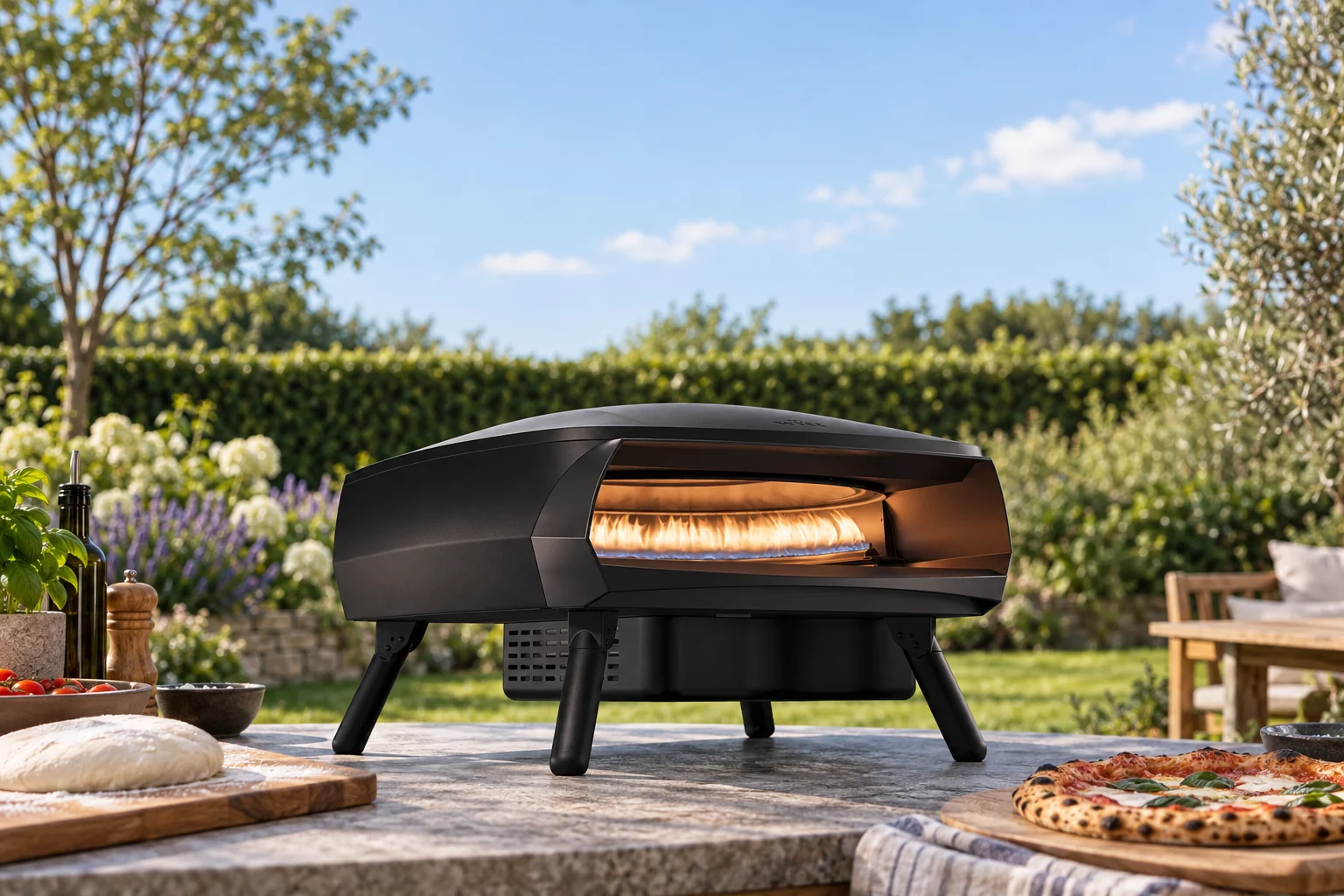
On paper, it is a straightforward appliance. One U-shaped gas burner wraps around the cooking area, a fixed stone sits on the floor of the chamber, and the oven stands on four foldable aluminium legs with rubber feet. There is electronic ignition, a UK gas hose and regulator, and not a great deal else. That simplicity is welcome. Fewer moving parts means fewer things to go wrong when the oven has spent a frosty week sitting outside.
What comes in the box
You get the oven body, the fixed pizza stone, a gas hose with UK regulator, and the instructions. That's the lot.
What you don't get is just as important for budgeting:
- A pizza peel for launching pizzas onto the stone.
- A turning peel, the small round one used to spin the pizza mid-bake. On a fixed-stone oven this is essential, not optional.
- A thermometer. There is no built-in temperature display, so an infrared thermometer is the sensible companion purchase.
- The AA battery for the ignition. Put one in your coat pocket now, while you remember.
- Gas. The cylinder is separate, and as we'll see in the next section, it's worth thinking carefully about which one you buy.
Reviewers who've had the oven on their own patios recommend buying the pizza tools at the same time as the oven, and I'd agree. There is nothing more deflating than a beautifully hot stone and no way to get a pizza onto it.
First impressions
The first thing anyone notices about the Fermo is its size. Expert Reviews described it as a "huge" oven, and at roughly 76cm deep and 66cm wide, it takes up a good chunk of a garden table. It is also attractive in a solid, purposeful way, with a broad, low mouth that looks inviting rather than fiddly. Witt promotes it as an award-winning design, and the UK launch material made a point of its double insulation and weather-resistant build.
In the UK it was launched in four colours: black, stone, graphite and orange. They're all the same fixed-stone oven underneath. Black is the one I'd choose for a British winter garden. It hides the grubby fingerprints of greasy pizza nights, and it doesn't fight with a dark fence or a winter planting scheme.
Fermo or Rotante? Witt also makes the ETNA Rotante, which is easily confused with the Fermo. The Rotante is a different model, not a colour option. It has a mechanically rotating stone and an additional burner, and the rotation needs its own power (a mains adapter or AA batteries). The Fermo has a fixed stone, a single U-shaped burner, and its only electrical part is the battery-powered ignition. If you've read about self-turning stones, that's the Rotante, not this oven.
Gas vs Wood in January: Understanding the Fermo's Fuel Choice
The Fermo is a gas-only oven. There is no wood tray, no charcoal option and no multi-fuel conversion. It runs on bottled LPG through a single 8.5kW U-shaped burner, and that is that.
For a summer oven, this would be a matter of taste. Some people love the ritual of a wood fire; others just want dinner. In winter, it becomes a practical decision, and gas has the clear edge.
Instant, controllable flame
Turn the knob and the burner lights. Turn it up or down and the flame responds straight away. There's no fire to nurse, no logs to feed, and no slumping heat when you get distracted topping the next pizza.
No log store to keep dry
Wood needs to be split, dried and sheltered. In a wet British winter that is a project in itself. A gas cylinder doesn't mind the rain, though it does need to be stored correctly.
Less smoke drifting next door
In summer, neighbours are often outside themselves. In winter, they're indoors with washing on the airer, and a plume of wood smoke is less welcome. Gas keeps the peace.
Repeatable heat
The burner's output doesn't depend on how seasoned your logs are or how well you've built the fire. Every session starts from the same point, which makes it far easier to learn your timings.
The trade-off is flavour. A gas oven won't give you wood smoke. If that matters most to you, this is the wrong appliance, and no amount of clever winter positioning will change that.
Propane, butane and the regulator question
This is the part of the Fermo that deserves the most attention before you buy gas, and particularly before you buy gas for winter.
Witt's manual lists the UK configuration as working on propane at 37mbar, or butane at roughly 28–30mbar. UK retailers describe the supplied setup as LPG or propane, with a hose and regulator meant for a patio-gas cylinder. However, when Expert Reviews tested the oven, their unit arrived with a 21mm clip-on regulator, which suits butane bottles, rather than the 27mm connector used on the propane patio-gas bottles common in UK barbecue use.
Why does this matter in winter? Butane is notoriously poor in cold weather, because it struggles to turn from liquid into gas as temperatures fall. That's why propane is the usual choice for cold-weather outdoor cooking in the UK. If your oven turns up with a butane-style clip-on regulator, you'll either be running butane through the coldest months or buying a correct replacement regulator for propane.
Before you buy a cylinder
- Look at the regulator in the box before you buy gas, and match the cylinder to it.
- For winter use, propane is the sensible choice. If you need a different regulator, buy the correct fixed-pressure type for propane at 37mbar from a reputable gas stockist.
- Never fit an adjustable high-pressure regulator of the sort sold for weed burners. The manual specifically warns against it.
- Keep the hose no longer than 1.5m.
- The manual limits the cylinder to a maximum of 310mm wide and 570mm tall, so check before you swap to a larger bottle.
Witt's figures put gas use at about 669g per hour on full. That's a useful number to keep in mind when working out how many pizza nights a cylinder will cover, and a reminder not to leave the burner roaring away whilst you go back indoors to look for the oregano.
The cylinder must also be properly placed: upright, secure, kept outdoors in a ventilated position, away from drains and enclosed spaces, and shielded from the heat of the oven. HSE guidance recommends storing LPG cylinders in the open air where practical, with the valves uppermost, on a surface that can take the weight. That rules out the cosy shed corner, even when it's sleeting.
From Cold Stone to 500°C: The Heat-Up Routine Explained
The Fermo is straightforward to light, but it rewards a calm, methodical start. Here is the routine, based on Witt's instructions, with my own notes on what matters in the cold.
- Position it first. Stand the oven on a stable, non-combustible surface. The underside gets hot, so the manual rules out plastic tables, tablecloths and anything combustible underneath. Keep it out from beneath trees, roofing and overhanging structures.
- Connect the gas with everything off. Check the burner control is off before connecting the hose and regulator. Open the cylinder valve only when all the connections are secure.
- Leak-test. Do this before first use, after every cylinder change, and after the oven has been stored for a long spell. Brush soapy water over the joints; bubbles mean a leak. Never test with the burner lit. If you can't stop a leak, turn off the gas and contact the service centre.
- Light it. Press and turn the control knob anticlockwise until it clicks and the burner lights. This can take around 8–10 seconds while gas travels along the burner pipe. Keep the knob pressed in for another 10 seconds after ignition, then release.
- If it doesn't light, stop. Turn the control back to off and wait five minutes before trying again. Repeatedly clicking away and filling the chamber with unburnt gas is how eyebrows go missing.
- Leave it on high and let the stone soak up the heat. This is where patience pays.
What "under 18 minutes" really means
Witt says the Fermo will heat from 0°C to 500°C in less than 18 minutes under its own test conditions. UK retailers repeat the 18-minute figure, alongside cooking times of 60–90 seconds. Those figures are honest enough, but they hide a distinction that matters a great deal for anyone cooking in the cold: the difference between air temperature and stone temperature.
The air inside the dome heats quickly, because the flame is heating it directly. The stone is a dense slab that has to absorb heat right through. A pizza base sits on the stone, so the stone temperature is what decides whether your base is crisp and spotted or pale and floppy. A hot dome over a lukewarm stone gives you that classic outdoor-oven disappointment: toppings scorched, underside undercooked.
Expert Reviews measured both with an infrared thermometer, and the results are worth looking at closely.
Two things stand out. First, the air was at 500°C in roughly ten minutes, well before the stone had caught up. Second, a drop of just four or five degrees in the ambient temperature, from a warm 24–25°C to a still-pleasant 20°C, was enough to stop the stone reaching 500°C inside the 18-minute window. It reached about 450°C instead.
That's not a damning result. The same reviewer cooked thin-crust pizzas successfully in around 60 seconds, even when the stone hadn't hit 500°C. It does, however, tell you which way the numbers will move on a winter evening. I'll come back to that in the cold-weather section.
Point the thermometer at the stone, not the flame
With no built-in display, an infrared thermometer is the most useful extra you can buy. Aim it at the centre of the stone, where your pizza will sit, rather than at the back wall or the burner. When the stone reading stops climbing and holds steady, you're ready. Until then, the oven is still warming up, however fierce the flames look.
One more winter note: start with a dry stone. If the oven has been left uncovered in rain, or condensation has built up during storage, give it a gentle start rather than going straight to full blast. Moisture trapped in the stone slows heating and is best driven off calmly.
The 40.5cm Stone: Capacity, Dough and What You Can Realistically Cook
The Fermo's headline capacity is pizzas up to 40.5cm (16in). That puts it in a different league from the many compact ovens built around 30–33cm (12–13in) pizzas. Pizzamand, a Danish pizza-oven tester, measured the stone at roughly 40 × 40cm, with a mouth about 43cm wide.
The interesting part is how that space plays out in real cooking. Most home pizza makers stretch their dough to about 30cm (12in). It's the size a standard dough ball naturally makes, it fits a typical peel, and it's what most people find easy to manage. On the Fermo, a pizza that size has room around it. It isn't jammed against the burner, and you aren't threading a needle every time you launch.
Expert Reviews worked mostly with pizzas of around 30cm (12in) and found the wide opening and roomy chamber made them easy to launch, turn and remove. Larger pizzas fitted, but big, heavily loaded ones were noticeably harder to turn. That matches what I'd expect from any fixed-stone oven: a 40cm pizza carrying half the fridge is a heavy, floppy thing to rotate at speed.
Living with a fixed stone
Because the stone doesn't turn, you'll turn the pizza yourself. Even with the U-shaped burner spreading heat more evenly than the L-shaped burners on many rival ovens (a point Expert Reviews praised), the side nearest the flame cooks faster than the side facing the door. So you launch, wait, slide the turning peel under the edge, rotate, and keep watching. Within a 60–90-second bake, that leaves very little room for wandering off.
It sounds daunting, but it's a skill you pick up quickly. By the end of the first session, most people have gone from tentative prodding to a confident flick of the wrist. In winter it also gives you something to do other than stand there feeling the cold.
Family pizza nights
One pizza at a time, but large ones, in quick succession. Prepare the bases in advance and you can feed a table steadily without anyone waiting long.
Focaccia and flatbreads
The broad stone suits wide breads and high-heat flatbreads as much as round pizzas.
Cast-iron cooking
With suitable cast-iron cookware, Expert Reviews also cooked bread, steak and vegetables at lower temperatures. In winter, a pan of roasted vegetables alongside the pizzas makes the evening feel more like a proper meal.
Learning to launch
The wide mouth and generous chamber are forgiving for beginners. A slightly wonky launch is less likely to end with a pizza folded against the back wall.
One at a time. The large stone is designed for one big pizza, not two small ones side by side. For a crowd, the real measure of capacity is how quickly you can move pizzas through, and Expert Reviews found the stone lost relatively little heat between bakes when the burner was kept high. Plan your session as a steady relay, not a single batch.
On the dough itself, winter brings its own quirks. Dough proves more slowly in a cold kitchen, and a dough ball carried straight from a chilly utility room will be stiff and reluctant to stretch. Let it come up to room temperature indoors, stretch it indoors, and only take it outside at the last moment on a well-floured peel. Building a pizza on a cold garden table, under a dim security light, is a recipe for sticking.
Cold-Weather Cooking in Practice: Winter Performance Deep Dive
This is the question behind this whole article: does the Fermo work in a British winter, when it's a few degrees above freezing, damp, and possibly frosty underfoot?
The answer is yes, with a different routine. To see why, it helps to put the Met Office's December averages next to the conditions in which the Fermo's heat-up was actually measured.
Here's the pattern. If 20°C was enough to hold the stone back at about 450°C after 18 minutes, then a December evening at 6°C will slow it further. Witt doesn't publish a winter heat-up figure, and I won't invent one. The practical response is to forget the clock entirely: give the oven longer than the headline time, and let the thermometer tell you when the stone has settled.
Why gas copes better than wood in the cold
Where the Fermo comes into its own is consistency. A wood-fired oven in winter has two problems at once: cold air chilling the dome and damp fuel struggling to burn cleanly. The Fermo only has the first. Its burner produces the same flame whatever the weather, and you can adjust it instantly. Once the stone is up to temperature, the cold air matters much less, particularly as Expert Reviews found the stone held its heat well between pizzas with the gas turned up.
In my experience with gas ovens through the colder months, the first pizza is always the sulky one. It's the one you launch slightly too early because everyone is hungry and you're cold. Resist. A few more minutes of heating makes a bigger difference to the whole session than anything else you do.
Wind, ventilation and where to put it
Wind matters more than cold. Expert Reviews noted it affected their results, and on an exposed British patio in December it can strip heat from the oven mouth faster than the burner can replace it. Shelter helps a lot. Set the oven with its back to the prevailing wind, or in the lee of a wall or hedge.
What you must not do is solve the weather problem by moving it under cover. The manual is unequivocal: outdoors only, in a well-ventilated location with at least two sides or the area above open, and never in a shed, garage, porch or other enclosed space. It also says not to put the oven beneath roofing or overhanging structures. So a sheltered corner of the open garden is fine; a gazebo, carport, lean-to or open-fronted shed is not. Gas appliances and enclosed spaces are a serious combination, and pizza is not worth the risk.
A winter pizza session checklist
- Check the forecast for wind as well as rain. A still, cold evening beats a mild, gusty one.
- Uncover and dry the oven well before you need it, and check the stone is dry.
- Light up before you start stretching dough, so the stone heats while you prepare.
- Have lighting sorted. December gives you very little daylight, and you need to see the base of the pizza.
- Keep toppings and peels indoors until the last moment; cold, damp peels encourage sticking.
- Keep the burner high between pizzas and check the stone again if there's a long gap.
- Wear sensible gloves, and keep children and dogs well back. The outside of the oven gets hot, however cold the air feels.
Frost underfoot is worth a word too. A heavy oven (quoted variously as around 25–32kg depending on source) on a slippery surface, with someone carrying a peel back and forth in the dark, is an accident looking for an opportunity. Grit or brush the path between back door and oven before guests arrive.
Build, Design and Portability: Living with the Fermo Year-Round
The Fermo makes a good first impression, as noted earlier. It also takes up a good deal of space. At around 76cm deep, 66cm wide and 44cm tall, and a stated weight that varies by source — Witt's marketing cites roughly 31.9kg gross, while the manufacturer manual lists 25.1kg net; the discrepancy is unresolved, so treat quoted weight figures as approximate — it's a substantial piece of garden furniture rather than a portable gadget.
Expert Reviews said it was too heavy for most people to lift on their own and needed help during setup. That's worth taking seriously. Whatever surface you choose will need to be sturdy, level and non-combustible, and big enough that the oven isn't perched on the edge with its legs at the corners. A heavy-duty outdoor table, a masonry worktop or a dedicated stand built for this sort of weight are the obvious choices. A lightweight bistro table or a resin garden table is not, both for weight and because the manual specifically excludes plastic surfaces.
The folding legs
The four foldable aluminium legs, with rubber feet, do two jobs. They lift the oven body off the surface beneath, and they fold away to make the oven more compact when it isn't in use. In practice, "more compact" still means a large, heavy box, and two people to move it.
That has a real bearing on winter. If you plan to cook through the colder months, the most practical approach is to decide on one sheltered, open-air spot where the oven stays, and use a fitted cover between sessions. Moving 32kg back and forth to the shed for every pizza night will quickly lose its appeal.
If you'd rather store it away during long wet spells, that's fine, as long as the oven has fully cooled, the gas is disconnected and the cylinder stays outside. Storing the appliance in a shed is not the same as using it there, and the cylinder belongs in the open air either way.
After winter storage: Witt's instructions call for a leak test after a long period of storage, as well as after every cylinder change. Before the first pizza of the year, brush the joints with soapy water. It takes a couple of minutes and should be as routine as checking the tyres before a long drive.
Weather and finish
The launch material highlighted double insulation and weather-resistant construction, both helpful for a British garden. Insulation helps the chamber hold heat against cold air, and a weather-resistant build means a damp week won't spoil it. Even so, a well-fitting cover and a dry stone at lighting time are simple habits that will keep the oven in good order for longer.
The four colours (black, stone, graphite and orange) are a nice touch. The Fermo is too large to hide, so it's worth choosing a colour you're happy to look at from the kitchen window every day of the year.
How the Fermo Compares: Context in Today's Outdoor Pizza Oven Market
This is an in-depth look at the Fermo, not a group test, so the following is context rather than a shopping list. It's worth knowing where the Fermo sits, though, because the decision between "big fixed-stone gas oven" and the alternatives shapes your whole experience.
Among large gas ovens, the obvious rival is the Ooni Koda 16, which also takes 16-inch pizzas. Gozney's Roccbox is another well-known gas-capable name in the outdoor oven market. When Expert Reviews tested the Fermo, they judged it expensive at its £579 RRP compared with the Koda 16 at the time, and Pizzamand felt similarly, rating its value far better when it was discounted than at full list price. If you are drawn to the Fermo, it's worth watching for a good price rather than paying full RRP without question.
The more useful comparison for most buyers is between oven types:
| Feature | Witt ETNA Fermo | Witt ETNA Rotante | Compact 30–33cm gas ovens | Traditional wood-fired ovens |
|---|---|---|---|---|
| Fuel | Bottled LPG only (note: supplied regulator may be a 21mm clip-on butane type rather than a propane connector — verify before buying gas, especially for winter use when propane is preferred) | Gas, plus power for the rotating stone | Usually bottled gas | Firewood |
| Stone | Fixed, takes pizzas up to 40.5cm | Rotates mechanically | Smaller, sized for 12–13in pizzas | Fixed oven floor |
| Turning the pizza | By hand with a turning peel | Stone does the rotating | Usually by hand | By hand |
| Burner layout | Single U-shaped burner | Includes an additional burner | Many use an L-shaped burner | Live fire |
| Portability | About 32kg, two-person lift | A large oven in the same family | Lighter and easier to move | Often permanent |
| Smoke flavour | No | No | No | Yes |
| Winter practicality | Consistent heat, no fuel to keep dry | Consistent heat, plus power for rotation | Easy to store indoors between uses; less room on the stone | Dry, seasoned wood needed in the wettest months |
What sets the Fermo apart in this group is its combination of a large cooking area, a full U-shaped burner and a simple fixed-stone layout. The UK hose and regulator in the box means you aren't sourcing basic gas fittings from scratch, though as covered in the fuel section, check the regulator against your chosen cylinder. Witt's description of the oven as award-winning adds some reassurance, but it's the practical details that will matter on a cold Friday night.
Pros, Cons and the Honest Limitations Buyers Should Know
Here's everything weighed up together. I've kept each point short; the reasoning is in the sections above.
Pros
- Rated to 500°C, with the air inside reaching that in about 10 minutes in testing (condition-dependent; wind and ambient temperature affect results)
- Thin-crust pizzas cooked in under 90 seconds per Witt's own product material (60-second figure is from Witt's UK launch marketing, not a confirmed Expert Reviews test result)
- Gas fuel gives consistent, adjustable heat with no firewood to keep dry through winter
- U-shaped burner spreads heat more evenly than many L-shaped designs
- Takes pizzas up to 40.5cm, with plenty of room around a standard 30cm pizza
- Wide mouth and roomy chamber are forgiving for beginners
- Holds heat well between pizzas with the burner on high
- UK gas hose and regulator included; simple electronic ignition
- Foldable legs, double insulation and a weather-resistant build
- Available in four colours
Cons
- Pizza peel, turning peel and thermometer must be bought separately
- AA battery for the ignition isn't supplied
- Fixed stone means manual turning, which is harder with large, heavily topped pizzas
- Gas only: no wood option and no smoke flavour
- No built-in thermometer
- Stone heat-up slows in cooler, windier conditions than the headline figure suggests
- Supplied regulator may need replacing to run propane in winter
- Large footprint and substantial weight (manufacturer manual quotes 25.1kg net; gross weight cited as ~31.9kg — figures conflict); not portable in any real sense
- Judged expensive at full RRP by reviewers
- One pizza at a time, so big gatherings mean a long, steady session
Most of the cons are fixable with a little preparation. Accessories are a one-off purchase. A thermometer turns the heat-up question from guesswork into a simple reading. The regulator issue is a check you make once, before buying gas. Manual turning is a skill that comes with practice.
The two that can't be fixed are size and fuel. If you have a small patio, a balcony or a narrow side return, the Fermo will dominate it. And if you love the ritual and flavour of wood smoke, no gas oven will replace it. These are the questions to settle before anything else.
Budget for the complete kit, not just the oven
The true starting cost of a Fermo pizza night is the oven plus a launching peel, a turning peel (both confirmed by Expert Reviews as not included in the box and must be bought separately), an infrared thermometer, a gas cylinder (and possibly a propane regulator), and a single AA battery. Plan for all of them together and your first session will be a pleasure rather than a dash to the shops.
Verdict: Is the Witt ETNA Fermo Right for Your Winter Garden?
The Fermo is a capable, sensible oven for winter pizza, as long as you meet it halfway. Gas does away with the biggest headache of cold-weather wood cooking, the U-shaped burner gives even heat, and the big stone and wide mouth make it an easy oven to cook on, even for beginners. Treat the heat-up time as a starting point rather than a promise, put it somewhere sheltered but properly open-air, and let a thermometer tell you when the stone is ready.
GardenScout's verdict
The Witt ETNA Fermo is a large, well-designed gas oven that suits British winter cooking better than most, thanks to fuel that never gets damp and a burner that heats the stone evenly. It asks for space, a two-person lift, a few extra accessories and some patience on cold, breezy evenings. Get those in place and it will turn out big, properly baked pizzas long after the summer barbecue has been covered up.
If you have the patio for it, and you'd rather cook on gas than wood, it's an easy oven to recommend. Just keep an eye out for a good price, check the regulator before you buy your gas, and buy the peel at the same time as the oven.
A good fit if you…
- Have a medium or large patio with a sturdy, heatproof surface
- Cook for a family or friends and want large pizzas in quick succession
- Prefer gas convenience to keeping a dry log store through winter
- Are new to pizza ovens and want a forgiving, wide-mouthed oven
- Are happy to keep the oven in one sheltered, open-air spot
Look elsewhere if you…
- Have a balcony, small patio or narrow access path
- Want an oven to carry around or take camping
- Want a self-turning stone or a built-in temperature display
- Value wood-smoke flavour above convenience
- Can't store a gas cylinder safely outdoors, or hoped to cook in a covered space
The Fermo is happy cooking in the cold. It just asks you to plan ahead. Sort your gas, peel and thermometer this weekend, find the sheltered corner of the garden, and you'll be ready for the first frosty pizza night well before Christmas.
- Witt ETNA FermoBest for big pizzasView on Amazon
Buying for a gardener? See our gifts for outdoor cooks, checked on Amazon every day.