
Trugs, Buckets and Garden Tidy Bags for Faster Clear-Ups
Collapsible bags, tip bags and flexible trugs compared for the leaves, weeds and prunings that seem to multiply the moment you turn your back.
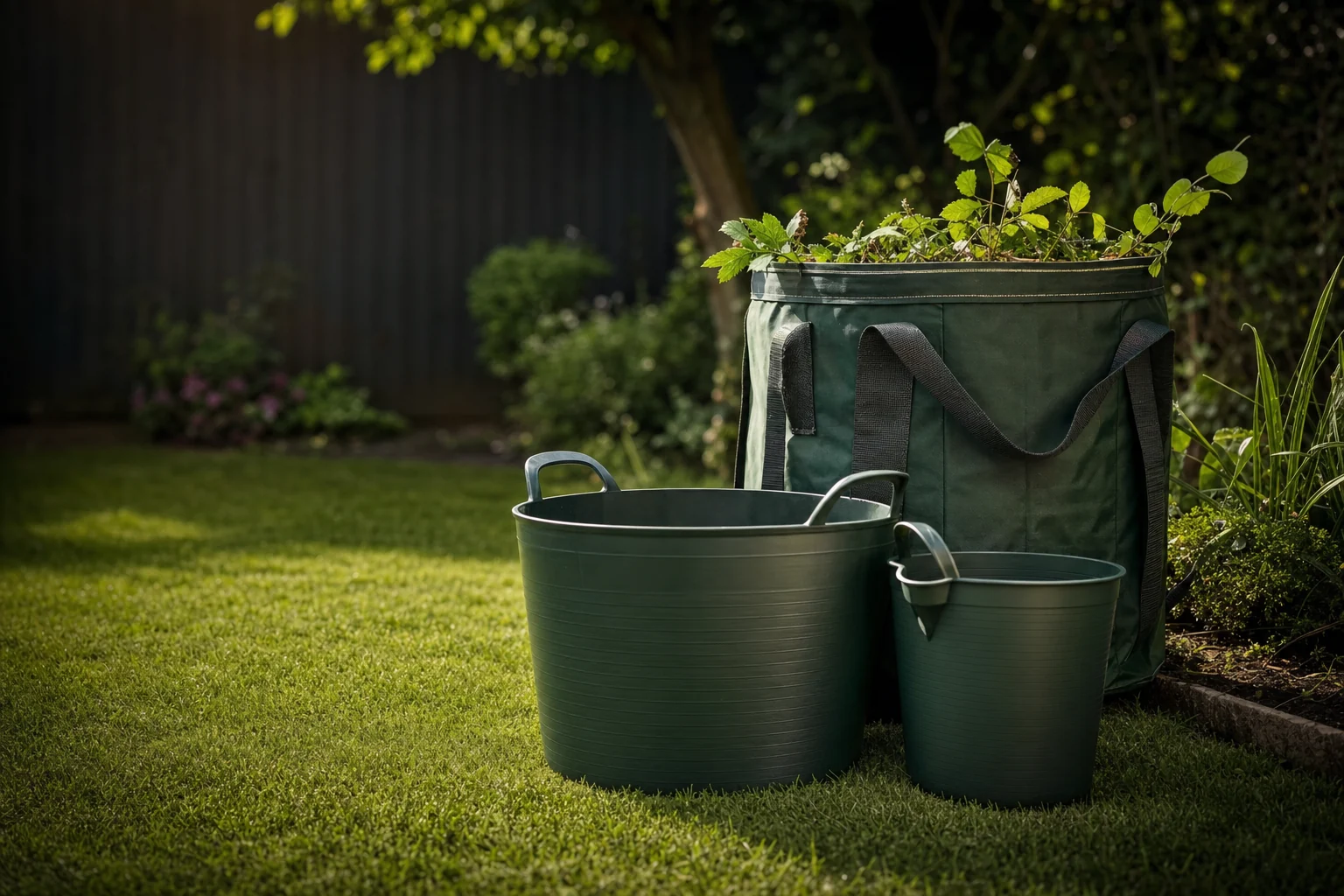
Why Your Garden Clearance Kit Is Holding You Back
It is mid-September, and the garden is beginning its annual habit of looking both lovely and faintly untidy at the same time. The first leaves are slipping from trees. Perennials are flopping with autumnal confidence. Hedges have had their last smartening-up cut, and every border seems to contain a small, damp mound of spent flowers that you meant to remove yesterday.
The actual gardening is often not the difficult bit. It is the clearing afterwards. You prune a shrub, turn around, and discover the path has disappeared beneath twiggy debris. You weed for twenty minutes, then spend another ten deciding where to put the weeds. You rake a neat pile of leaves, only to try lifting it into an old compost sack that immediately collapses into a tragic green puddle.
Most of us begin with whatever is nearby: a tired bucket from the shed, a wheelbarrow that needs its tyre pumping up, or an empty compost bag with a suspicious little split in the corner. These will all hold garden waste, up to a point. But they are not necessarily designed to make garden work quicker. A bucket is durable but small. A wheelbarrow carries a great deal but is absurdly large for deadheading roses by the patio. A flimsy sack is light, until wet grass and thorny prunings remind it of its limitations.
A better clearance kit is not about owning every container under the sun. It is about matching the vessel to the job. In broad terms, gardeners have three useful choices: flexible trugs, springy pop-up bags and woven polypropylene tidy bags. Each has a different personality. One is the tough all-rounder, one is the volume specialist, and one is the transport-minded compromise.
The useful rule of three
Use a trug when the load is wet, heavy, awkward or likely to be reused for another task. Choose a pop-up bag when you need a large, open target for dry, bulky material. Reach for a woven tidy bag when you want capacity that folds away afterwards and can be carried to the compost heap, green-waste collection point or car.
There is another small but important benefit: a container gives a clearance session a boundary. It tells you when a task is finished. Fill it, empty it, sweep the last few scraps into it, and move on. This is particularly helpful at this point in the year, when an hour in the garden can easily turn into a slightly chaotic tour of every border you own.
The following guide looks at the practical differences rather than pretending there is one perfect answer. A big bag is not automatically better. A 75-litre trug is no use if it stays in the shed because it is cumbersome for your regular jobs. Conversely, a neat little 14-litre tub is delightful for weeding but may become irritating during a serious leaf fall. The right choice is the one you will actually take outside.
Meet the Contenders: A Field Guide to Garden Waste Containers
Garden waste containers have rather more in common than a spade and a tea towel: both are useful, but they are definitely not interchangeable. Before comparing them head to head, it helps to understand what each format is trying to do.
Flexible trugs: the dependable, muddy all-rounder
The flexible trug is a familiar sight in British gardens, stables and DIY corners. Red Gorilla's Gorilla Tub® is one of the best-known versions of the format, which was invented in Great Britain some 30 years ago. It is fundamentally a robust, flexible bucket with two handles, but that description undersells how useful the shape can be.
The range begins with the 14-litre SP14, then moves through the 26-litre SP26, approximately 38-litre SP42 and 75-litre SP75. That spread matters. The smallest size feels naturally at home beside you whilst you weed or deadhead. The bigger tubs can handle hedge trimmings, soil, wet leaves and the assorted nonsense that gathers after a serious gardening session.
Red Gorilla tubs use flexible plastic, with frost and UV resistance stated for the material. The SP26 has reinforced ribbed sides for strength, chamfered edges intended to make scooping and pouring easier, and easy-grip handles with a golf-ball-style texture. It sounds like a tiny detail. It is not tiny when your hands are wet, muddy or wearing gloves that have lost most of their grip halfway through the afternoon.
The SP26 is also offered in red, blue, black, pink, pistachio, orange and sky blue. Colour choice is not merely decorative. A household that gardens seriously can assign one colour to weeds, one to compost ingredients, one to tools and one to the muddy things that nobody wants in the potting shed. It is a simple system, but simple systems tend to survive contact with real life.
Comfortable with wet work
Flexible trugs suit damp weeds, wet grass, muddy roots and jobs where rinsing the container afterwards is part of the routine.
Useful beyond pruning day
A trug can move compost, hold potting mix, carry tools or collect debris; it is not limited to green waste.
Sizes for different jobs
The 14-litre to 75-litre Gorilla Tub® range makes it possible to choose manageable loads rather than one oversized container for everything.
Made for outdoor use
Frost and UV resistance are useful qualities for something that will spend much of its working life beside a compost heap or shed wall.
Canvas pop-up bags: the volume-first leaf collector
A pop-up bag takes a different approach. Instead of being a bucket that happens to hold waste, it is a large, open target that springs upright when needed and folds down when it is not. Sleek Garden's collapsible canvas bags are an example: they stand to a height of about 71 cm, then fold to around 5 cm.
That tall, open shape is especially attractive during a leaf-clearance session. You can rake towards the bag instead of repeatedly bending to lift handfuls of leaves into a low container. The 30-gallon version holds roughly 114 litres, whilst the 45-gallon bag is about 170 litres. These are generous volumes, though volume is not the same thing as a sensible carrying weight. Wet leaves can turn surprisingly dense, with the timing of a rain shower apparently governed by some ancient law of gardening.
The Sleek Garden canvas design includes a drawstring top, weighted bottom and drainage holes. The fabric is intended to repel mildew, which is useful when a bag is asked to spend the autumn full of damp foliage. It is a specialised tool rather than an all-purpose tub. That is not a criticism. Most useful gardening kit becomes better once it stops trying to be everything.
Woven polypropylene tidy bags: fold-flat capacity
Woven polypropylene garden tidy bags sit between the two other types. They generally have a broad, bag-like shape, multiple handles and enough structure to stand up once filled, without needing a permanent footprint in the shed. They fold flat after use, which makes them tempting for smaller gardens, terraces and sheds already crowded with pots, canes and the lawnmower's mysterious collection of cables.
Examples include tidy bags in 70-litre, 149-litre and 272-litre capacities, plus a 200-litre Harrod Horticultural bag measuring 58 cm by 58 cm by 60 cm. Smaller formats are also available: Gardening Direct offers a pack of three 45-litre tidy or grow bags, each measuring 46 cm high by 30 cm wide by 30 cm deep.
Some tidy bags have two side-carry handles at the top, plus side and bottom handholds to make emptying more controlled. Others include top flaps secured with webbing straps and clips. That can be helpful if garden waste is travelling in the car to a recycling centre, although it is still wise to avoid overfilling anything with hedge clippings. The bag may survive. Your upholstery may not.
Capacity is a guide to volume, not an invitation to test your back. Dry leaves may fill a very large bag comfortably; wet lawn clippings, soil or sodden weeds can become awkward long before the bag looks full.
Specification Showdown: Numbers That Actually Matter in the Garden
Garden containers are often sold on capacity alone. It is an easy number to print in large letters, and it does matter. But it is only useful when read alongside shape, storage and how the container behaves once it contains a damp mixture of weeds, soil and plant stems.
The widest capacity span here runs from the 14-litre Red Gorilla SP14 to polypropylene tidy bags of up to 272 litres. Between those two ends are several practical choices: the 26-litre SP26, the approximately 38-litre SP42, the 45-litre Garden Pride Trug, the 75-litre SP75, 70-litre and 149-litre tidy bags, 114-litre and 170-litre canvas pop-ups, and 200-litre tidy bags.
Red Gorilla SP14
Red Gorilla SP26
Red Gorilla SP42
Red Gorilla SP75
Sleek Garden
58 × 58 × 60 cm
Polypropylene bag
For many routine garden jobs, around 45 litres is a sensible middle ground. It is enough space for several rounds of weeding, deadheaded flowers or pruning from a modest shrub, yet it does not encourage you to create an unmanageable load. The 45-litre Garden Pride Trug is a good illustration of this practical scale, combining a useful working volume with two comfortable handles.
For storage, the formats behave very differently. Canvas pop-ups have the obvious advantage: when folded to around 5 cm, they can hang on a wall or slide into a narrow gap. Polypropylene bags fold flat too, though their creased woven material is not quite as neat as a sprung canvas disc. Flexible trugs do not flatten, but they can nest. Red Gorilla's smaller SP14 can sit inside the SP26, which can sit inside the SP42. That is a rather more orderly arrangement than a collection of unrelated buckets rolling around the shed.
Choose by material, not just litres
Large capacity is ideal for low-density waste such as dry leaves and light stems. For soggy weeds, compost, gravel, soil or water, a smaller flexible trug is generally the more sensible vessel, even when a much bigger bag is sitting nearby.
Handle arrangement deserves attention as well. Trugs use two substantial handles, designed for carrying and, in some cases, bringing together in one hand. Tidy bags may offer side handles and bottom grips, which are useful once the bag needs tipping. Canvas pop-ups are intended primarily for loading in place, with their drawstring top and weighted base helping them stay open. There is no universally superior handle system. The question is whether you will be carrying the container often, dragging it short distances, or simply loading and emptying it in two locations.
Finally, consider drainage. Sleek Garden canvas pop-up bags have drainage holes, a real advantage for wet leaves that would otherwise carry a good deal of rainwater. Flexible trugs are better where you actually want to retain a wet mix: muddy weeds, water, compost tea or soil. Polypropylene tidy bags are useful general carriers, but they are not the first choice when drainage is essential.
Head-to-Head: Trugs vs Canvas Pop-Ups vs Polypropylene Tidy Bags
The simplest summary is this: a trug is built for punishment, a canvas pop-up is built for bulk, and a polypropylene tidy bag is built for flexible storage and carrying. In practice there is overlap, of course. A trug can collect leaves. A tidy bag can hold prunings. A canvas pop-up can take weeds. But there are jobs each does with distinctly less fuss.
| Feature | Red Gorilla Gorilla Tub® SP26 | Sleek Garden 45-gallon canvas pop-up | Woven polypropylene tidy bag |
|---|---|---|---|
| Capacity | 26 litres | Approx. 170 litres | 70, 149 or 272 litres; 200-litre versions are also available |
| Container material | Flexible plastic with reinforced ribbed sides | Specialised canvas fabric | Hard-wearing woven polypropylene |
| Storage approach | Nests with compatible trug sizes | Folds to about 5 cm | Folds flat |
| Handles or loading aids | Golf-ball-textured easy-grip handles | Drawstring top and weighted bottom | Top side-carry handles, with side and bottom handholds on some designs |
| Drainage | Not a listed feature | Drainage holes | Not a listed feature |
| Outdoor durability features | Frost and UV resistant | Mildew-repelling fabric | Hard-wearing polypropylene |
| Best at | Wet, heavy or mixed loads; potting and general carrying | Dry leaves, light prunings and rapid large-volume collection | Bulk garden waste, fold-flat storage and transport |
| Less ideal for | Very large leaf falls requiring minimal trips | Dense, heavy loads and mixing jobs | Jobs requiring the bag to stay rigidly open without support |
There is a temptation to treat the 26-litre SP26 as too modest for proper clearance. That would be unfair. Its strength is not in swallowing a whole lawn's leaf fall in one go. Its strength is that it is easy to bring along for almost any task. It holds its shape, copes with wet material and can be repurposed for compost, potting mix, tools or a quick tidy of the patio. It earns its shed space repeatedly.
The 170-litre Sleek Garden canvas pop-up works at the opposite end of the spectrum. It is ideal when material is bulky but relatively light: crisp leaves, ornamental grass cuttings, spent annuals and twiggy pruning. The standing height of around 71 cm is handy because you can work towards the bag rather than constantly stooping. Its drainage holes also make good sense in an autumn garden, where dry leaf clearance can become wet leaf clearance before you have finished your first border.
A polypropylene tidy bag is more of a practical middle path. It offers serious capacity, folds flat and may include extra grips for tipping. A 200-litre bag measuring 58 cm by 58 cm by 60 cm is a useful size for a substantial session, although its full load still needs treating with common sense. It is a container, not a weightlifting challenge in disguise.
If you only want one format, a medium flexible trug is usually the least regrettable starting point because it has so many uses. If leaf clearance is your dominant autumn job, add a pop-up or large tidy bag. If you regularly take garden waste elsewhere, a tidy bag with closing flaps and handles may prove the most convenient partner. The ideal setup is often one trug plus one large bag. One works beside you; the other waits for the bulk.
Task-by-Task Performance: What Handles Leaves, Prunings and Weeds Best?
Task one: raking and bagging autumn leaves
Right now, this is the task most likely to expose a weak container choice. Leaves do not seem heavy at first. They are mostly air, especially when newly fallen and dry. The difficulty is volume. A modest raking session can produce a startlingly large pile, and if the wind is up you may have the peculiar experience of watching your carefully gathered leaves return to the border behind you.
Canvas pop-up bags are the standouts for this job. Their tall, upright form creates a broad loading point, so you can rake leaves directly into the opening with fewer bends. The approximately 71 cm pop-up height is particularly helpful if you are clearing a path, lawn edge or driveway. You are not trying to feed a low bucket from ground level every few minutes.
The 170-litre Sleek Garden 45-gallon format is useful for a larger garden because it reduces the number of journeys to the compost heap or collection point. Drainage holes on that model are an equally valuable feature once rain arrives. Leaves do not necessarily become dry just because you had a dry morning. A quick shower, dew or a damp lawn is enough to add unwanted water weight, and a draining bag stops it becoming a portable pond.
Polypropylene tidy bags are also very good leaf containers. A 200-litre bag can take a substantial amount of loose foliage, and the 58 cm by 58 cm footprint of the Harrod Horticultural example gives it a stable-looking working shape. Their weakness is that wet leaves do not have the same obvious drainage route. If your leaf clear-up tends to happen in drizzle because that is when you finally have time, a canvas pop-up has the edge.
A trug is still worthwhile for leaves in smaller areas: around a bench, on a patio, beneath a single tree or when collecting dry material for leaf mould. It is simply not the fastest option for a large lawn. The SP75 gives much more volume than the smaller tubs, but even a large flexible trug has a more compact opening than a standing leaf bag.
Leaf-mould sorting saves work later
Keep clean fallen leaves separate from weeds, diseased foliage and thorny pruning if you want to make leaf mould. A dedicated tidy bag or pop-up makes this easier; use a trug for the mixed border debris that should not join the leaf pile.
Task two: pruning shrubs, climbers and herbaceous growth
Pruning produces a more awkward sort of waste. It is springy, poky and oddly talented at catching on every edge of a container. A rose stem can hook itself in place with the determination of a tiny grappling hook. Long hedge clippings form loose bundles that look manageable until you attempt to turn a corner.
For light stems and soft herbaceous material, a pop-up bag works beautifully. It stays open, takes a generous armful and is easy to position close to the plant. This is particularly useful during autumn cutting-back work, when old perennial stems and ornamental grass foliage can quickly cover a path. Put the bag where you are working, cut into it where practical, and you will spend less time retracing your steps collecting escaped pieces.
For woody pruning, a polypropylene tidy bag is often the better large-capacity option. Its woven construction and multiple handholds are helpful when you need to tip the contents at the compost area or load them for green-waste disposal. Bags with closing flaps and webbing straps are particularly sensible when the contents must travel. Loose twigs in a car have an astonishing ability to find their way into places twigs ought not to be.
A flexible trug comes into its own for a smaller pruning session, especially where the debris is wet, muddy or mixed with old potting compost. The chamfered edge on the Red Gorilla SP26 is designed to help with scooping and pouring, while the tub's sturdy form remains useful when the job expands into clearing soil from around the base of a shrub or carrying tools along the border.
For thorny material, none of these containers is magical. Handle the stems carefully, keep the bag close to avoid carrying armfuls across the garden, and do not ram sharp woody bundles down simply to gain another few litres of space. The quickest way to shorten the life of any bag is to ask it to become a hedge shredder.
Task three: weeding, digging and clearing damp border debris
Weeding has different demands again. You are often crouched or kneeling. The material is damp, rooted and mixed with soil. A tall bag can feel slightly irritating in this situation because you must keep standing to drop in each handful. It is not impossible, just less natural than having an open trug beside your knee.
This is where a 14-litre or 26-litre flexible tub is at its most persuasive. It holds itself open, can be moved along with you easily and is happy to contain a muddy mixture of weeds, roots and soil. If you are clearing a border in sections, the smaller SP14 is a very handy companion. If you are tackling a more established bed with larger weeds and more debris, the SP26 gives useful breathing room without becoming excessively bulky.
The 45-litre Garden Pride Trug is another sensible option for this kind of work. Made from tough synthetic rubber and fitted with two comfortable handles, it sits in that pleasing middle territory: roomy enough for an extended session, but still very much a garden-side container rather than a mini skip.
Polypropylene bags can work for weeding, particularly if you are clearing a large bed in one go. But they are more satisfying when there are enough weeds to justify their capacity. Otherwise, they may need propping open or repositioning more frequently than a trug. The bag is not wrong; it is simply being asked to perform a job better suited to a lower, more stable vessel.
One final note for September: separate perennial weeds and seed heads from compost-friendly green material where possible. A container system makes this surprisingly easy. Keep a trug for persistent roots and seeding weeds, then use the larger bag for leaves and softer plant material. It is less glamorous than buying a new plant, admittedly, but it is one of those small habits that saves trouble next spring.
Build Quality and Longevity: Will It Survive a British Garden?
A British garden tests equipment in a very particular way. We do not always get dramatic weather, but we get persistence. Rain that arrives during a ten-minute job and lingers for three days. A frosty morning followed by bright sun. Mud that clings to tools as though it has signed a tenancy agreement. Then there is the shed: often cold, slightly damp and home to at least one spider with greater confidence than you possess.
Flexible trugs are strong contenders in these conditions because their materials are designed for hard use. Red Gorilla describes the flexible plastic used in the Gorilla Tub® range as frost and UV resistant. The SP26 also has reinforced ribbed sides, while its chamfered edges are intended to help with scooping and pouring rather than presenting a brittle, crack-prone rim under normal use.
Garden Pride's 45-litre trug uses tough synthetic rubber and is described as frost-proof, UV stable and shatterproof. That is reassuring language for a container likely to be dragged over paving, left beside the compost bin and occasionally filled with far more than you originally intended. The format's longstanding popularity in equestrian settings also makes sense. Mucking out stables is not a job known for being gentle on equipment.
Frost resistance does not remove the need for sensible storage. Emptying and rinsing a trug after especially muddy work, then storing it out of standing water, is still kinder to both the container and your shed floor.
Canvas pop-up bags have a different durability profile. Their specialised fabric is designed to repel mildew, and their purpose-built spring construction allows them to stand up and then fold away. For leaf collection and light pruning, that is exactly what matters. They are less naturally suited to being used as a mixing vessel, dragged across rough ground full of stones, or filled with compacted soil. A big bag can look indestructible until a dense load asks rather too much of its seams and base.
Polypropylene tidy bags are practical and hard-wearing, but their longevity depends heavily on how they are loaded and moved. Their woven material handles ordinary garden waste well, while side and bottom grips can make emptying safer and less clumsy. The main danger is overstuffing with sharp, rigid material or trying to drag a loaded bag across rough paving. Lift with the handles where possible; do not treat a folded bag as though it were a wheelbarrow.
There is no need to baby garden kit. It is garden kit. But a little maintenance has an outsized effect. Knock off soil before it dries solid. Rinse containers after carrying anything particularly muddy or unpleasant. Let bags dry before folding them away for months. Check handles and seams at the end of autumn, before the next clearance session becomes a surprise repair job in cold weather.
Durability strengths
- Flexible trugs are suited to wet and dirty work, with frost and UV resistance listed for the Gorilla Tub® range.
- Garden Pride's synthetic-rubber trug is described as frost-proof, UV stable and shatterproof.
- Canvas pop-ups use mildew-repelling fabric and fold away after use.
- Polypropylene bags offer hard-wearing construction without taking up permanent storage space.
What shortens lifespan
- Overloading any container with wet grass, soil or saturated leaves.
- Forcing thorny or woody cuttings into fabric bags.
- Dragging loaded bags across abrasive paving or gravel.
- Folding and storing damp bags for long periods.
Pros, Cons and the Compromises Every Gardener Should Know
No container format wins every round. The most useful buying decision comes from accepting the compromise before you buy, rather than discovering it halfway through a wet Sunday clear-up. Here is the honest version of what each type does well and where it asks you to adapt.
Flexible trugs: Red Gorilla and Garden Pride styles
Pros
- They hold their shape whilst you work, which is particularly useful for weeding and muddy border clearance.
- They cope well with wet, mixed material and crossover jobs including potting, carrying and mixing.
- Chamfered edges on the SP26 are designed to aid scooping and pouring.
- Frost and UV resistance make the Gorilla Tub® range well suited to outdoor garden life.
- The SP26 colour range makes task colour-coding genuinely practical.
- Nested storage is tidier than a collection of unrelated buckets.
Cons
- They do not fold flat, even if they nest efficiently.
- Smaller trugs mean more trips during a large leaf-clearance session.
- They are less efficient than a tall bag when raking a large volume of dry foliage.
- Their open design is not intended to contain loose waste for transport.
Canvas pop-up bags
Pros
- The large open mouth is excellent for raking leaves and collecting light prunings.
- Approximate capacities of 114 litres and 170 litres reduce journeys with bulky, low-density waste.
- The upright height of around 71 cm reduces repeated bending during leaf clearance.
- Drainage holes help wet leaves shed excess water.
- They fold to around 5 cm, a major benefit in a compact shed or storage cupboard.
Cons
- Large volume can tempt you to create a load that is awkward to move once wet.
- They are less suited to soil, gravel, wet compost and other dense materials.
- Thorny pruning needs care to avoid stressing fabric and seams.
- A tall bag is not always comfortable for close-to-the-ground weeding work.
Woven polypropylene tidy bags
Pros
- They provide large capacities, including 70-litre, 149-litre, 200-litre and 272-litre options.
- They fold flat after use, which is valuable in small gardens and crowded sheds.
- Side-carry handles and bottom grips can make controlled emptying easier.
- Some bags include closing flaps, webbing straps and clips for moving material securely.
- They can double as grow bags in smaller 45-litre formats.
Cons
- They do not offer the same rigid, always-open working shape as a trug.
- They are not the first choice for repeated wet, heavy loads.
- Wet leaves and grass may add weight quickly where drainage is absent.
- They need sensible loading to avoid strain from sharp or overly compacted pruning.
The compromise is therefore quite straightforward. Flexible trugs ask you to make more trips, but reward you with toughness and versatility. Pop-up bags ask you to be mindful of weight, but reward you with speed and storage efficiency. Polypropylene tidy bags ask for a little care in loading and lifting, but reward you with generous capacity that disappears flat when the work is done.
Build a Faster Autumn Clearance Setup
The fastest clear-up is rarely achieved by buying the biggest possible bag. It comes from reducing the little interruptions: walking back and forth, bending repeatedly, sorting a mixed heap later, or stopping because your only container is already full of something else. A simple two-container system is enough for most gardens.
For general autumn work, place a flexible trug beside the bed you are tending and a larger bag at the end of the path or lawn. The trug takes weeds, muddy rootballs, spent annuals and anything dense. The larger bag takes clean leaves, soft stems and light pruning. When the trug fills, empty it into the appropriate destination rather than using it as a miniature holding bay for everything. This sounds fussy until you try it. Then it feels rather wonderfully efficient.
If you are raking leaves, put the pop-up bag or tidy bag downwind where possible. Rake in manageable strips towards it rather than making one enormous pile first. Large piles are satisfying for approximately thirty seconds, after which a breeze, a pet or your own feet tend to redistribute them with great enthusiasm. Several smaller sweeps into an open bag are usually quicker.
For hedge trimming, open the tidy bag before you start and put it close enough that you can gather cuttings in short armfuls. If the material is thorny, wear gloves and avoid compacting it aggressively. A trug is useful as a second container for heavier twiggy pieces or tools. It also prevents you from repeatedly placing secateurs on the lawn, which is how perfectly good secateurs become invisible.
For weeding, use the smallest container that will make the session feel uninterrupted. A 14-litre trug is often enough for routine hand-weeding, especially around containers and border edges. A 26-litre or 45-litre trug makes more sense for a proper border clean-out. Large bags can wait nearby for the softer green material once you have finished the kneeling part of the job.
The leaf-heavy garden
Choose a canvas pop-up or large polypropylene tidy bag for bulk collection, ideally with a smaller trug alongside for wet or mixed debris.
The keen pruner
A tidy bag is useful for long, light cuttings, while a flexible trug handles denser, muddier and more awkward material.
The border weeder
A 14-litre or 26-litre flexible trug is the most comfortable companion for close-to-the-ground jobs.
The small-space gardener
Prioritise fold-flat canvas or polypropylene bags, then add one medium trug if storage permits.
Come next spring, the same system remains useful. Trugs carry compost and potting mix. Tidy bags can gather pruning from early shrubs and clear winter debris. Pop-up bags collect cut grass, deadheaded spring bulbs and the general flotsam that appears once growth starts racing ahead. Good clearance kit does not have an off-season; it simply changes jobs.
Care, Storage and Safer Emptying
Garden containers are low-maintenance, but there are a few habits worth adopting. First, empty them more often than you think you need to. This is not because the bag cannot hold more. It is because your arms, shoulders and lower back will appreciate a load that remains reasonably manageable. Wet grass, rain-soaked leaves and freshly dug weeds all weigh more than they look.
With a trug, it is often easiest to grasp both handles, tip from the knees rather than rounding your back, and use the flexible body to guide the contents out. The chamfered edges of the SP26 are intended to make the scooping and pouring side of that process easier. Do not fill a tub to the brim with muddy soil simply because it is technically possible. Gardening should leave you pleasantly tired, not walking like an elderly question mark.
With a polypropylene bag, use the lower handholds where fitted. They give you more control when emptying and help prevent the bag suddenly flipping its contents in an entirely unhelpful direction. If it has flaps, straps and clips, close them before moving loose waste in a car. That is especially sensible with dry leaves, which have a legendary ability to escape through the smallest possible opening.
Canvas pop-ups need a little care when folding. Empty them fully, shake out leaves caught around the base, and allow wet fabric to dry before storing it. Folding a damp bag flat and forgetting about it until spring is a good way to create an unpleasant surprise. The mildew-repelling fabric is useful, but it is not an excuse to give a wet bag a winter holiday in a sealed cupboard.
Try not to leave any container permanently full. A trug full of rainwater and leaves is less a useful tool than a private wildlife pond with very limited ambition. Bags left packed with damp material are harder to move later and encourage you to postpone the final disposal stage. Clear it, empty it, dry it if needed, and put it away. Future you will be almost irritatingly grateful.
Frequently Asked Questions
For broad everyday use, around 45 litres is a manageable middle ground. For large volumes of dry leaves and light pruning, 149-litre, 200-litre or larger bags reduce trips. The key is to match capacity to the weight of what you are collecting, not just the amount of space it occupies.
For garden work, usually yes. A flexible trug has a wider opening, two handles and a shape designed for carrying, scooping and pouring. It is also more comfortable for bulkier material such as weeds, compost and pruning, whilst remaining useful around the house and shed.
Yes, though it is sensible to empty it before it becomes excessively heavy. Sleek Garden canvas pop-up bags have drainage holes, which help excess water escape. Wet leaves remain much heavier than dry ones, however, so filling a large bag completely may not be practical.
A flexible trug is generally the best fit. It stays open beside you, copes with wet and muddy material, and is easy to rinse afterwards. A 14-litre or 26-litre model is particularly useful for close-to-the-ground weeding sessions.
It is better to empty, dry and store them when possible. Polypropylene bags fold flat, and canvas pop-ups collapse compactly, so there is little advantage in leaving either full of damp garden waste through the coldest months.
The GardenScout Verdict
There is no single winner because there is no single sort of garden mess. That may feel inconvenient when you are trying to buy one useful thing and get on with your weekend, but it is also rather liberating. You do not need a grand clearance system. You need the right companion for the jobs you actually do.
For the gardener who wants one tough, endlessly useful container, a flexible trug is the most sensible choice. The Red Gorilla Gorilla Tub® range covers everything from the 14-litre SP14 to the 75-litre SP75, while the 26-litre SP26 sits in an especially versatile everyday position. The Garden Pride 45-litre trug is similarly appealing for gardeners who want a larger, robust rubber option.
For autumn leaf clearance, a canvas pop-up bag is the clear convenience choice. Its large capacity, upright working height and, on Sleek Garden models, drainage holes make the repetitive business of raking and collecting much easier. Sleek Garden models also fold to around 5 cm when the leaves have stopped falling, which is the kind of practical detail that feels very satisfying in a small shed.
For big-volume garden waste and transport, polypropylene tidy bags are excellent supporting players. They fold flat, come in a broad range of capacities and can include useful carrying, tipping and closing features. Just be realistic about load weight. The bag may hold 200 litres; that does not mean your body wants to carry 200 litres of wet garden material across the lawn.
Our practical recommendation
Start with a medium flexible trug if your current collection method is an ageing bucket or a collapsing compost sack. Add a pop-up canvas bag if autumn leaves are your main nuisance, or a polypropylene tidy bag if fold-flat storage and moving bulk waste matter most. Used together, a trug and a large bag make garden clear-ups quicker, calmer and considerably less likely to end with debris spread across the path again.