
The Best Plants for People Who Always Forget to Water Them
A sensible UK guide to houseplants and garden plants that can cope when watering day becomes watering fortnight. Again.
There are two kinds of forgetful plant owner. One genuinely means to water the pots on Sunday, then remembers somewhere around Thursday evening. The other has an immaculate watering can, a perfectly good tap, and somehow still notices the crispy leaves only when visitors arrive. I have sympathy with both camps. Life is busy. Plants, unhelpfully, do not keep a shared calendar.
The answer is not to give up and replace every windowsill with a plastic fern. It is to pick plants whose biology gives you some breathing room. Drought-tolerant plants are not indestructible, and they are not an excuse for permanent neglect. They are simply better equipped for a missed watering, a warm spell, a fortnight away, or the annual moment when the garden appears to have turned into a large and slightly judgemental to-do list.
Why Most of Us Kill Plants (And What the Science Says About Drought Tolerance)
It is tempting to imagine that plant death is always caused by too little water. In practice, overwatering is every bit as troublesome. A thirsty plant may wilt visibly and give you a chance to intervene; a plant sitting in persistently wet compost can lose healthy roots quietly, beneath the surface, whilst its owner keeps adding water in the belief that drooping leaves must mean thirst. Gardening does enjoy a paradox.
The useful distinction is between a plant that likes dry conditions and one that merely tolerates a short dry spell. The latter still needs a reasonably regular routine. The former has evolved physical systems for holding on to water, reducing water loss, or finding water beyond the reach of less determined plants.
Succulents are the obvious example. Their plump leaves, stems or trunks act as reservoirs. Aloe Vera stores moisture in its fleshy foliage. A ponytail palm stores water in its bulbous trunk, which is why it can survive extended dry periods without collapsing into melodrama. This does not mean it is a camel with leaves, but it is a much more relaxed house guest than many tropical foliage plants.
Other plants keep their reserve underground. The ZZ plant, Zamioculcas zamiifolia, grows rhizomes that store water below the compost. Those swollen underground structures allow it to endure weeks of neglect far more calmly than a thin-rooted plant. Bearded iris uses a similar broad principle outdoors: its rhizomes help it cope with dry conditions, rather than demanding a permanently damp border.
There are also plants adapted to reducing water loss. Some use specialised photosynthetic strategies associated with dry environments, including CAM photosynthesis, which helps plants make economical use of water. Deep or extensive root systems can be equally useful outdoors, giving a plant access to moisture held lower in the soil. Mediterranean plants such as lavender and rosemary are familiar examples of species shaped by brighter, drier conditions than a typical British summer provides.
The most important distinction
Drought tolerance is not the same thing as liking a wet pot followed by a drought. Most low-water plants cope best with a clear cycle: water thoroughly, allow the growing medium to dry appropriately, then water again. Their roots need air as well as moisture.
This is why compost, drainage holes and position matter as much as the plant label. A drought-tolerant specimen in a container with no drainage is not receiving "extra care". It is being asked to swim. Equally, a lavender planted in a heavy, wet patch may struggle despite its tough reputation. The right plant in the wrong conditions is still the wrong plant.
Start by checking the compost rather than watering by habit. Push a finger into the top layer. If it remains moist, leave the can alone. That one pause prevents a surprising number of houseplant mishaps.
How We Chose These Plants: Our Drought-Tolerance Rating System Explained
A list of "easy plants" can be rather vague. Nearly anything is easy when it is placed in perfect light, planted in perfect soil and watered by somebody who owns a spreadsheet for their begonias. That is not the real-world test. The useful question is whether a plant remains attractive and healthy when a normal person forgets it for a bit.
For this guide, the plants are judged against five practical questions. First: how long can an indoor choice go between waterings, or can an established outdoor choice manage on rainfall alone? Second: what light does it need? A plant that only survives dry conditions on a blazing south-facing windowsill is not much help in a dim hallway.
Third comes winter resilience. For outdoor planting in Britain, the RHS hardiness scale is a valuable shorthand. H4, hardy to around -10°C, is a sensible minimum benchmark for a plant intended to remain outdoors through much of the UK. H5, hardy to around -15°C, and H6, hardy to around -20°C, provide still greater reassurance where cold is part of the deal rather than an occasional inconvenience.
The fourth consideration is soil tolerance. Mediterranean plants often demand drainage and sunshine; succulents can be badly affected by waterlogged compost; rhizomatous plants have particular planting preferences. Finally, there is the plain visual question. A plant can be drought-tolerant and still not suit your room or border. You have to look at it, after all.
This is a deliberately practical framework, not a competition to find the plant that can survive the longest without water. A healthy plant is the goal. The best choice is the one that fits the gap between your actual habits and the care it genuinely needs.
Bars like these should never override common sense. A low-light plant in a cool room uses water slowly. The same species next to a radiator in bright light can dry much more quickly. Think of every watering interval as a starting point, not a legally binding contract with the plant kingdom.
Indoor Champions: The Houseplants That Practically Water Themselves
If your main issue is an indoor watering routine that tends to drift, begin with plants that store their own reserve. They are not actually watering themselves, sadly. That would be a spectacular development. But they reduce the consequences of a missed reminder far more effectively than moisture-hungry foliage plants.
ZZ Plant: the quiet overachiever
The ZZ plant is the first houseplant I would suggest to somebody who wants leaves rather than anxiety. Its glossy stems look composed even when the plant has been left alone longer than intended, and its underground rhizomes hold water for leaner times. That built-in storage is the reason it has earned such a durable reputation.
In summer, water a ZZ plant roughly every two to three weeks, allowing the compost to dry between waterings. In winter, the interval can extend to around three to six weeks. It also tolerates low light, which makes it genuinely useful for homes where the only available space is not a sun-drenched conservatory but a hallway, office corner or shelf a few feet from a window. It holds an RHS Award of Garden Merit, an encouraging sign for a plant that often has to perform under ordinary domestic conditions.
Snake plant: architectural and unusually patient
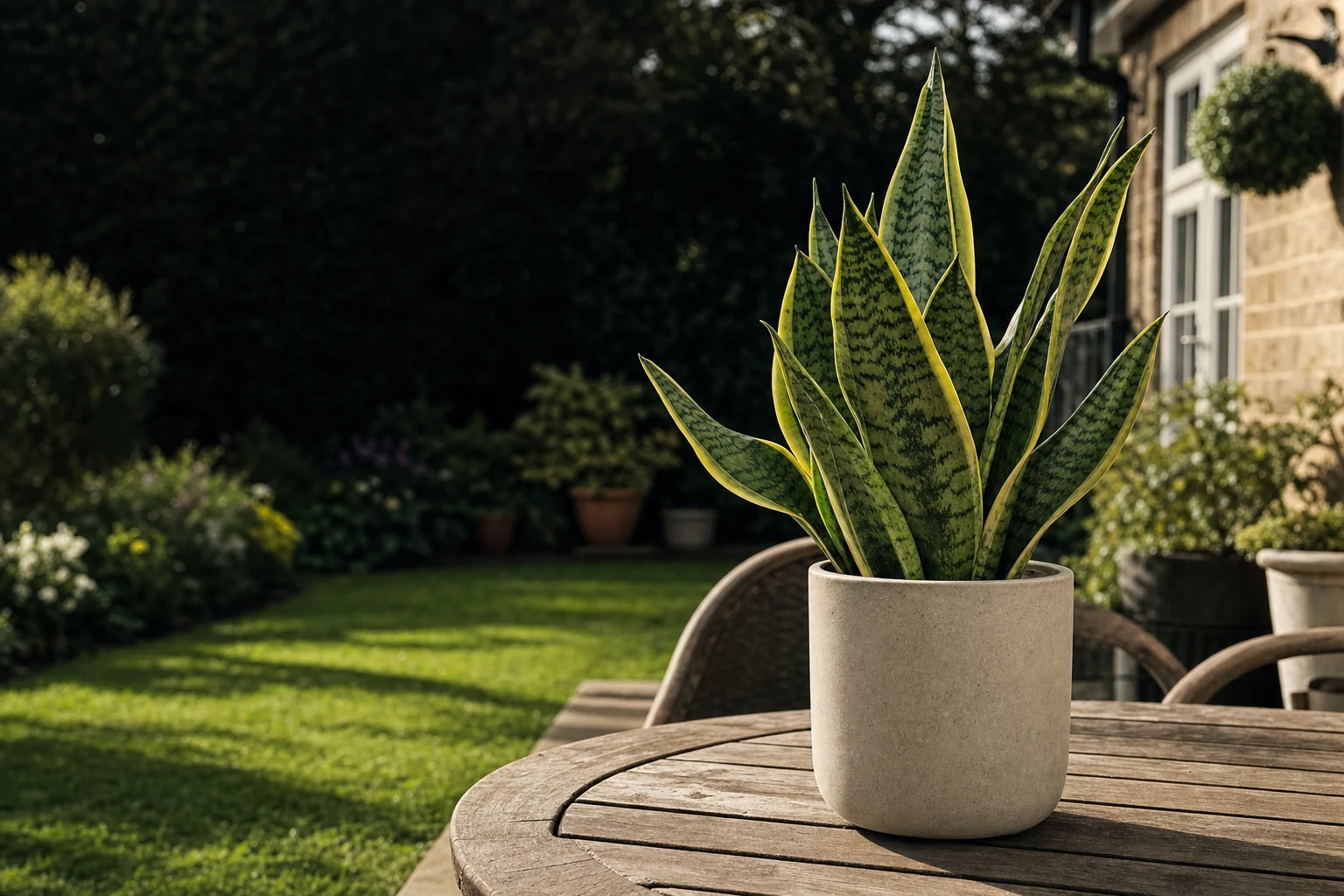
Sansevieria, commonly called the snake plant, is another excellent candidate. Its upright, sword-like leaves offer a neater silhouette than the arching foliage of a ZZ plant, so it works especially well where floor space is tight. Give it indirect light and avoid keeping its compost continually damp.
Depending on season and conditions, snake plants may be watered every two to eight weeks. That is a wide range, but it reflects their ability to cope with differing indoor conditions rather than a reason to set an eight-week alarm and disappear. They are also noted in the NASA Clean Air Study as air-purifying plants associated with the removal of formaldehyde and benzene. It is a nice additional quality, though the main attraction here remains their willingness to forgive a distracted owner.
Pothos: ideal if you need a visual reminder
Pothos, Epipremnum aureum, is less drought-proof than the ZZ plant or snake plant, but it earns its place because it communicates. Its leaves visibly wilt when it needs a drink, making it much harder to miss the message. You water it, it perks up, and everyone moves on with their lives.
Water pothos every one to two weeks in normal conditions, whilst recognising that it can tolerate an occasional skipped watering. It appreciates indirect light and offers a softer, trailing or climbing look than the two architectural choices above. That makes it particularly good for a bookcase, high shelf or hanging position where a few vines can soften hard lines.
| Houseplant | Typical watering pattern | Light preference | Why it suits forgetful owners |
|---|---|---|---|
| ZZ Plant | Every 2–3 weeks in summer; every 3–6 weeks in winter | Tolerates low light | Water-storing rhizomes provide a substantial buffer |
| Snake Plant | Every 2–8 weeks depending on season | Indirect light | Slow, forgiving and compact in form |
| Pothos | Every 1–2 weeks, with tolerance for a skipped watering | Indirect light | Visible wilting makes thirst easy to notice |
Choose a pot with drainage
All three indoor champions need a route for excess water to leave. A decorative outer pot is fine, but do not allow the nursery pot to stand in a pool of water afterwards.
Use the soil check, not the calendar alone
Intervals are useful, but a finger test of the compost is more useful. Light, temperature and season will alter how fast a pot dries.
Match the plant to the room
ZZ plants are the more accommodating choice for low light. Pothos and snake plants are comfortable with indirect light, but no plant thrives in genuine darkness.
There is a small caution with all three: low-water does not mean low-attention forever. Leaves can gather dust, compost can become compacted, and a plant eventually outgrows its pot. The maintenance is light, though, rather than relentless. For a normal home, that is often exactly the point.
Outdoor Survivors: Hardy Border Plants That Thrive on UK Rainfall Alone
Outdoor drought tolerance is a slightly different game. A houseplant lives in a controlled pot, whereas a garden plant has to cope with soil type, wind, sun, winter cold and the particular behaviour of your local weather. One British garden can be parched at the front and waterlogged at the back. This is not a country short of variety.
Lavender: sunshine, drainage and very little fuss
Lavandula angustifolia is one of the most useful low-water plants for a sunny garden. Once established, which takes approximately one growing season, it can survive on UK rainfall alone. Its RHS H5 rating indicates hardiness to around -15°C, giving it strong credentials for much of the country.
Lavender needs full sun and well-drained soil. That second requirement is where most of the practical work lies. It is not a good match for a persistently wet, heavy patch unless drainage is improved. Give it the bright, free-draining conditions it wants, however, and it provides aromatic foliage, flowers and a valuable food source for bees. A low-maintenance plant that also helps pollinators is rather difficult to argue with.
Rosemary: drought-adapted and useful at dinner
Rosemary, now classified as Salvia rosmarinus, brings Mediterranean character without demanding Mediterranean levels of attention. It has RHS H4 hardiness and a natural adaptation to dry conditions. Established rosemary can make use of average UK rainfall, and its culinary value means it earns its space twice: once as an evergreen-ish structural plant and again whenever roast potatoes are involved.
Like lavender, rosemary strongly prefers drainage and sun. It is not the shrub to tuck into a gloomy, damp corner just because there is a spare gap. Put it near the kitchen in a sunny bed or generous container, though, and it becomes one of those plants you use often enough to remember it exists.
Bearded iris: dry feet, exposed rhizomes
Bearded iris is the choice for gardeners who want dramatic flowers but do not want to spend summer hovering with a hose. Its rhizomes store water, and the plants actually prefer dry conditions rather than a constantly wet border. With RHS H6 hardiness, to around -20°C, it is a formidable candidate for cold-prone gardens.
There is one detail worth remembering because it catches out plenty of beginners: plant the rhizomes half-exposed above the soil. Burying them too deeply is a common mistake. The rhizome wants warmth and air around its upper surface, not a full underground burial. It is a slightly counterintuitive planting job, which is perhaps why it is so often done wrongly.
Planting detail that matters
For bearded iris, keep the rhizome half-exposed rather than burying it deeply. For lavender and rosemary, prioritise full sun and drainage. In all three cases, planting technique matters more than an enthusiastic watering schedule.
Sedum and agapanthus also deserve a place in the low-water conversation. Sedum brings succulent character outdoors, often with useful late-season structure, whilst agapanthus offers bold flower heads and strappy foliage. Neither should be treated as an excuse to ignore newly planted specimens; establishment is still the vulnerable stage. Once roots have settled, however, these are much more sensible choices than plants that require continuously damp ground.
Head-to-Head: The Eight Best Drought-Tolerant Plants Ranked and Compared
Putting an indoor ZZ plant beside lavender and bearded iris is not an entirely fair contest. They solve different problems. One is an indoor foliage plant that accepts low light; another is a sun-loving border shrub; another is a flowering perennial with very particular rhizome preferences. But viewed through the lens of watering forgetfulness, the comparison is still useful.
The eight plants below cover a genuinely practical spread: quiet indoor corners, sunny kitchen windows, dry borders, pollinator-friendly planting and containers that tend to get overlooked. The aim is not to crown a universal winner. It is to make it easier to choose the right kind of resilience.
| Plant | Best setting | Water-resilience advantage | Key condition to respect |
|---|---|---|---|
| ZZ Plant | Indoor, including low-light rooms | Rhizomes store water; can go weeks without attention | Allow compost to dry between waterings |
| Snake Plant | Indoor indirect light | Can be watered at wide intervals depending on season | Avoid persistently wet compost |
| Lavender | Sunny, well-drained outdoor border | Established plants can rely on UK rainfall | Needs full sun and good drainage |
| Sedum | Dry border or container | Succulent growth suits lower-water planting | Do not leave roots waterlogged |
| Bearded Iris | Sunny, drier border | Water-storing rhizomes and a preference for dry conditions | Keep rhizomes half-exposed |
| Aloe Vera | Bright indoor spot | Fleshy leaves hold water | Use free-draining compost and avoid overwatering |
| Rosemary | Sunny bed or container near the kitchen | Mediterranean drought adaptation | Sun and drainage are essential |
| Agapanthus | Sunny outdoor planting or container | A resilient option for lower-water schemes | Water carefully whilst becoming established |
For sheer tolerance of a missed watering indoors, the ZZ plant remains the standout. Its maximum suggested gap can reach 42 days in suitable winter conditions, which is an exceptionally generous margin. That figure should not be treated as a target, though. A healthy ZZ plant can survive a very long dry spell; it does not necessarily look its finest because you set out to prove a point.
My practical shortlist would be simple. Choose ZZ plant if you want the lowest-fuss indoor foliage. Choose snake plant if you prefer an upright, graphic shape. Choose pothos if you are likely to respond to a plant that makes its needs obvious. Outdoors, choose lavender or rosemary for dry, sunny ground; choose bearded iris for flowers and strong cold hardiness; add sedum and agapanthus where their shape suits the scheme.
The Good, The Bad, and The Wilted: Honest Pros and Cons of Going Low-Water
Low-water planting sounds like an uncomplicated win, and mostly it is. Less watering means fewer chores, less panic before a weekend away and a garden that is less dependent on you appearing with a hose at precisely the right moment. Yet it has trade-offs. A forgiving plant still has preferences, and choosing drought-tolerant species often means accepting a certain look and a particular approach to soil.
The good
- Watering routines become simpler and less frequent.
- Plants with stored water offer a useful buffer when life becomes busy.
- Lavender, rosemary and similar choices suit sunny, well-drained spaces beautifully.
- Reduced watering is helpful during summer hosepipe restrictions.
- Many options add more than foliage: flowers, fragrance, pollinator value or culinary use.
The reality check
- Newly planted specimens still need attention whilst roots establish.
- Many drought-tolerant plants dislike poor drainage even more than drought.
- Sunny, dry-position plants are not ideal for every garden or room.
- "Low water" can lead people into overcorrecting and leaving plants dry for too long.
- A small selection of plants can look repetitive without thoughtful mixing.
The time-saving case is persuasive. A garden filled with thirsty bedding plants and moisture-loving containers can turn into a near-constant summer round of checking, carrying and topping up. Low-water planting will not eliminate maintenance, but it makes the rhythm gentler. You spend more time pruning, harvesting rosemary or enjoying the scent of lavender, and less time trying to work out where you last put the watering can.
There is also a useful environmental dimension. Reduced water use makes sense in periods of dry weather and under hosepipe restrictions, which are familiar summer events in parts of South East England. The aim should not be a sterile gravel garden with one sad succulent in the middle. It is a planting style that works with available rainfall rather than demanding constant intervention.
Water-saving gardens are not automatically maintenance-free gardens. They work best when plants are grouped by similar needs: sun-lovers together, dry-border plants together, and thirstier specimens elsewhere. One mixed pot full of conflicting needs is gardening on hard mode.
The biggest downside is the false confidence a "tough plant" label can create. A ZZ plant can handle neglect, but it cannot prosper indefinitely in darkness and stagnant water. Lavender can manage rainfall after establishment, but it cannot magically thrive in shade and dense, wet clay. Resilience is not a superpower. It is a margin for error.
UK Soil, Climate, and Hardiness: What Every British Gardener Needs to Know First
The UK's temperate maritime climate is often described as mild and rainy. That is broadly true, but it disguises some dramatic local variation. National average annual rainfall is around 885mm, yet South East England averages around 600mm, whilst parts of the Scottish Highlands exceed 3,000mm. A plant guide written for "the UK" is therefore always a starting point rather than a guarantee.
If you garden in a drier part of the South East, sunny-border plants such as lavender and rosemary may be particularly logical, provided the soil drains freely. In wetter areas, their tolerance of drought does not remove their dislike of sitting wet. This is the crucial point: rainfall amount is only half the story. The speed at which your soil drains, the exposure of the site and the position of the plant all matter.
Clay-dominant soil is common through the Midlands and South East. It is fertile and holds water well, which is useful for many plants but can be awkward for drought-adapted Mediterranean choices. Improving drainage and avoiding low-lying wet pockets is often more important than adding extra feed. Free-draining sandy soils, common in parts of East Anglia, suit dry-loving plants more naturally but may dry quickly after planting. Peaty Scottish soils can retain moisture and bring their own planting considerations.
Your garden has its own microclimate
A south-facing wall, a windy balcony, a sheltered courtyard and an exposed border may behave like four different gardens. Observe where rain lands, where puddles linger and where the sun sits before choosing a plant simply because it is labelled drought-tolerant.
The RHS hardiness scale helps make sense of winter risk. H1a plants need temperatures above 15°C and are suited to heated greenhouse conditions. The scale then runs through increasingly cool-tolerant categories to H7, for plants hardy below -20°C. For permanent outdoor planting, H4 is a useful baseline: it indicates hardiness to approximately -10°C. Lavender at H5 is hardy to around -15°C, whilst bearded iris at H6 is hardy to around -20°C.
H1a to H3: sheltered or protected plants
These ratings are relevant to tender plants and greenhouse conditions, not a carefree year-round planting plan in an exposed British garden.
H4: a sensible outdoor threshold
Hardy to around -10°C, H4 is a practical minimum for many outdoor choices. Rosemary falls into this category.
H5 and H6: stronger cold tolerance
Lavender reaches H5, around -15°C, and bearded iris H6, around -20°C. Both bring valuable winter confidence alongside dry-condition resilience.
For containers, remember that roots are more exposed than they are in open ground. A hardy plant in a small pot can be more vulnerable to cold and rapid drying than the same plant in a border. Use a suitable pot, ensure drainage is unobstructed and place it where its needs are met. Containers are wonderful, but they do make everything more immediate: heat, cold, wind and your occasional forgetfulness.
UK Sourcing Guide: Choosing Healthy Low-Water Plants
The best place to buy depends less on status and more on whether you can choose a healthy plant suited to your conditions. Garden centres, independent nurseries and seasonal plant ranges can all be useful. The important thing is to inspect what is in front of you rather than assuming every plant on a trolley has had a peaceful, well-managed life.
For straightforward choices such as lavender, rosemary, sedum, small cacti and Aloe Vera, seasonal plant areas can be a sensible place to start. Look for a plant with firm growth, leaves free from obvious damage and a root system that is not desperately packed into the pot. A little root growth around the edge is normal. A solid, circling mass that has turned the compost into a dry brick is less promising.
Independent garden centres are particularly useful when you are trying to match plants to tricky conditions. If your soil is dense clay, your garden is cold, or your only usable border is oddly shaded, a conversation before you buy can save a great deal of disappointment. Ask specifically about drainage, final position and winter exposure rather than asking only whether something is "easy". Easy for whom, and where, is the question.
Specialist nurseries are worth considering for more particular choices such as named agapanthus cultivars or collections of bearded iris. The attraction is not simply variety. It is the opportunity to choose plants selected for a clear purpose, whether that is flower colour, flowering period, form or suitability for a particular type of garden.
Avoid buying a drought-tolerant plant and immediately placing it in a situation it cannot tolerate. A lavender needs sun, not goodwill. A snake plant needs drainage, not a giant decorative pot with nowhere for water to go. A pothos needs a little attention, even if it is admirably good at shouting when that attention is overdue.
Busy indoor gardeners
Choose a ZZ plant or snake plant if you want attractive foliage without a demanding weekly watering routine.
Sunny-border gardeners
Choose lavender for fragrance, flowers and a bee-friendly planting choice once it is established.
Cooks with a dry corner
Choose rosemary when you want drought adaptation and something useful within a few steps of the kitchen.
Frequently Asked Questions About Forgetful-Friendly Plants
The thread running through every answer is simple: choose resilience, then respect the conditions that make that resilience possible. You do not need to become a precision irrigation engineer. You just need to avoid turning a low-water plant into a permanently wet one, or a sun-loving plant into a resident of the darkest corner of the garden.
GardenScout Verdict
If watering is the garden task most likely to disappear from your week, start with a ZZ plant indoors and lavender, rosemary or bearded iris outdoors according to your space. These are not miraculous plants. They are simply built with a far more useful margin for human error.
The winning approach is not neglect; it is intelligent laziness. Give drought-tolerant plants drainage, suitable light and a sensible start whilst they establish. After that, they will ask much less of you than thirstier alternatives — which leaves more time to enjoy the garden rather than apologise to it.