
The Best Garden Shears for Topiary and Neat Box Balls
The right hand shears, sheep shears and battery snips for crisp curves, clean edges and box balls that look intentionally round rather than mildly apologetic.
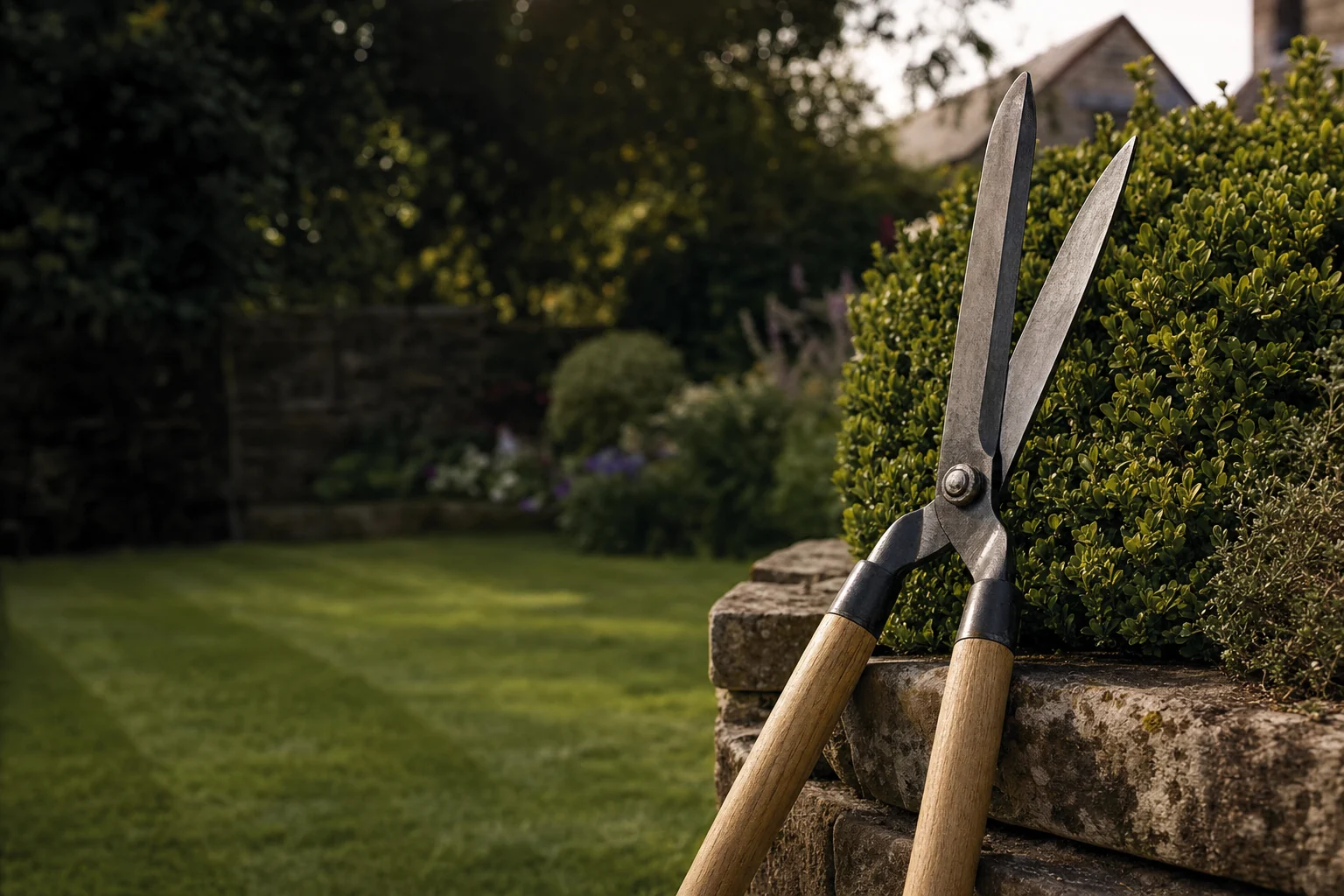
Why Your Box Balls Deserve Better Than the Kitchen Scissors
There is a particular moment in every topiary gardener's life. You stand back after an enthusiastic trim, squint at the box ball in front of you and realise it is not quite a sphere. It is more of a potato with ambitions. We have all been there.
Topiary is not really about brute cutting power. It is about control. A neat box ball needs blades that can follow a continuous curve without chewing the foliage, tips that can reach into tight places, and a handle shape that does not turn your wrist into a small protest movement halfway through the second shrub.
Kitchen scissors may technically remove leaves, in much the same way a bread knife can technically prune a rose. That does not make either one a good idea. Box, yew, holly and other dense evergreen subjects look their best when every cut is clean and the surface is even. Ragged cuts, crushed leaves and accidental gouges show up surprisingly clearly once the light catches them.
For this job, there are three useful tool families. One-handed topiary shears are the detail instruments: light, nimble and excellent for small balls, spirals and awkward inside curves. Two-handed hedge shears cover greater distances with each closing stroke, making them the sensible choice for parterres, broad faces and mature shapes. Battery snips sit somewhere between the two. They provide repeated cutting action without the constant squeeze-and-release cycle, which can be a blessing if you have plenty of shrubs or less hand strength than you used to.
This guide considers topiary tools from Burgon & Ball, Niwaki, Darlac, Berger, Wilkinson Sword and STIHL. There is no single perfect shear for every garden. That would be much too easy, and gardeners are rarely granted easy things. There is, however, a much better match for your particular number of box balls, your preferred working style and the amount of patience you possess on a Sunday afternoon.
The topiary rule worth remembering
Use a small, precise tool to establish curves and finish details. Use a longer two-handed shear to keep large faces and repeated edges consistent. Trying to do both jobs with one tool is possible, but it is rather like painting a hallway with a toothbrush.
The Anatomy of a Perfect Topiary Shear: What the Specs Actually Mean
Garden shears can look remarkably similar when hanging on a shop wall. Two handles. Two blades. A certain amount of reassuring metal. Yet the geometry behind them changes how they behave in a dense box plant.
Blade length is the first thing to consider. Longer blades are useful when you need to create a plane: the side of a box hedge, the top of a low parterre boundary or the broad shoulder of a large clipped dome. Burgon & Ball's GTO/THS RHS Topiary Hedge Shears use 18cm blades, which gives each closing action a meaningful sweep. That makes it easier to avoid the faintly corrugated surface that comes from making lots of tiny, inconsistent cuts.
For close clipping, long blades are not always the answer. Niwaki Topiary Shears use long, slender blue steel blades specifically for delicate topiary and box clipping. Their narrow profile is valuable around fine outlines, where a bulky blade can hide the very edge you are trying to judge. They are designed for clipping rather than hacking through thick hedge growth, and that distinction matters. A topiary shear should skim foliage with intent, not be deployed like an axe at a bramble problem.
Compact one-handed shears are another thing again. The Burgon & Ball Sophie Conran Topiary Shears have 11cm blades and an overall length of 28cm. That shorter format lends itself to small, controlled passes around a box ball. Darlac's Expert Topiary Shears DP852 take the same one-handed approach in a 35cm-long tool with a hand grip intended for extended use.
Steel type is the second important distinction. High carbon steel, used on the Burgon & Ball GTO, Darlac DP852 and Berger shears, can take a very fine edge. Niwaki's blue steel blades belong in the same sharp, specialist-minded camp. The trade-off is care: carbon steel appreciates being wiped clean and lightly oiled after use. Ignore that routine and the tool will eventually return the favour with surface rust.
Stainless steel is more forgiving. The Sophie Conran shears are stainless steel, with a brass safety clasp, and suit gardeners who value a practical tool that is less fussy about damp conditions. Stainless generally will not retain an edge in quite the same way as high carbon steel, but for occasional clipping of a handful of small shapes, corrosion resistance can be a very sensible virtue.
Finally, do not dismiss weight as a dull catalogue detail. A 350g Darlac DP852 and a 750g two-handed GTO are both entirely useful tools, but they ask different things of you. The GTO's reach and cutting sweep justify its additional mass when working a hedge or large form. For repeated wrist-led shaping, particularly around shoulder height, the lighter Darlac is the less tiring proposition. Over a long session, 400g is not a theoretical difference. Your forearms will have opinions.
Match blade length to the line you are creating
Use long blades to establish a straight plane or broad sweep. Move to compact hand shears when you are refining a sphere, clipping close to a stem, or correcting the small bumps that become annoyingly obvious once you have stepped back.
Manual Hand Shears Head-to-Head: Five Blades, One Box Ball
A 45cm established Buxus sempervirens ball is an excellent thought experiment for choosing a shear. It is large enough that a slow tool becomes tiresome, yet small enough that an over-long blade can make the final shape surprisingly difficult to control. The aim is not merely to remove fresh growth. It is to preserve a smooth, continuous outline from every angle.
The Burgon & Ball Sophie Conran Topiary Shears are the compact, civilised option. Their 11cm blades and 28cm overall length make them easy to hold close to the plant, which is exactly what you want when trimming an individual ball near a path or front door. The polished stainless-steel construction and brass clasp give them the sort of appearance that means they would not look out of place on a potting bench in a very tidy garden. More importantly, the short format supports deliberate corrections. This is a tool for the gardener who would rather take three careful passes than one heroic swipe.
Darlac's Expert Topiary Shears DP852 are more overtly practical. At 350g, they are light for prolonged one-handed work, while their high carbon steel blades are appropriate for close clipping. The hand grip and retaining clip are not glamorous features, but neither is finding a sharp tool half open in a shed drawer. For box topiary, their appeal is straightforward: they are designed for the task, they are light enough to keep moving, and they have the reach of a 35cm tool without becoming a full hedge shear.
Niwaki Topiary Shears are the precision choice for gardeners who enjoy the process as much as the finished object. Their long, slender blue steel blades are made for delicate work on box, and the description "lethally sharp" is not one to treat as decorative marketing language. These are specialist clipping tools. They are not intended for rough hedge work, thick woody stems or hurried assaults on an overgrown boundary. Keep them for their intended role and they reward careful use with an exceptionally clean, controlled cut.
Berger Topiary Shears bring traditional sheep-shear geometry into the garden. Their forged, self-sharpening scissor blades, round spring and soft-coated handles create a very different feel from a conventional spring-loaded snip. The 5.5-inch cutting length is generous enough to sweep around a curve, whilst the 12.2-inch overall length keeps the tool compact. They suit either hand, which is genuinely useful when changing angle around a ball rather than merely a nice sentence on a label.
Wilkinson Sword Topiary Shears lean towards low-effort handling. Their hardened steel blades have a non-stick coating, while the spring-loaded mechanism and non-slip grip aim to make repeated cutting less demanding. The locking catch is another welcome safety feature. Their mechanism should appeal particularly to gardeners who prefer a tool that returns ready for the next cut, rather than one that asks the hand to reopen it each time.
| Shear | Best role | Blade material or finish | Handling character |
|---|---|---|---|
| Burgon & Ball Sophie Conran | Small box balls and finishing work | Stainless steel | Compact one-handed format |
| Darlac Expert DP852 | Extended hand clipping on box topiary | High carbon steel | 350g with hand grip |
| Niwaki Topiary Shears | Fine box clipping and delicate detail | Blue steel | Long, slender specialist blades |
| Berger Topiary Shears | Sweeping curved cuts and traditional clipping | Heat-treated carbon steel | Round-spring sheep-shear style |
| Wilkinson Sword Topiary Shears | Comfort-led general shaping | Hardened non-stick steel | Spring-loaded, non-slip grip |
For smooth box-ball curves
Short, easily positioned shears make it simpler to take away a little foliage at a time. Sophie Conran, Darlac and Berger are all natural candidates for this more controlled style of clipping.
For straight parterre lines
A longer blade gives a cleaner visual run. The Burgon & Ball GTO is better suited to this job than a compact one-handed shear, especially where repeated edging needs to look consistent.
For gardeners who dislike maintenance
Stainless steel is the easier-going choice. Carbon and blue steel reward a little oil and care, but should not be left dirty and damp after a clipping session.
For box hedging and formal parterre work, one-handed shears can still do the job, but efficiency changes quickly as the run becomes longer. You can make a straight line with a small blade. You can also cut a lawn with nail scissors. The question is whether you would enjoy it. Two-handed hedge shears allow a wider, more even cutting rhythm, particularly on level top edges and long vertical faces.
That does not make the smaller tools redundant. Quite the opposite. The finest result often comes from using a two-handed shear first to set the broad shape, then a hand shear to take away the remaining tufts and correct the inevitable tiny deviations. Good topiary is often created in stages. The final ten per cent of the work is where the magic lives, and where the small shear earns its place.
Burgon & Ball GTO Hedge Shears: The RHS-Endorsed Workhorse
The Burgon & Ball GTO/THS RHS Topiary Hedge Shears are the standout two-handed manual option in this group. Their 18cm high carbon steel blades, 65cm overall length and 750g weight place them firmly in the serious home-gardener category: substantial enough for regular clipping, but not so large that they become awkward around formal planting.
The real strength here is the balance of cutting reach and manageable control. An 18cm blade can skim along the side of a larger box form or establish a crisp horizontal plane without requiring dozens of tiny closures. On a parterre edge, that means fewer joins between cuts and less chance of ending up with a wavy line that only reveals itself when the evening sun shines along it. The garden has a cruel eye for this sort of thing.
Lightweight aluminium handles help offset the mass of the steel blades, while rubber grips provide a more secure hold. The cushion function is a particularly useful part of the specification. It is designed to stop the blades from jarring at the end of the cut, which matters when you are doing repeated closing strokes through dense evergreen growth. A tool does not need to be loud or motorised to tire your hands; repeated shock travels surprisingly efficiently through handles.
These are manufactured in England, are RHS-endorsed and include a 10-year guarantee. Those details matter because hedge shears tend to become long-term garden tools rather than occasional purchases. A good pair will see years of clipping seasons, provided the blades are cleaned, dried and treated with the basic respect owed to sharp carbon steel.
Pros
- 18cm blades suit broad faces, parterres and established topiary.
- High carbon steel is intended for precise, durable cutting performance.
- Aluminium handles and rubber grips support practical handling.
- Cushion function reduces end-of-cut jarring.
- Made in England, RHS-endorsed and backed by a 10-year guarantee.
Limitations
- At 750g, they are noticeably heavier than compact hand shears.
- The 65cm format is less nimble for tiny balls and tight internal curves.
- Carbon steel needs cleaning and oiling rather than being abandoned damp in the shed.
At £42.99 RRP and available at £34.39, the GTO sits in a very sensible place for gardeners who have more than one formal feature to maintain. It is not the tool I would reach for to finesse a miniature box ball on a tabletop. For regular hedge lines, larger spheres and structured borders, though, it is the pair that makes the biggest jobs feel properly manageable.
Battery Snips Enter the Topiary Garden: STIHL HSA 26 and the Electric Option
Battery garden shears are not a replacement for every manual topiary tool. They are, however, very persuasive for gardeners with multiple specimens, a long run of small-leaved evergreen hedging, or hands that do not relish repeated squeezing. The basic advantage is wonderfully simple: the cutting motion is powered, so your hand guides the tool rather than generating every blade closure.
The STIHL HSA 26 is designed for maintaining small evergreen hedges and small-leafed ornamental trees. It runs on a 10.8V rechargeable battery with 28Wh of energy. Its stated running time is up to 110 minutes per charge, equivalent to around 30 box shrubs, and the tool weighs 0.8kg without the battery. That is a useful balance: compact enough to manoeuvre around individual shapes, yet capable of handling far more than a quick touch-up.
Two interchangeable blades are included: a 20cm shrub cutter bar and a 12cm grass trimmer blade. For topiary, it is the shrub blade doing the useful work, while the grass attachment gives the tool a second role around paths, bed edges and lawn borders. The HSA 26 is intended for branches up to 8mm thick, which is appropriate for fresh clipping growth rather than neglected woody renovation. If your box hedge has become a thicket, do not expect compact battery snips to solve every life decision that led to that moment.
The practical advantage is consistency. A manual shear can produce a beautiful finish, but its speed and smoothness depend on your grip remaining relaxed and accurate. With a battery tool, the blade action remains consistent as the session goes on. That can be especially helpful when the garden contains a repeated sequence of balls, cones or low clipped boundaries.
There are limits. A powered blade works quickly, and that means it can remove too much quickly as well. It is sensible to approach the surface lightly, make short passes and step back often. Battery snips are excellent for maintaining a clearly established form. They are less forgiving when you are still learning how to see the shape.
The STIHL HSA 26 has an LED charge-level indicator and belongs to the STIHL AS System, so its battery can be used with other compatible tools. For gardeners building a compact cordless kit, that shared-battery approach can be genuinely useful.
Gardena's ComfortCut Li is another relevant electric option for detailed garden work. It weighs 600g and has an integrated lithium-ion battery with around 80 minutes of runtime. Its precision-ground, non-stick coated blade is available as an 8cm grass blade, with a 12cm shrub blade in the set version. The adjustable angle is useful where low edging and awkward approaches demand a different wrist position.
Terratek's cordless 2-in-1 Topiary Shears offer another compact format, with a 7.2V lithium-ion battery, a quoted weight of 0.65kg, a 24cm hedge trimmer blade and a 15.5cm grass shear blade. It is the hedge blade that makes it relevant to small shaping tasks, especially in tighter spaces where a larger hedge trimmer would feel needlessly theatrical.
Sheep Shears in the Topiary Garden: The Old Shepherd's Secret
Sheep shears in a topiary article can sound faintly eccentric until you pick up a good pair. Then it starts to make perfect sense. Traditional sheep-shear geometry has long appealed to professional clippers because it encourages a smooth scissor action across a curved surface. You are not punching little bites into the foliage. You are gliding the blade line through it.
Berger Topiary Shears make that crossover explicit. They are suitable for sheep shearing as well as trimming boxwood, ivy and ornamental shrubs. The design uses forged, self-sharpening scissor blades with a round spring, a 5.5-inch cutting length and a 12.2-inch total length. At 8.8oz, they are notably light in the hand, whilst soft-coated handles make repeated use less severe on the palms.
This shape is especially appealing for box balls. A sphere asks you to move continuously around its curve, shifting wrist angle, shoulder position and viewpoint as you go. A traditional scissor-style tool supports that movement. There is less sense of forcing the foliage between two broad hedge blades, and more sense of drawing a controlled line along the plant's outer skin.
Wide scissor action
The Berger format suits a light, sweeping cut around rounded forms, rather than a series of small, choppy nibbles.
Left- and right-hand compatible
Being able to change hands or approach a shape from either side is useful when working around tight planting, walls and paths.
Heat-treated carbon steel
The blades are built around the sharpness and edge retention expected of a serious clipping tool, with the usual need for sensible aftercare.
Why the old design still works
A round box ball is not made of straight lines. Sheep-style shears are effective because their cutting action follows a sweep, helping the gardener move around the form instead of repeatedly attacking it from one fixed angle.
The round spring is also part of the experience. Spring-assisted tools reopen after a cut, which can reduce effort for many people. A sheep-shear style tool has a different rhythm: open, sweep, close, reposition. Some gardeners find that wonderfully intuitive; others prefer the automatic return of a spring-loaded topiary shear. Neither approach is inherently superior. It comes down to whether you enjoy a more traditional, deliberate clipping motion or want a tool that does more of the repetitive work for you.
Price vs Performance: What Your Budget Actually Buys You
Topiary shears are one of those garden purchases where a little extra thought can make more difference than a great deal of extra money. The right tool is not necessarily the most expensive one. It is the one that lets you finish the job before your hands get tired, your patience runs out and the box ball acquires a mysterious flat side.
The Burgon & Ball Sophie Conran Topiary Shears have an RRP of £32.99 and are available at £26.39. That puts them in an accessible manual category for gardeners maintaining one to three smaller shapes, especially where the work is seasonal rather than relentless. Their stainless-steel construction and compact 11cm blades are a good fit for neat detail work. You are paying for a refined, practical hand tool rather than all-day hedge-cutting capacity.
The Burgon & Ball GTO moves up in scale rather than simply in price. With an RRP of £42.99 and an available price of £34.39, it costs more than the Sophie Conran pair but remains close enough that the choice should be driven by task. If you have mature box balls, broad hedging or parterre lines, the GTO's 18cm blades and two-handed format are likely to save time every time you clip.
The STIHL HSA 26 starts from £87.59. That is a significant step into battery-tool territory, but it includes a 20cm shrub cutter bar, 12cm grass trimmer blade and up to 110 minutes of stated runtime per charge. It makes most sense where the garden contains enough ongoing clipping to justify a powered approach, or where hand fatigue is a serious consideration rather than a mild grumble.
Compact manual clipping
Burgon & Ball Sophie Conran sale price; RRP £32.99. Best suited to close work on smaller forms.
Two-handed manual value
Burgon & Ball GTO available price; RRP £42.99. A stronger fit for larger topiary and edging.
Battery-powered maintenance
STIHL HSA 26 pricing starts here, with the benefits of cordless shrub and grass blades.
| Garden situation | Most sensible tool type | Why it earns its place |
|---|---|---|
| One or two small box balls | Compact hand shear | Maximum control and a gentle learning curve around curves. |
| Formal parterre or low box edging | Two-handed hedge shear | Longer blades make straight planes and repeated runs more efficient. |
| Several topiary specimens maintained regularly | Battery snips | Consistent blade action reduces repetitive hand effort. |
| Fine, detail-led clipping | Specialist topiary or sheep shear | Slender or scissor-style blades suit small corrections and curved surfaces. |
The strongest value decision is often a two-tool approach. A broad-cutting hedge shear plus a small finishing shear gives you a more flexible kit than trying to make one medium-sized tool do everything. If that feels extravagant, remember that neat topiary is often maintained for years. The tools have plenty of time to earn their keep.
How to Keep Edges Crisp After the First Cut
Buying a proper shear is only half the story. Crisp topiary comes from a repeatable method, and the good news is that the method is less mystical than it first appears. It is mostly about taking away less foliage than your instincts suggest.
Start by clearing the outline rather than trying to finish one patch at a time. On a ball, work around the whole circumference in light passes. Stand back frequently. A clipped form needs to be judged from a distance, because the view from six inches away tells you almost nothing about the overall silhouette. If you can see a tuft from a few steps back, remove it. If you can only see it because your nose is nearly inside the shrub, perhaps leave it alone.
For straight box edging, use the longest appropriate blade and move with a steady rhythm. Do not repeatedly correct the same small section, as this is how a crisp edge turns into a narrow trench. Establish the line, inspect it from each end, then make only the minimum corrections needed. Tight right-angle corners benefit from a smaller shear, because the long blade that makes a beautiful straight run can be clumsy at the final turn.
Clean blades are not optional. Resin and leaf residue increase drag and can interfere with a smooth cut. After clipping, brush away debris, wipe the blades and dry them. Carbon steel and blue steel benefit from a light oiling. Store spring-loaded shears closed using their safety catch, and close scissor-style shears securely before putting them away. Your future self, reaching into a crowded shed, will be grateful.
The small formal garden
Choose compact manual shears if you maintain a few box balls near a front path, terrace or doorway and want careful control.
The parterre keeper
Choose the Burgon & Ball GTO type of two-handed shear for long edges, clipped borders and larger forms.
The regular clipper
Choose battery snips if several evergreen specimens need frequent maintenance or repeated hand squeezing is uncomfortable.
The detail enthusiast
Choose Niwaki or Berger-style specialist shears if refining curves is part of the pleasure, not merely another job on the list.
Topiary Shears: Common Questions Answered
Final Verdict: The Best Shear Is the One That Fits Your Garden
For most gardens with a formal edge, mature box balls or repeated evergreen structure, the Burgon & Ball GTO/THS RHS Topiary Hedge Shears are the strongest all-round manual recommendation. The 18cm high carbon steel blades, cushioned action, aluminium handles and 10-year guarantee create a properly capable package for the work that takes the longest: establishing broad, clean shape.
For small balls and precise finishing, the choice is more personal. The Burgon & Ball Sophie Conran Shears offer compact stainless-steel practicality. Darlac's DP852 makes a compelling lightweight carbon-steel option for longer hand-clipping sessions. Niwaki suits gardeners who want specialist sharpness and delicate control. Berger brings a traditional, sweeping scissor action that feels exceptionally natural on rounded forms. Wilkinson Sword offers spring-assisted handling and non-stick blades for those who prioritise ease of use.
And if topiary maintenance is a regular fixture rather than an occasional spring ritual, the STIHL HSA 26 is the battery option to consider first. Its 10.8V battery, 110-minute stated runtime, 20cm shrub blade and compact format make it a very useful tool for sustained upkeep.
GardenScout's short version
Buy compact hand shears for detail, two-handed hedge shears for broad structure, and battery snips when volume or hand fatigue makes manual clipping a chore. Keep blades sharp and clean, trim in light passes, and step back more often than you think you need to. Your box balls will thank you by looking like box balls rather than green planets with weather systems.