
The Best Heated Propagators for Reliable Seed Germination
A practical guide to bottom heat, thermostatic control and choosing between a compact windowsill propagator and a larger greenhouse set-up.
It is late September, which is precisely when the garden starts making you think ahead. The tomatoes are winding down, the nights have developed a definite chill, and any seed packet left on the potting bench begins to look faintly optimistic. That is not a reason to stop sowing altogether. It is a reason to be realistic about warmth.
A heated propagator is one of those modest bits of kit that can make seed sowing feel considerably less like a gamble. It does not replace decent seed compost, sensible watering or adequate light. It cannot rescue old seed that has been stored in a damp shed since the coalition government. What it does do is give the compost a stable, useful warmth at the point where a seed is trying to wake up.
For gardeners who raise tomatoes, peppers, aubergines, chillies or half-hardy flowers from seed, that matters enormously. These are plants that do not naturally regard a cool British windowsill in early spring as a compelling invitation to begin life. A heated propagator removes one of the largest variables: cold compost.
The best choice is not automatically the biggest, cleverest or most expensive model. A four-cell unit can be exactly right for someone with one bright windowsill and a modest list of crops. A thermostatically controlled three-tray model can be the more sensible purchase for a greenhouse gardener sowing in volume. The trick is matching the propagator to where it will live, what you genuinely sow, and how much attention you are prepared to give it.
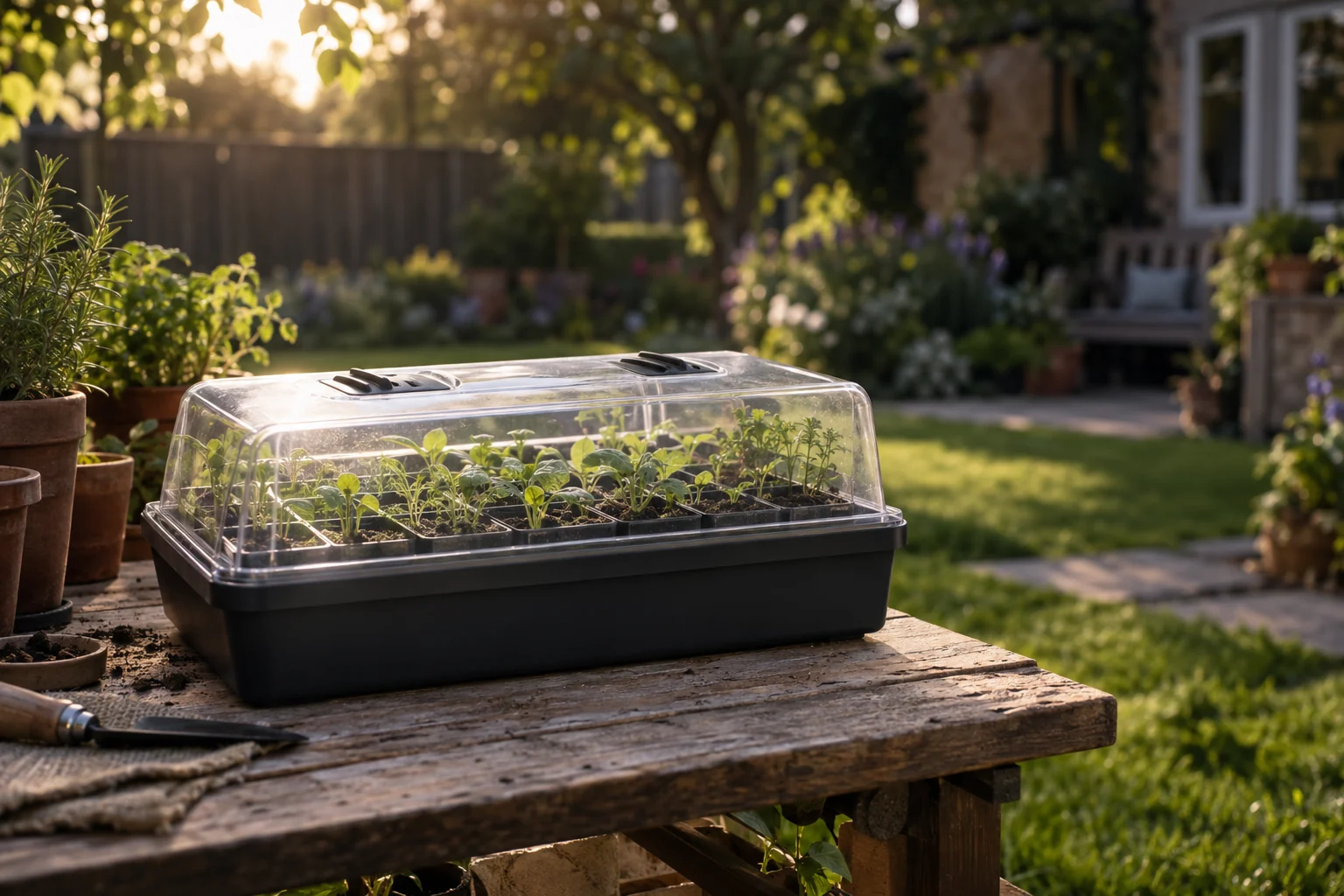
Why Bottom Heat Changes Everything: The Case for Heated Propagators
Seeds are rather less interested in the temperature of the room than we are. They sit in compost, after all, and it is the temperature around the seed itself that governs how readily the internal processes of germination get moving. Air can feel pleasantly warm whilst a tray of damp compost on a cold sill remains stubbornly chilly. Equally, a sunny windowsill can swing from bright warmth at lunchtime to a distinctly unfriendly temperature overnight.
For many commonly sown vegetables and half-hardy ornamental plants, compost temperatures of roughly 18–25°C give dependable germination. Some warmth-loving crops are happy towards the upper end of that territory. The important point is consistency. A seed does not need tropical drama. It needs a compost temperature that is sufficiently warm, sufficiently steady and paired with the right level of moisture.
An unheated propagator still has a role. Its clear lid holds humidity around the compost, prevents the surface drying with absurd speed and creates a small sheltered environment. On a warm spring windowsill, or in a heated conservatory, that may be all you need for hardy annuals and plenty of vegetables. But it relies entirely on the warmth already present around it. There is no safety net if the sill is cold, the greenhouse is unheated, or the central heating is turned down overnight.
A heated model adds warmth from beneath. This is important because warmth rises through the compost, reaching the seed where it matters. Compact fixed-output propagators commonly work by lifting compost temperature by around 8°C above the surrounding conditions. In a typical home at 18°C, that could put the compost at about 26°C. That is a very different proposition from leaving a tray at room temperature and hoping the weather remembers it is spring.
Bottom heat is not the same as a warm room
A cosy room helps, but a heated propagator directs warmth into the compost itself. That is why it can bring seeds up more evenly than an ordinary covered tray on the same windowsill.
There is another advantage that is easy to overlook until you have watched a batch of seedlings emerge in stages. Even germination gives you seedlings of a similar size. That makes watering, pricking out and hardening off more straightforward. It also avoids the familiar situation in which the first tomato seedlings are getting leggy whilst the last few are only just deciding whether to appear.
At this point in the UK gardening year, bottom heat is especially useful for small autumn sowings that need a protected start, and for gardeners wanting to experiment indoors without relying on a greenhouse. It is also a chance to plan properly for the sowing rush next spring. When February arrives with its dim mornings and optimistic seed catalogues, a propagator already cleaned, positioned and understood is much more useful than one still in its cardboard box.
Heat encourages germination; it does not remove the need for light after seedlings emerge. Once the first shoots appear, give them the brightest practical position and ventilate the lid gradually. Warmth without enough light is an excellent way to grow stretched, theatrical seedlings.
That distinction is worth holding on to. Germination and growing on are different stages. A propagator is brilliant at the first. It can also be useful for the first few days after emergence, particularly when nights are cold, but seedlings should not be left sealed up in warm, humid conditions for longer than necessary. Good ventilation and prompt attention remain part of the bargain.
The Propagator Landscape: Brands, Categories and What to Ignore
The UK market offers a slightly confusing mix of compact electric trays, self-watering units, large greenhouse propagators and elaborate stackable systems. Garland, EarlyGrow, Stewart, Selections, Vitopod and X-Stream are names gardeners will come across regularly. They are not all solving the same problem, which is where plenty of comparisons go wrong.
Broadly speaking, there are three ways to buy into bottom heat. The first is a compact fixed-output windowsill propagator. These are usually divided into several small compartments, use relatively little electricity and are designed to raise compost temperature above ambient conditions. They are straightforward: plug them in, fill the cells, sow, cover and keep an eye on moisture. For many home gardeners, that is all the technology required.
The second route is a larger thermostatically controlled propagator. This is for gardeners sowing enough plants to justify tray space, or working somewhere where the ambient temperature is less predictable. Rather than merely providing a constant gentle heat, a thermostatic unit regulates the temperature it is designed to maintain. Garland's Big 3 Automatic Temperature Control Electric Propagator is a clear example of this type of machine: it has a 40W carbon fibre element, takes three trays and is designed to maintain compost at 19°C.
The third category is the premium expandable system: the sort of equipment that appeals if propagation has become a significant part of your gardening year. Systems such as Vitopod-style set-ups are built around capacity, control and expansion. They are useful for gardeners raising many batches over a long season, but they are not automatically the right answer for a handful of tomato plants and some sweet peas. A propagator should fit your actual sowing habit, not the version of you who owns a colour-coded seed spreadsheet.
The fixed-versus-thermostatic divide is the one worth understanding before you spend anything. A fixed model does not decide that the compost is warm enough and then switch itself off. It is designed to add a fairly consistent amount of heat above the local ambient temperature. In a living room or spare bedroom that remains around 17–21°C through the day and night, this can be entirely adequate. Add around 8°C and you have the sort of warmth that suits many warm-season crops.
Move the same unit into a cold porch, an unheated greenhouse in January or a garage where the temperature falls sharply after dark, and the arithmetic becomes less comforting. It is still adding heat, but the starting point is lower. A thermostat becomes more useful because the objective is not merely to warm the compost a little; it is to hold conditions close to a chosen target despite a fluctuating environment.
Garland Fab 4
Compact four-compartment windowsill propagator.
EarlyGrow 3-Bay
Three vented compartments with a capillary mat.
Garland Super 7
Seven compartments across a long, slim footprint.
What should you ignore? First, grand claims that a propagator somehow removes all skill from seed growing. It does not. You still need fresh compost, clean containers, sensible sowing depth and enough patience not to excavate every pot after three days. Second, do not become hypnotised by wattage alone. A higher figure can reflect a larger heated surface rather than a hotter or automatically superior growing environment.
Finally, do not buy a huge unit simply because it looks like proper gardening equipment. Large propagators are useful, but unused tray space is not a mark of serious horticulture. It is a place to store damp compost while wondering why you bought it.
Garland Fab 4 (G125): The Windowsill Workhorse That Earns Its Place
The Garland Fab 4 Electric Heated Propagator, model G125, is one of the clearest examples of what a basic heated windowsill model ought to do. It is compact, divided into four independent sections and designed for gardeners who want reliable warmth without turning seed sowing into an electronics project.
At 38.5cm long, 24cm wide and 17.5cm high, it is comfortably sized for an ordinary indoor sill, bench or table near a window. The four individual cells are each 17cm long by 10cm wide. That layout is more useful than it may first appear. Instead of one large tray in which everything shares the same humidity and timing, you can sow four different crops or varieties separately.
That means one compartment can be growing tomatoes, another peppers, another basil and another half-hardy flowers. Or, if you are the sort of gardener who likes to compare varieties, it gives you four tidy trials without assembling a small plastic city on the kitchen windowsill.
The Fab 4 does not have thermostat control. It runs on a fixed basis, using its carbon fibre heating element (cited as around 8–10W depending on retailer) to lift the compost temperature by around 8°C over ambient conditions. In a typical heated room at 18–20°C, that points to compost around 26–28°C. In practice, the exact result will depend on where you put it, whether it is in a draught, how cold the glass is behind it and how much compost is in each cell. Gardening rarely offers laboratory conditions, even when we would quite like it to.
That level of warmth is particularly useful for tomatoes, peppers, aubergines and many half-hardy annuals. These are all crops for which a warm start can make the difference between a reasonably prompt, even batch and a tray that appears in instalments over several weeks. The separate compartments also allow you to vary ventilation between crops. A lid can be adjusted to suit what is happening beneath it rather than forcing everything to live under the same little climate.
What works well
- Four separate growing areas make it easy to keep varieties and sowing dates organised.
- The compact footprint suits a windowsill far better than a full-size tray system.
- Low 8W power use is sensible for a propagator likely to run continuously during germination.
- Vented, shatterproof lids give practical control over humidity.
- It is made in the UK and requires little more than a suitable position and regular checking.
Where it asks for compromise
- There is no thermostat, so its performance is closely tied to room temperature.
- It is not the ideal choice for a very cold garage or unheated greenhouse in winter.
- The ventilation sliders can feel loose.
- The lids are easily knocked off if the propagator is placed somewhere busy.
The practical appeal of the Fab 4 is that it imposes a little useful order on the spring sowing season. Four sections encourage you to label things properly and stop you scattering unrelated seed trays around the house. It is not a dramatic piece of equipment, which is a compliment. A good entry-level propagator should quietly make the difficult bit more reliable.
For autumn and winter, I would treat it as an indoor tool rather than a greenhouse one. Keep it on a stable surface, away from a cold draught and somewhere you can inspect the compost daily. In spring, it comes into its own for small batches of warm-season crops. Do not sow every seed packet at once simply because you now own a heated propagator. Success is more enjoyable when you still have somewhere to put the resulting plants.
Best use for the Fab 4
Use each compartment for one crop group or one sowing date, label it clearly and open the vents as soon as seedlings emerge. The built-in separation is most valuable when you let it simplify your routine.
Garland Super 7: When One Variety Simply Isn't Enough
The Garland Super 7 Electric Heated Windowsill Propagator takes the same basic idea as the Fab 4 and stretches it along the sill. Literally. With seven compartments, it is designed for gardeners who want to sow a wider selection of varieties at once without moving into a much bulkier greenhouse-sized system.
It measures 76cm long, 18.5cm wide and 14cm high. That makes it notably longer and lower than the Fab 4. The shape is the point: it is intended to sit across the length of a standard windowsill, using a narrow strip of space rather than claiming a square section of bench. If your available growing area is a bright kitchen sill rather than a greenhouse staging shelf, this is a genuinely useful distinction.
The Super 7 uses 13W carbon fibre heating and, like the Fab 4, is a fixed-output model designed to warm compost by around 8°C above ambient conditions. The larger wattage should not be read as a promise of more intense heat. It is heating a larger area. The thermal logic remains much the same: at an 18°C room temperature, compost could sit at around 26°C.
| Feature | Garland Fab 4 | Garland Super 7 | EarlyGrow 3-Bay |
|---|---|---|---|
| Compartments | 4 | 7 | 3 |
| Heating | 8W carbon fibre | 13W carbon fibre | Heated electric base |
| Dimensions | 38.5 × 24 × 17.5cm | 76 × 18.5 × 14cm | 54.5 × 21.5cm |
| Temperature approach | About 8°C above ambient | About 8°C above ambient | Fixed heating |
| Useful for | Small mixed sowings | Multiple varieties on one sill | Compact sowing with capillary mat |
| Price | £34.99–£42.15 | £49.99–£60.75 | £39.95 |
Seven separate cells are useful if you are sowing lots of varieties in modest numbers. This can be the ideal arrangement for a gardener trying two tomato varieties, a few types of chilli, some peppers and a couple of ornamental annuals. It is not the choice for producing a large quantity of one thing. If you want 60 tomato plants, you will either need several rounds of sowing or a larger tray-based set-up. For most domestic gardens, though, seven small batches is surprisingly generous.
A long, narrow footprint
The 76cm length uses the full run of a sill, whilst the 18.5cm depth is easier to accommodate than a wide bench propagator.
Seven separate sowing opportunities
Each compartment can hold a different variety, crop type or sowing date, making it easier to avoid an all-or-nothing batch.
Simple fixed heating
The heat is designed to lift compost around 8°C above the surrounding temperature, so it performs best in a reasonably warm room.
Its limitation is the same one that applies to all fixed-output windowsill models: you are dependent on ambient warmth. That is not a flaw so much as a condition of use. Place it in a centrally heated room, check the compost rather than assuming it is perfect, and it should offer the kind of warm, steady start that difficult germinators appreciate. Place it against single glazing in a cold room in February and you are asking more of it.
I would choose the Super 7 over the Fab 4 when variety is your main priority and you have the sill length to accommodate it. Choose the Fab 4 when you have less horizontal space or want slightly roomier individual sections. Neither is a replacement for a thermostat-controlled greenhouse unit; they are simpler tools for a different job.
EarlyGrow 3-Bay: The High-Scorer That Punches Above Its Price
The EarlyGrow 3-Bay Heated Electric Propagator, model MPL50034/C/P, occupies a useful middle space. It is still compact enough for ordinary home growing, but its three-bay arrangement and supplied capillary mat make it a particularly appealing option for gardeners who want an organised, lower-fuss start to the season.
Its footprint is 54.5cm long by 21.5cm wide. That makes it longer than the Fab 4 but shorter than the Super 7, with enough room to feel practical without commandeering every inch of the windowsill. It has three vented trays beneath shatter-resistant lids, and the included capillary mat is the feature that differentiates it from many basic compact propagators.
A capillary mat can help maintain more even moisture beneath pots or modules. That does not mean you can fill the propagator and go on holiday until the seedlings are ready to pot on. Seed compost still needs checking. But it can reduce the sharp wet-to-dry swings that cause trouble with tiny seeds, especially when a heated base is encouraging evaporation.
Those scores are strong, particularly the full marks for design and performance. According to DIYGarden 2026, the overall rating is 4.5 out of 5, with 5 out of 5 for design and performance, and 4 out of 5 for features and value. In practical terms, that reflects the things most gardeners care about: steady heat, sensible dimensions, solid construction and a set-up that is easy to understand.
In use, the appeal is consistency. The propagator creates a steady heated microclimate, and reports of seedlings sprouting evenly within days are exactly what you want from this category. Early germination is satisfying, of course, but even germination is the greater prize. It gives you a neater batch and makes subsequent care far simpler.
Reasons to shortlist it
- The three-bay design creates sensible separation without taking up excessive room.
- A capillary mat is included to support more even moisture management.
- Shatter-resistant, vented lids are reassuring for an item likely to be moved and cleaned regularly.
- It has earned particularly strong scores for design and performance.
- The 54.5cm by 21.5cm footprint is a practical compromise between compactness and capacity.
Things to remember
- The heating is fixed rather than adjustable.
- Watering still needs attention, particularly once seedlings are growing strongly.
- Three compartments may feel limiting if you like sowing many varieties at the same time.
This is a particularly good fit for someone who wants more than a bare heated base but does not need seven separate sections or a greenhouse-sized propagator. It should appeal to the gardener who likes a system to be uncomplicated, tidy and forgiving of the odd busy day. It is not magic, but the capillary mat makes the routine a little less demanding. That is often enough to improve results.
Thermostat or Not? The Decision That Defines Your Propagation Results
When choosing a heated propagator, this is the question that deserves the most thought: do you need thermostatic control? The answer depends far more on location and growing ambitions than on whether you consider yourself a beginner or an expert.
A fixed-output propagator is simple. It supplies heat continuously and raises compost temperature above the ambient conditions around it. Garland's Fab 4 and Super 7 work in this way, both being designed to add roughly 8°C. In a centrally heated home, that is often exactly what you want. If the room stays between about 17°C and 21°C, your compost can sit in a useful warm range for tomatoes, peppers, aubergines and many annual vegetables and flowers.
Thermostatic control takes a different approach. It is designed to regulate heat to maintain a target temperature rather than simply adding a fixed amount above whatever the surrounding air happens to be doing. That is valuable where conditions are changeable. A greenhouse can be surprisingly warm in a patch of winter sunshine and sharply cold again after dusk. A fixed unit follows those movements. A thermostatic one is intended to moderate them.
The simple rule
For a heated indoor room and modest sowing quantities, fixed bottom heat is usually enough. For a cold greenhouse, a fluctuating outbuilding or substantial sowing programme, thermostat control is the feature most likely to justify spending more.
The Garland Big 3 Automatic Temperature Control Electric Propagator illustrates the greenhouse approach neatly. It uses a 40W carbon fibre element and has room for three 37.5cm by 23cm trays. It is thermostatically controlled and designed to maintain compost at 19°C, with separate neon indicators for power and heat. That is very different from lining up individual cell units along a kitchen sill.
Neither arrangement is inherently superior. A 19°C controlled compost temperature is useful for a wider, larger batch, particularly where ambient temperatures are unreliable. A compact fixed unit in a warm home may actually deliver warmer compost, depending on room conditions. The key difference is predictability. The thermostat-controlled model is not relying on a warm house to do half of the work.
Choose fixed heat for a warm indoor position
A spare bedroom, utility room or bright living-room sill can give a fixed propagator the stable baseline it needs. This is the natural home of the Fab 4, Super 7 and EarlyGrow 3-Bay.
Choose thermostat control for variable conditions
Greenhouses and cooler workspaces can vary sharply through a 24-hour period. A thermostatically controlled model is built for gardeners who need more dependable temperature management.
Choose capacity according to your sowing list
Small, divided compartments help with variety. Larger trays suit bulk sowing. Work out what you sow in a normal year, not an imaginary year in which every seed packet gets used.
It is worth saying plainly that a thermostat does not make a propagator maintenance-free. Compost can still dry out. Condensation can still build up. Seedlings can still become leggy if they are kept too warm after germination and not given enough light. The thermostat is about controlling one important variable, not outsourcing horticulture altogether.
Warm compost loses moisture faster than cool compost. Check it by touch rather than following a rigid watering timetable. The aim is evenly moist compost, not a permanently saturated miniature bog.
There is also a sensible middle ground. If you are sowing indoors, a fixed propagator may be the best buy now, with a larger controlled system something to consider only if your propagation grows beyond the windowsill. Plenty of excellent gardeners never need more. Conversely, if you already know your main sowing area is an unheated greenhouse, it is often wiser to buy the correct tool at the start rather than trying to make a compact windowsill unit do a job it was not intended to do.
Windowsill vs. Greenhouse Propagators: A Head-to-Head Breakdown
There is a tendency to describe greenhouse propagators as the serious option and windowsill models as beginner equipment. That is not quite right. They are designed around different growing spaces, different quantities and different levels of temperature control. A good windowsill propagator used in the right place can be much more effective than an over-large greenhouse model used badly.
Windowsill units are about convenience and compartmentalisation. They live where you see them every day, which is a major advantage. You notice condensation. You spot the first emerging seedling. You remember to open the vent. You also have the benefit of household warmth, which is precisely what fixed-output heating needs in order to work at its best.
Greenhouse units are about capacity and control. The Garland Big 3, with three 37.5cm by 23cm trays and a 40W heating element, offers considerably more sowing area than a divided sill unit. Its thermostat is designed to maintain compost at 19°C, and its indicator lights make it easy to see whether the unit has power and whether the heating element is active. That is practical equipment for gardeners raising a proper quantity of plants.
| Consideration | Windowsill propagator | Greenhouse propagator |
|---|---|---|
| Typical examples | Garland Fab 4, Garland Super 7, EarlyGrow 3-Bay | Garland Big 3 Automatic Temperature Control |
| Heat approach | Usually fixed heating above ambient conditions | Thermostatically controlled on the Big 3 |
| Known power output | 8W Fab 4; 13W Super 7 | 40W Big 3 |
| Capacity style | Small individual compartments | Three larger trays |
| Best location | Bright, reasonably warm room | Dedicated growing space or greenhouse |
| Daily routine | Easy to inspect because it is in the house | Better for larger sowings, but still needs daily checks |
The size comparison tells its own story. The Fab 4 measures 38.5cm by 24cm by 17.5cm and gives four individual cells. The Super 7 is 76cm by 18.5cm by 14cm, using its long shape to create seven compartments. The EarlyGrow 3-Bay is 54.5cm by 21.5cm. These are all practical options where a sill or indoor bench is the available growing space.
The Big 3's three trays are each 37.5cm by 23cm. That is a very different scale of sowing. It makes sense for someone starting many plugs, raising batches for several beds or producing enough plants to share with family and neighbours. If your normal spring sowing consists of six tomato plants, a few sweet peppers and some herbs, it may be rather more propagator than you need.
Choose a windowsill model if…
You have a bright indoor space, sow smaller batches and want your seedlings where you will naturally check them every day.
Choose thermostat control if…
Your growing area is cooler or variable, and you want compost warmth that is not so dependent on surrounding air temperature.
Choose larger trays if…
You routinely raise many plants at once and can give a larger propagation station regular attention.
There is one final practical point. A greenhouse propagator does not automatically solve the question of light. It may be a better place for natural daylight, but late winter light can still be weak, and greenhouse glass can produce sizeable temperature swings. An indoor unit may receive less direct light but benefit from more stable warmth. There is no universal winner; there is only the propagator that matches your space.
How to Use a Heated Propagator Without Wasting Its Advantages
Even the best propagator can be undermined by a few predictable mistakes. Fortunately, the good routine is neither difficult nor time-consuming. It is mostly a matter of doing small things at the right moment.
Start with fresh, clean seed compost. It should be fine enough for small seeds, free-draining and moist before sowing. Aim for the texture of a squeezed-out sponge: damp throughout, but not shiny with water. If compost is dry when you sow, it can be difficult to wet evenly afterwards without disturbing seed. If it is saturated, warmth and lack of air quickly become a problem.
Sow according to the packet guidance and label every compartment. Every one. The first time you think you will remember what is in the back-left cell is the first time you will end up with a tray of mystery seedlings. Labels should include the crop, variety and date. It takes seconds and saves a great deal of squinting later.
Once the lid is on, use ventilation thoughtfully. Keep more humidity in while seeds are germinating, but inspect daily for condensation and emerging shoots. As soon as seedlings appear, begin increasing ventilation. The aim is to prevent the warm, still conditions that favour weak growth and fungal trouble. It is a transition, not an abrupt event: open vents gradually and respond to what the seedlings are doing.
Water with restraint
Check moisture every day. Add water only when the compost is beginning to dry, and avoid leaving seed trays standing in excessive water.
Move seedlings towards light
Once germinated, seedlings need as much suitable light as you can give them. Do not leave them sealed in warm shade simply because the propagator feels safe.
Do not overfill the unit
Leave enough space to inspect and water properly. A manageable number of healthy seedlings is better than a crowded collection of problems.
For gardeners starting seeds next spring, it is worth staggering sowings. Tomatoes, peppers and aubergines all benefit from warmth, but you do not need to sow every variety on the same day. A propagator's compartments make successive sowings particularly easy. This can spread the work, avoid a sudden mountain of seedlings, and give you a useful backup batch if the first one is damaged or disappointing.
At this end of September, use your heated propagator with a little restraint. It is ideal for carefully selected indoor sowings, but it is not a licence to force every summer crop into action as daylight declines. Its biggest value now may be preparation: clean the trays, inspect lids and vents, plan where the unit will sit, and make sure there is a safe power point nearby. Come late winter and early spring, you will be ready to sow without the usual scramble.
Frequently Asked Questions About Heated Propagators
No. Hardy annuals, many salad crops and plenty of outdoor vegetables can germinate perfectly well without bottom heat when the season and conditions are right. A heated propagator is most valuable for warmth-loving plants and for early sowings when compost temperatures would otherwise be low or erratic.
It can be used there, but it will be much more dependent on the local temperature. Fixed units such as the Garland Fab 4 and Super 7 are designed to lift compost by around 8°C above ambient conditions. In a very cool space, that may not create the warmth you want for tender crops. A thermostatically controlled greenhouse propagator is the better fit for that job.
Begin venting as soon as seedlings emerge, increasing airflow gradually. Seedlings need light and fresh air, and they can become weak or suffer problems if kept too warm and humid for too long. The lid is most important during germination rather than as a permanent growing environment.
The Garland Super 7 is the obvious choice if you have the sill length and want seven separate compartments. The Garland Fab 4 is a good smaller option with four sections. The EarlyGrow 3-Bay suits gardeners who want three compartments alongside the convenience of a capillary mat.
It helps support more even moisture around the growing containers, which can make watering less fiddly. It does not remove the need to check compost moisture, particularly when bottom heat is speeding up evaporation, but it can make conditions more consistent.
Final Verdict: Which Heated Propagator Should You Buy?
For most gardeners with a bright indoor sill, a compact fixed-output propagator is the most sensible place to start. They are simple, low-fuss and particularly good at giving warmth-loving seeds the consistent compost temperatures they struggle to find in an ordinary British home during late winter and early spring.
The Garland Fab 4 is the tidy, versatile choice for a smaller sowing list. Its four independent cells, carbon fibre heating element (cited as around 8–10W depending on retailer) and compact 38.5cm by 24cm footprint make it an easy fit for mixed batches of tomatoes, peppers, aubergines and half-hardy flowers. It is a straightforward tool that earns its place by being useful rather than flashy.
The Garland Super 7 is the better option when variety is the priority. Its seven cells and 76cm-long, narrow profile are well suited to gardeners who enjoy trying several cultivars but do not need greenhouse-scale capacity. It asks for more windowsill length, but repays it with genuinely useful separation.
The EarlyGrow 3-Bay stands out as a very capable middle choice. Its three compartments, shatter-resistant lids, vents and capillary mat create a practical little system, while its 4.5 out of 5 overall score (as rated by DIYGarden 2026) reflects especially strong design and performance. It is ideal for the gardener who wants help with moisture management as well as bottom heat.
For larger quantities and cooler, more variable surroundings, the Garland Big 3 Automatic Temperature Control Electric Propagator is the more appropriate kind of tool. Its three 37.5cm by 23cm trays, 40W carbon fibre element and thermostat designed to maintain 19°C are aimed at a different scale of propagation. It is not an upgrade everyone needs. It is a more specialised answer to a larger job.
GardenScout's practical recommendation
Buy a compact windowsill propagator if your seed sowing is modest and your home is reasonably warm. Choose the Garland Fab 4 for four useful growing zones, the Garland Super 7 for maximum variety across a long sill, or the EarlyGrow 3-Bay for a compact system with capillary-mat support. Move to thermostatic greenhouse propagation when capacity and temperature stability matter more than compactness.
Above all, remember what you are buying: not a magic seed-growing machine, but a dependable warm start. Pair it with fresh compost, careful watering, proper labels and enough light after germination, and it will make spring sowing calmer, more reliable and rather more enjoyable. Which, after all, is the point.