
Bird Baths and Heated Options to Keep Birds Going in Frost
Stone, resin and heated baths plus practical, tested advice for keeping water ice-free when temperatures plummet.
There's a particular kind of frustration that visits every garden bird lover around the start of December. You've spent autumn topping up the feeders, you've watched the goldfinches squabble over the niger seed, and then one cold morning you wander out to find your bird bath frozen into a solid disc of milky ice. The birds are still there — perched hopefully on the rim, tilting their heads at a surface they can't drink from — and you suddenly realise that, in winter, water matters every bit as much as food.
I've kept bird baths going through several hard British winters now, and I've learned the hard way that the romantic stone bath you bought for its looks is often the worst possible thing in a frost. So in this guide I want to walk you through the whole spectrum: traditional stone baths, lightweight resin ones, fully integrated heated baths with thermostats built in, and the clever little de-icers you can drop into a bath you already own. I'll share what's actually worked when the mercury has dropped well below freezing, where the real-world limitations lie, and how to keep things running without your electricity bill spiralling out of control.
By the end you'll know exactly which type suits your garden, your climate and your budget — and, just as importantly, which features are worth paying for and which are marketing fluff.
Why Winter Water Is Non-Negotiable for Garden Birds
Let's start with the "why", because it's easy to assume birds can simply nibble snow or find a puddle somewhere. They can, up to a point, but it's a poor substitute. Birds need liquid water both for drinking and for bathing, and bathing in winter isn't the indulgence it sounds. Clean, well-maintained feathers trap a layer of insulating air against the body, and that layer is what keeps a tiny blue tit alive through a -5°C night. A bird with grubby, matted plumage loses heat far faster, which in the depths of winter can be the difference between surviving until dawn and not.
Eating snow to rehydrate is metabolically expensive, too. The bird has to burn precious calories warming that snow to body temperature, calories it desperately needs to maintain its core warmth. Offering open, drinkable water effectively gives those calories back. When natural sources — ponds, ditches, shallow puddles — lock up under ice, your garden bath can become the only reliable water for some distance around, and word gets around the local bird population remarkably quickly.
The practical takeaway is this: a bird bath that freezes solid the moment the temperature dips isn't doing the job you bought it for. That doesn't mean you must rush out and buy a heated model — there are perfectly good manual methods — but it does mean you need a plan for sub-zero mornings rather than crossing your fingers.
Pro Tip
Site your bath in a sheltered spot that still catches the morning sun. A south-facing position against a wall or hedge will thaw naturally on milder mornings and stay slightly warmer overnight thanks to the thermal mass of the wall behind it. Even an unheated bath benefits hugely from clever placement.
Stone, Resin and Heated: Choosing Your Material
The single biggest decision you'll make is what your bath is made of, because the material dictates almost everything else — weight, durability, how it behaves in frost, and how easy it is to keep clean. Let me run through the main contenders honestly.
Stone and Concrete Baths
Stone is the classic choice and there's no denying the appeal. A proper cast-stone or concrete bath looks magnificent, weathers beautifully, and is heavy enough that it won't blow over in a gale or get nudged off its pedestal by a determined wood pigeon. The thermal mass also means it holds warmth a touch longer than thinner materials, so on a marginal frost it may thaw a little sooner.
The downsides are real, though. Stone is heavy to move and position, it's prone to cracking if water freezes inside hairline fissures and expands, and it absolutely cannot take an electric de-icer being plonked into a fixed reservoir without risk. In a genuinely hard frost, a stone bath freezes solid like everything else, and the very weight that makes it stable makes it a pain to tip out and refill twice a day. It's a beautiful ornament that needs babysitting in winter.
Resin and Plastic Baths
Resin has come a long way and many modern baths convincingly mimic stone, terracotta or aged metal while weighing a fraction as much. Crucially for our purposes, resin and plastic tolerate freeze-thaw cycles far better than stone — they flex slightly rather than cracking — and they're light enough to lift, empty and refill without doing your back in. Many of the integrated heated baths on the market use a textured plastic bowl precisely because it handles repeated freezing gracefully and won't shatter.
The trade-off is stability. A lightweight resin bath on a tall stand can topple in strong winds or when a heavier bird lands on the rim, so most are designed with a wider, lower stance or come with ground anchors. They can also look a little less premium up close, though honestly the birds couldn't care less.
Heated Baths
Then there's the category that really earns its keep in frost: baths with a heating element built right into the basin. These do the freezing problem for you, automatically, and we'll dig into the specific models shortly. They're almost universally made of plastic or powder-coated terracotta-look material, both for the freeze tolerance mentioned above and because you simply can't safely run a heating element inside solid cast stone.
Stone / Concrete
Stunning looks and rock-solid stability, but heavy, crack-prone in deep frost and no safe option for built-in heating. Best for milder gardens or as a fair-weather centrepiece.
Resin / Plastic
Lightweight, freeze-tolerant and easy to empty and refill daily. Less stable in wind unless anchored, but by far the most practical for hands-on winter management.
Heated
A thermostatically controlled element keeps water liquid automatically. The most convenient solution by a mile, with the obvious caveat that you'll need a safe outdoor power supply.
How Heated Bird Baths Actually Work
Before we get into individual models, it helps to understand what's happening under the surface — quite literally. The good news is that a heated bird bath is far less power-hungry than people imagine, and the engineering is straightforward.
The principle is simple: a low-wattage heating element, sealed away so birds never touch it, warms the water just enough to stop it freezing. The element is paired with a thermostat that switches the heater on only when it's needed. This is the single most important feature to look for. A thermostatic heated bath doesn't sit there belting out heat 24 hours a day; it monitors the temperature and kicks in when things approach freezing, then switches off again once the danger has passed.
The aim is never to make a warm bath — that would be a waste of energy and could even tempt birds to bathe excessively in dangerous cold. On a well-designed model like the Allied Precision API-970, the thermostat keeps water in a narrow band between 40 and 50°F (roughly 4–10°C), which is just above freezing. That's enough to keep a drinkable surface open without the water ever getting genuinely warm.
One reassuring point on safety: on quality units the heating element is fully enclosed within the structure of the bowl, or in the case of de-icers, sealed inside a solid housing. Birds never come into contact with anything electrical or hot. The thermostat also protects the heater itself — it won't run dry and burn out if you keep the water topped up.
Most heated baths and de-icers sold are rated for 120-volt supplies, reflecting their North American origins. If you're in the UK, you'll need an appropriate transformer or a model rated for 230V — never simply plug a 120V appliance into a UK socket. Always run any outdoor electrical kit through an RCD-protected circuit.
The Integrated Heated Baths Worth Knowing
Now to the products themselves. Integrated heated baths build the heating element straight into the basin, so there's nothing to drop in or fish out — you fill it, plug it in, and the thermostat handles the rest. Here are the standout models I'd point you towards, with their genuine specifications.
Allied Precision API-970 (20" Classic Pedestal)
This is the one I'd hold up as the benchmark for a freestanding heated bath. It's a 150-watt unit with the heating element cleverly hidden between dual walls, so it's completely out of sight and out of reach. The basin measures 18.75 inches across with a gentle 1.75-inch depth, and the whole thing stands 20 inches wide by 25 inches tall on its pedestal. It can be set up on its stand or mounted to a deck rail, giving you flexibility on placement.
What sells it for me is the real-world track record. The thermostat holds the water between 40 and 50°F, and owners in genuinely brutal climates — Wisconsin winters at -10 to -20°F — report the water never froze solid. At a featherweight 9 lbs it's easy to position, it's made in the USA, and it carries a reassuring 3-year warranty. The only practical gripe is the 12-inch power cord, which is short and will almost certainly need a proper outdoor extension lead.
Allied Precision API-650 (20" Deck Mount)
If you'd rather mount your bath to a deck rail or fence than have it freestanding, the API-650 is the sibling to consider. It's a 20-inch bath built around the same 150-watt fully enclosed heating element that prevents ice forming, but its party trick is the EZ-Tilt deck mount. This lets you lift and tilt the whole bowl for easy cleaning or to tip out and store it, and it clamps neatly to either a 2x4 or 2x6 rail.
The 2-inch depth with a gradual slope is genuinely well thought out — shallow enough for small birds to wade in safely, deep enough that larger visitors can have a proper splash. In testing the water never froze. As with the API-970, the integrated cord is on the short side, so factor in an extension lead.
Allied Precision All-Seasons API-400 (12" Terra Cotta)
For a more compact, year-round option, the API-400 is a smart pick. It's a 12-inch bath with a textured plastic bowl finished to look like terracotta, sitting on a 30-inch metal stand with three ground anchors for stability — or you can deck-mount it, where it sits just 2.5 inches tall. The bowl depth is a shallow, bird-friendly 1.5 inches.
The clever bit is the removable heating element, which snaps in and out. Through the colder months it keeps the water open; come spring you simply pop the heater out and carry on using it as an ordinary bath. It's USA made and a tidy solution for smaller gardens or patios.
Farm Innovators BD-75 (14" 3-in-1)
The Farm Innovators BD-75 is a versatile 14-inch bath with a 75-watt thermostatically controlled heater built in, finished in a powder-coated terracotta style. It holds roughly a quart of water and has been tested down to 10°F (-23°C). Its headline feature is flexibility: three mounting options let you set it on a deck post, use the clamp mount, or stand it on the ground on its legs. The cord tucks away neatly for warm-weather use, and it comes with a 1-year limited warranty.
GESAIL Heated Bird Bath (75W)
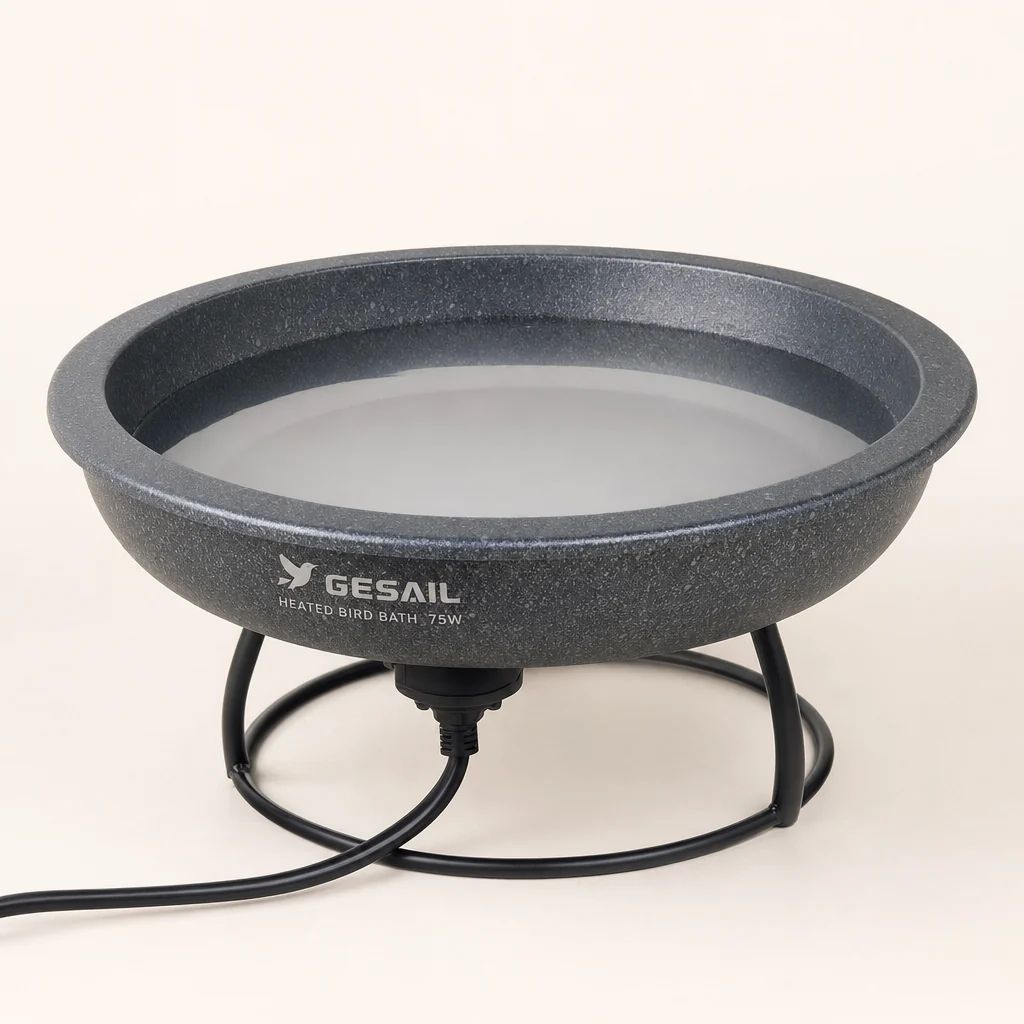
The GESAIL is a budget-friendlier 120-volt, 75-watt option whose element is thermostatically controlled to activate only when necessary, with targeted heating to prevent ice forming. A nice practical touch is the three EVA gaskets that stabilise the tray on uneven surfaces — handy if your patio or wall top isn't perfectly level. The bowl detaches for easy cleaning and water changes, which is more important than it sounds when you're maintaining a bath through a long winter.
| Feature | Allied API-970 | Allied API-650 | Farm Innovators BD-75 |
|---|---|---|---|
| Power | 150W | 150W | 75W |
| Size | 20" pedestal | 20" deck | 14" |
| Depth | 1.75" | 2" | ~1 quart |
| Thermostat | Yes (40–50°F) | Yes | Yes |
| Mounting | Stand or deck | Deck (EZ-Tilt) | Post / clamp / ground |
| Tested to | -10 to -20°F | Below freezing | 10°F |
| Warranty | 3-year | — | 1-year |
| Origin | USA | USA | — |
De-Icers: Upgrading the Bath You Already Own
Here's the thing that surprises a lot of people: you don't necessarily need to replace your existing bath at all. If you've got a stone bath you love, or simply don't fancy the cost of a whole new heated unit, a drop-in de-icer is often the smarter move. These are sealed, low-wattage immersion heaters that you place into the water of your existing bath, where the thermostat keeps the surface ice-free.
K&H Pet Products Ice Eliminator Range
K&H makes two versions worth knowing. The original Ice Eliminator is a 50-watt unit rated for baths up to 10 gallons, and the Super Ice Eliminator steps up to 80 watts for larger baths. Both are built around a solid aluminium housing with an 18-inch cord, and — this is the clever part — they're styled to look like a rock, so they sit discreetly in the bath rather than ruining the aesthetic. You can even spray-paint them to match your landscaping.
What makes these particularly suitable for the stone-bath crowd is the reassurance that they won't melt plastic bird baths, rust, or leave stains. They're thermostatically controlled, switching on and off as needed, MET listed for safety and backed by a 3-year warranty. In real-world testing they've held open water at temperatures as low as -20°F, which is about as severe as anyone in Britain is ever likely to face.
Farm Innovators C-50 De-Icer (150W)
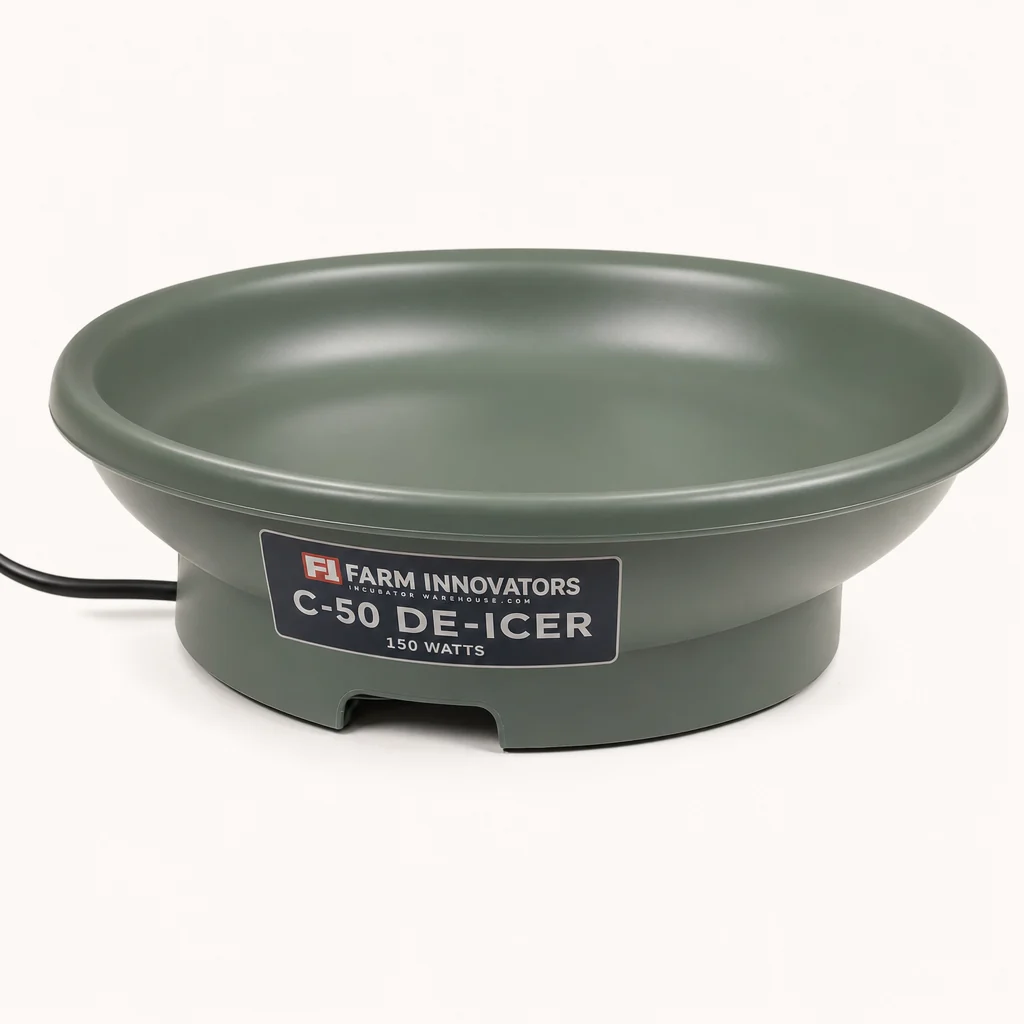
The Farm Innovators C-50 is a 150-watt de-icer aimed squarely at colder regions where the lower-wattage units might struggle. It's thermostatically controlled like the K&H units, and it's worth being clear-eyed about the trade-off here: that 150 watts is three times the draw of the 50-watt K&H Original, which translates directly into running costs. If you live somewhere genuinely arctic it's the safer bet, but for most British gardens the lower-wattage options will cope fine and cost far less to run.
Wattage and Your Wallet
Wattage isn't a measure of quality — it's a measure of capacity and running cost. A 50W de-icer keeps a small-to-medium bath open through a typical UK winter at a fraction of the cost of a 150W unit. Match the wattage to your climate, not to a "bigger is better" instinct, and you'll save money every single night the thermostat fires up.
Integrated Bath vs Drop-In De-Icer: Which Way to Go?
This is the question I get asked most, so let me lay out the case for each side plainly. Neither is "best" — it genuinely depends on what you already own and how hands-off you want to be.
Integrated Heated Bath
- Everything's built in — fill, plug in, done
- Element completely hidden and out of birds' reach
- Designed as a whole, so heating is evenly distributed
- Models like the API-970 carry up to a 3-year warranty
- Removable-element designs (API-400) double as summer baths
Integrated Heated Bath
- You're replacing your bath, not upgrading it
- Mostly plastic, so less premium than cast stone
- Short integrated cords nearly always need an extension
- Lightweight stands can be less stable in wind
Drop-In De-Icer
- Keep the stone or ceramic bath you already love
- Rock-style housing hides discreetly in the water
- K&H units won't melt plastic, rust or stain
- Choice of wattage to match your climate and budget
- Tested to hold open water down to -20°F
Drop-In De-Icer
- A visible (if disguised) object sits in the water
- Trailing cord to manage over the rim
- Higher-wattage models cost noticeably more to run
- Only as good as the bath you put it in
My honest steer: if you've already got a bath you're fond of, especially a heavy stone one, a K&H Ice Eliminator is the elegant, cost-effective answer. If you're starting from scratch or want the absolute minimum of fuss, an integrated bath like the API-970 is the cleaner solution.
Running Costs and Energy Sense
Let's talk about the elephant in the room, because the prospect of leaving something switched on outdoors all winter understandably makes people nervous about their electricity bill. The key reassurance is the thermostat. Because these units only draw power when the temperature genuinely threatens to freeze the water, they're idle for large chunks of even a cold winter's day — through milder afternoons and any spell above freezing, the element simply isn't running.
Wattage is your guide to the worst-case draw. A 50-watt de-icer like the K&H Original uses a third of the power of the 150-watt Farm Innovators C-50 when both are running flat out. Over a long winter, that difference adds up substantially. For most British gardens, where truly extreme cold is rare and short-lived, a 50–75W unit gives you all the ice-prevention you need at the lowest possible cost.
The bars above show relative maximum draw, not constant consumption — remember the thermostat keeps actual usage well below these figures. The practical lesson is to buy the lowest wattage that suits your climate. There's no prize for running a 150W unit in a mild Hampshire garden when a 50W one would keep the water just as open.
Manual Methods When You'd Rather Not Plug In
Not everyone wants or can run electricity to the bottom of the garden, and that's fine — birds were drinking from gardens long before heated baths existed. Here are the no-power approaches that genuinely work, which I've leaned on plenty myself.
The Hot Water Top-Up
The simplest method of all: each morning, pour a kettle of warm (not boiling) water over the iced surface to melt it, or tip out the ice and refill with tepid water. Never use boiling water on a stone or ceramic bath — the thermal shock can crack it. Repeat at dusk on hard days.
The Floating Ball
Drop a light ball — a ping-pong ball or small rubber ball works well — onto the surface. The slightest breeze keeps it bobbing, agitating the water and slowing the formation of a complete ice sheet. It won't survive a deep frost but it buys you valuable time on marginal nights.
Smart Placement
As mentioned earlier, a sheltered, sun-catching spot does a surprising amount of the work for free. Tucked against a south-facing wall, an unheated bath will thaw on milder mornings without any intervention at all.
What Never to Do
Never add salt, antifreeze, glycerine or any other chemical to lower the freezing point. All of these are harmful — even fatal — to birds, and salt damages their feathers' waterproofing. Plain water and a bit of daily effort, or a proper heated unit, are the only safe routes.
If you go the manual route, consistency matters more than perfection. Birds quickly learn the rhythm of your garden. Refilling at the same time each morning means they'll be waiting for you — and they'll waste fewer precious calories searching elsewhere when they know water arrives on schedule.
Keeping It Clean and Safe All Winter
A heated bath that's left to grow grimy isn't doing the birds any favours — in fact a dirty bath can spread disease through a population gathered tightly around a scarce water source. Winter maintenance is a little fiddlier than summer, but it's not onerous.
Empty and rinse the bath every few days, scrubbing off any algae or droppings with a stiff brush and plain water — no detergents, which can leave harmful residues. This is where the detachable-bowl designs really earn their keep: the GESAIL's removable tray and the Allied API-650's EZ-Tilt mount make this a thirty-second job rather than an awkward wrestle. Keep the water level topped up too, both so the heater isn't working against a near-empty bowl and so birds always have a decent depth to drink from.
On the electrical side, inspect cords periodically for damage, keep all connections off the ground and protected from standing water, and always use an RCD-protected outdoor socket. The reassuring news is that quality units are built for this life — the K&H de-icers are MET listed and won't rust, and the fully enclosed elements on the Allied baths keep everything electrical sealed away from both water and birds.
Who Should Buy What
Let me pull this all together into clear recommendations, because the "best" choice genuinely varies from garden to garden.
The Set-and-Forget Gardener
If you want the least possible fuss and have power nearby, an integrated heated bath like the Allied API-970 is the answer. Fill it, plug it in, and the thermostat does the rest all winter.
The Stone Bath Owner
Already have a handsome stone or ceramic bath? Don't replace it — drop in a K&H Ice Eliminator. The rock-style housing hides beautifully and won't crack or stain your bath.
The Year-Round Thinker
Want one bath that works in every season? The Allied API-400 with its removable element, or the Farm Innovators BD-75 with its tuck-away cord, give you winter heating and a normal summer bath in one.
The No-Power Gardener
No outdoor socket? A lightweight resin bath in a sunny, sheltered spot plus a daily warm-water top-up keeps birds drinking through all but the very hardest frosts.
Frequently Asked Questions
Our Overall Rating
Taking the category as a whole — integrated baths and de-icers together — here's how I'd score the winter-water solutions on offer, weighing convenience, effectiveness, value and build against the realities of a British winter.
The effectiveness score is the headline. When even budget units are holding open water at temperatures far below anything Britain throws at us, you can have real confidence these things do the job. The only marks lost are for running costs on the higher-wattage models and for the slightly utilitarian look of the all-plastic baths compared to traditional stone.
The Verdict
Keeping birds going through frost comes down to one simple truth: liquid water is as vital as food, and a frozen bath helps nobody. The good news is that the solutions available are genuinely excellent and suit every kind of garden and budget.
If you want maximum convenience and have a power supply, an integrated heated bath like the Allied Precision API-970 — with its hidden 150W element, 40–50°F thermostat and proven performance down to -20°F — is hard to beat, backed by a 3-year warranty. If you treasure an existing stone bath, a K&H Ice Eliminator drops in discreetly and keeps it ice-free without any risk to the bath itself. And if you'd rather not plug anything in, a lightweight resin bath in a sunny, sheltered corner plus a daily warm-water top-up will see your birds through all but the harshest cold snaps.
Whichever route you choose, the birds will thank you — and there are few finer winter pleasures than watching a blackbird take a proper splash on a morning when everyone else's bath is a sheet of ice. Get the water sorted, and you'll have a garden full of grateful, healthy visitors all winter long.