
How to Pressure-Wash Paths Without Stripping the Surface
Choose the right pressure, distance and cleaning technique for paving, steps, walls and garden furniture — without turning a tidy-up into a repair job.

Long 10 m hose, 500 L/h flow and eco!Booster lance make it the strongest choice for varied larger gardens.
Check price on Amazon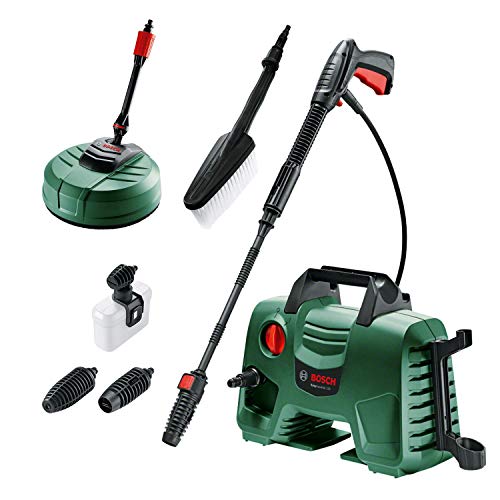
The Amazon-exclusive EasyAquatak 120 kit combines compact handling with a patio cleaner, wash brush and variable fan-jet nozzle.
Check price on AmazonWe link to the exact model on Amazon UK. Prices change often, so check the live price before you buy. As an Amazon Associate we earn from qualifying purchases.
Why Pressure-Washing Goes Wrong (and How to Get It Right)
At the end of October, paths are often at their slipperiest. Leaves have sat in damp corners, green algae has crept across the north-facing side of the patio, and the steps by the back door have acquired that slightly theatrical black-and-green look. It is tempting to reach for a pressure washer and blast the lot into next week.
That is where trouble starts. Most damage caused by pressure-washing does not come from owning an especially powerful machine. It comes from using the wrong setting, holding the lance too close, or lingering over one stubborn patch until the surface gives up before the dirt does. Pressure washers are wonderfully effective. They are also spectacularly democratic: they will happily remove algae, mortar, pointing, jointing sand, old sealant and the outer face of soft stone if given the opportunity.
The useful way to think about the job is that you are controlling three dials all the time:
Pressure
More bar means more potential cleaning force, but it does not mean a better result on every surface. A lower setting used patiently is often the safer and cleaner option.
Distance
The closer the nozzle gets, the more aggressive the spray becomes. Distance is your quickest safety control, and it costs nothing to use.
Dwell time
How long the water stays on one place matters. Keep moving, overlap your passes, and let pre-treatment do the hard work where possible.
Those three variables apply whether you are cleaning concrete slabs, block paving, natural stone, brick steps, rendered walls or garden furniture. They matter more than the badge on the machine. A powerful washer can be gentle; a modest one can still scar a surface when a narrow jet is held a few centimetres away. The lance, in other words, is not a magic wand. More of a very efficient garden hose with opinions.
The first rule
Start with the widest practical spray, the lowest practical pressure and a generous working distance. Increase cleaning strength only after testing an inconspicuous area and seeing how the material responds.
For a late-autumn clean, aim to remove slip hazards, leaf staining and surface grime rather than chasing a newly laid, uniform finish. Older paving naturally has colour variation. Removing it with brute force is not restoration; it is abrasion with a hose attached.
Reading Your Surface Before You Pick Up the Lance
Before connecting the hose, work out what you are actually cleaning. This sounds obvious, but patios are often a mixture of materials: hard porcelain by the house, sandstone edging around beds, concrete paving by the shed and a short run of old brick steps somewhere between them. Treating the whole lot as "patio" is a quick route to a patchwork finish.
In broad terms, the more dense, hard and intact a surface is, the more tolerant it will be of pressure. Porcelain and ceramic exterior tiles sit at the robust end of the scale when they are soundly laid and properly grouted. Then come good-condition concrete slabs. Block paving follows, although its vulnerable point is usually the sand-filled joints rather than the blocks themselves. Natural sandstone and limestone need more restraint because they can be porous and comparatively soft. Old brick, especially handmade or weathered brick, is softer again. Rendered, painted and already-damaged finishes belong at the cautious end of the spectrum.
That does not mean hard surfaces can be attacked with abandon. Concrete can pit. Porcelain can suffer if grout is weak or edges are already chipped. Block paving can lose so much jointing sand that it begins to move. Strong materials still deserve sensible technique.
Do a condition check first. Walk the route slowly in dry light if possible. Look for cracks, loose slabs, flaking faces, crumbling mortar, missing pointing, previous repairs and areas where water already sits. Pressure washing will reveal these faults very efficiently, but it will not fix them.
Signs to stop and reassess
Spalling is one of the clearest warning signs. It looks like thin flakes or chips breaking away from brick, concrete or stone. Once the hard outer face has failed, the material beneath is generally more vulnerable. High pressure can accelerate the process and leave you with a surface that traps moisture and dirt more readily afterwards.
Loose mortar joints are another red flag. If pointing can be scratched out with a finger or a stiff brush, a pressure washer will not improve the situation. Keep water away from the joint, repair it first, and allow the repair to cure properly before considering any cleaning.
Efflorescence — pale, chalky salts on brickwork, paving or masonry — deserves a light touch too. It is not dirt sitting on the surface in the usual sense. It is mineral salt carried through the material by moisture. Pressure may temporarily shift the visible deposit, but aggressive washing can drive more water into the substrate and make the cycle worse.
Porcelain and ceramic tiles
Usually the most pressure-tolerant paving materials, provided tiles, grout and edges are secure. Use a broad fan and avoid forcing water into failed grout lines.
Concrete slabs and blocks
Generally forgiving when sound, but susceptible to pitting, exposed aggregate and stripped jointing sand if cleaned too closely or too aggressively.
Natural stone
Sandstone and limestone reward patience. Start low, stay well back and never assume a dark patch is simply surface dirt rather than part of the stone's natural colour.
Brick, render and paint
These are the materials most likely to suffer visible damage. Use a wide fan, modest pressure and plenty of distance, or choose a softer cleaning method.
Sealed surfaces need particular consideration. A sealant can make cleaning easier, but it is still a coating. Concentrated pressure can lift it, dull it or create patchy, cloudy areas that demand a complete re-seal rather than a small local touch-up. Test a hidden edge first. If the finish changes colour, feels rougher, or develops a noticeably different sheen, stop there.
It is also worth checking the weather forecast. A cold, wet afternoon is not automatically a problem, but avoid cleaning when frost is expected before the surface can dry. Do not pressure-wash in high winds, either: the spray goes everywhere, including places it has absolutely no business being.
Pressure, Distance and Nozzle Angle: The Three Dials You're Always Adjusting
Pressure figures are useful for comparing machines, but they are not a cleaning instruction. A machine capable of 145 bar has plenty in reserve for domestic outdoor jobs. That does not mean 145 bar should be applied to every path, chair or wall. Most sound domestic surfaces respond well at around 60–100 bar, and many delicate jobs need less. The secret is using enough force to detach grime while leaving the surface itself exactly where it was.
Distance matters just as much as the number on the box. The spray spreads as it travels, so a nozzle held 40 cm away delivers its force over a much larger area than one held at 20 cm. Halve the distance and the effective force per square centimetre rises dramatically — roughly fourfold in the simple inverse-square model. That is why moving the lance in by a handspan can turn a gentle wash into a gouging tool.
The chart is not a recommendation to use the maximum setting. Quite the opposite. It is a reminder that both machines have enough capability to cause surface damage when used badly. Maximum pressure is reserve capacity for hard, stubborn grime on suitable materials. It is not a default mode.
Fan angle changes everything
Nozzle angle determines how concentrated the water is. A 0° pencil jet concentrates virtually all the force in a tiny spot. On garden surfaces it is rarely appropriate. It can cut lines into concrete, carve mortar from brickwork and make an otherwise decent patio look as though it has been cleaned with a very determined laser.
A 15° fan is still narrow and best reserved for isolated, stubborn stains on robust concrete, used from a sensible distance and kept moving. A 25° fan is the useful general-purpose choice for sound paving. It has enough bite for algae and grime without concentrating force quite so brutally. A 40° fan is the safer starting point for walls, furniture, painted finishes and delicate stone.
A practical starting position
Begin about 30–40 cm from the surface with a broad fan. Make one slow pass. If the dirt remains, reduce pressure first or make another pass before moving closer. Distance is the last dial to tighten, not the first.
Keep the lance moving in smooth, overlapping lanes. Imagine mowing a lawn, except the thing you are trying to avoid is stripes. Start at the far edge, work back towards yourself, and overlap each pass by roughly a third so that the result is even. Do not scrub one dark patch for thirty seconds while leaving the rest untouched. Treat it, move on, then return after the treatment has had time to work.
Angle is important too. For broad paving, hold the fan close to perpendicular but not so close that water is driven into every crack. For walls, direct water downwards rather than upwards under laps, flashings, loose paint edges or render cracks. For block paving, avoid sweeping across joints at an angle, because this is an efficient way to empty them of sand.
There is one more small habit that saves a great deal of grief: trigger away from the surface. Start the water pointed safely at the ground or into an open area, then bring the moving fan across the work. This avoids the first sharp burst landing full-force on a single tile, chair arm or brittle brick edge.
Step-by-Step Method for Every Garden Surface
The following methods are deliberately conservative. You can always increase cleaning effort after a test patch. You cannot easily put the aged surface back onto a sandstone slab after it has been removed in a moment of enthusiasm.
1. Concrete slabs and concrete paving
- Clear furniture, pots, leaves and loose debris. Brush grit away from edges and drains first so you do not simply wash it into the gully.
- Wet nearby plants, then protect delicate foliage from runoff. Cover electrical fittings and keep external doors and air vents shut.
- Apply a suitable path cleaner diluted to its manufacturer's instructions. Allow it to sit for 5–10 minutes, but do not allow it to dry on the paving.
- Start with a 25° fan at about 80–100 bar and around 30 cm from the surface. Test a quiet corner before committing to the visible middle.
- Wash in parallel lanes, moving steadily and overlapping each lane. Work from the highest point towards the drain or lawn edge where runoff can be managed.
- Rinse from high to low with a broad fan. Check the surface once it dries; wet concrete can disguise faint stripes and areas of pitting.
Concrete is usually robust, but repeated close-range washing can expose aggregate and create a rougher, more absorbent finish. If one particular mark is refusing to shift, treat it again rather than closing in with the lance. Patience is cheaper than replacing slabs.
2. Block paving
- Remove weeds and brush the surface clean before washing. This avoids spreading weed seeds and muddy debris around the entire area.
- Pre-treat algae and staining as above, observing the product label and keeping solution off planted areas.
- Use approximately 60–80 bar as a cautious starting point, with a broad fan and a working distance of around 30 cm.
- Keep the lance as near perpendicular to the blocks as practical. Angling the spray across the joints strips jointing sand with alarming efficiency.
- Wash a section at a time, using steady, parallel passes. Avoid chasing sand out of the joints simply because it looks satisfying. It is not satisfying when the blocks wobble later.
- Allow the paving to dry fully, then sweep kiln-dried sand into the joints. Brush it across the surface in several directions until joints are properly filled.
Do not skip re-sanding. Jointing sand stabilises block paving, helps prevent movement and reduces the empty gaps where weeds and moss are keen to make themselves at home.
3. Natural sandstone and limestone
- Identify the stone if you can. If you cannot, treat it as sensitive until a discreet test proves otherwise.
- Choose a stone-safe, pH-neutral cleaner for the pre-treatment stage. Avoid assuming that a strong patio cleaner is suitable for calcareous stone.
- Start with the widest fan, the lowest practical pressure and a distance of 40 cm or more.
- Make a single pass across a small test area and allow it to dry. Judge the result dry, not wet, because wet stone always looks more evenly coloured.
- Continue only if the texture and colour remain consistent. Work gently, keeping the fan moving and avoiding edges, fossil markings, chipped corners and open veins.
- Rinse thoroughly but gently, particularly where water may flow into beds or onto other stonework.
Natural stone often has shade variation that a pressure washer cannot — and should not — erase. A patch that appears darker may be natural mineral variation, old weathering or moisture within the stone. Stripping the face until that patch matches can leave a pale, rough scar that stands out far more.
4. Brick steps and masonry walls
- Check mortar, brick faces and any nearby paintwork. Repair loose pointing before cleaning.
- Choose a wide fan, low pressure and at least 40 cm of working distance. Start on the least visible side.
- Direct the spray downwards. Never force water up beneath coping stones, into weak joints or behind peeling paint.
- Use broad, quick passes rather than lingering. If moss remains in a joint, remove it with a brush after pre-treatment instead of drilling into the mortar with water.
- Rinse carefully from the top down, preventing dirty water from streaking across clean lower courses.
Old brick is not failed brick just because it is old. It has earned its character. Treat it as a finish worth preserving, especially around Victorian paths and garden walls where softer faces are part of the material's charm.
5. Rendered or painted walls
- Inspect closely for cracks, hollow sections, bubbling paint and loose render. Do not pressure-wash a finish that is already detaching.
- Use a 40° fan and modest pressure, from a generous distance. A soft brush and suitable wash may be the wiser option for fragile areas.
- Keep the spray moving downwards and avoid windows, vents, light fittings and junctions with timber.
- Stop immediately if paint lifts, render darkens unevenly or fine cracks begin to show more clearly.
6. Garden furniture
- Remove cushions, textiles and loose fittings. Check labels for any care restrictions.
- For plastic and metal furniture, use a broad fan at low pressure and stand well back. Wash from top to bottom.
- For timber furniture, use the gentlest possible setting and avoid close work along the grain, which can raise fibres and leave a furry finish.
- Rinse, allow to dry completely and assess whether timber needs sanding or re-oiling before it goes back into service next spring.
The stop-test-rinse routine
For every material, clean a test patch, stop, let it dry a little, then inspect it before continuing. The few minutes spent checking can prevent a permanent colour mismatch across an entire patio.
Pre-Treatment, Detergents and Aftercare: The Steps That Actually Prevent Damage
Pressure should be the final part of the cleaning process, not the only part. A suitable cleaner or algaecide does the chemical work of loosening organic growth, so the washer only has to rinse away what is already releasing. This is how you clean more gently without accepting a half-finished result.
For ordinary green algae and light organic grime, a path and patio concentrate or an algaecide spray is usually the sensible place to start. Benzalkonium chloride is a common active ingredient in products intended for algae control. Follow the dilution rate and contact time on the label, keep pets and children away until surfaces are safe and dry, and take care around ponds, drains and planted areas.
For stone, choose a cleaner explicitly described as stone-safe and pH neutral. Limestone and sandstone are particularly poor candidates for strong acidic or highly alkaline cleaners. A product may make a patio look bright in the moment, but it is not a win if it etches the surface or alters the colour permanently.
Sodium hypochlorite-based products can be effective against heavy black spotting, but they are not a general-purpose answer. Do not use them on natural stone or coloured concrete, and never mix cleaning products. That last bit is not gardening folklore. Mixing chemicals can create dangerous fumes, which is an exceptionally silly way to spend a Saturday morning.
Keep cleaners wet, not dried on. Apply only to an area you can rinse within the label's stated contact time. On a dry or breezy day, work in smaller sections and pre-wet surrounding plants first.
Pressure-washer detergent systems are useful because they apply solution at low pressure before the high-pressure stage. The Kärcher K 5 WCM Flex eco!Booster uses a detergent suction hose, allowing cleaning solution to be drawn through the machine for application. This is useful for broad areas where a controlled pre-treatment saves time and reduces the need for aggressive rinsing afterwards.
Aftercare depends on the material. Block paving should be re-sanded once fully dry. Natural stone and concrete should be allowed to dry before deciding whether a sealer is needed; do not rush into sealing a surface simply because it has been cleaned. Walls should be checked for softened mortar or areas where moisture has entered cracks. Timber furniture should dry thoroughly before any protective finish is applied.
Finally, clean the washer itself. Flush detergent from the system according to the manufacturer's instructions, disconnect the water, release trapped pressure from the gun and store accessories together. A blocked nozzle or detergent line is a tedious little problem, and it always appears when you are already in old clothes and have somewhere else to be.
The Kit That Makes This Easier: Our Recommended Pressure Washers
Technique comes first, but a suitable machine makes that technique easier to repeat. For mixed gardens, the useful qualities are enough pressure for hard concrete when needed, sufficient water flow to rinse efficiently, several nozzle options, and a hose long enough that you are not dragging the machine over every three slabs.
Both machines below are corded electric pressure washers, which remains the practical domestic norm for a British garden. They suit different garden sizes and workloads. The Kärcher is the more substantial choice for repeated multi-surface cleaning and larger areas. The Bosch Amazon-exclusive package is the lighter, compact option for smaller-to-medium jobs, with a notably useful selection of included accessories.
Neither machine removes the need for restraint. In fact, a capable washer makes the advice above more important. A good nozzle, a sensible working distance and a cleaning solution used properly are what separate a fresh-looking path from an expensive lesson in surface repair.
Kärcher K 5 WCM Flex eco!Booster: Best Overall for Multi-Surface Gardens
The Kärcher K 5 WCM Flex eco!Booster is the more capable machine in this guide for gardeners who regularly clean a mix of paths, patios, walls, garden equipment and vehicles. It has the output for a sizeable driveway or several connected outdoor spaces, but its real appeal for careful cleaning is the ability to adapt rather than simply blast.

Check today's price: Kärcher K 5 WCM Flex eco!Booster on Amazon UK
Its 2.1 kW motor delivers a maximum pressure of 145 bar, across an operating range of 20–145 bar, with a maximum flow rate of 500 litres per hour. Kärcher quotes area performance of 40 m² per hour. That is a useful guide to its intended class, although actual pace depends heavily on the material, level of soiling, water supply and, crucially, whether you are cleaning sensibly rather than racing across the surface.
The standard kit includes the G 180 Q high-pressure gun, a 10 m PremiumFlex high-pressure hose, an eco!Booster lance, a Dirt Blaster lance and a ¾-inch garden-hose adapter. There is also an integrated water filter, on-board storage, Quick Connect fittings and a detergent suction hose. The machine uses a water-cooled motor and aluminium pump, both features that suit frequent domestic use.
For this article's particular job, the eco!Booster is the headline attachment. Kärcher positions it as a more efficient alternative to a standard flat-jet nozzle and says it delivers 50% higher cleaning performance than its standard flat jet, whilst improving water and energy efficiency. That is Kärcher's own comparison, but the practical point is straightforward: it is designed for more sensitive surfaces where a broad, controlled wash is preferable to a concentrated attack.
The Dirt Blaster has a different role. It is for stubborn grime on suitable, robust surfaces. Think hard concrete in good condition, not soft brick, loose pointing or a treasured sandstone step. It is very much a specialist tool rather than the attachment to leave on for every job because it makes dramatic noises and feels powerful. Plenty of garden damage has begun with exactly that thought.
Why it suits mixed patios
The K 5's combination of a long 10 m hose and two purposefully different lances makes it easier to work gently on sensitive sections, then reserve stronger cleaning for genuinely robust areas without changing the whole setup.
The 10 m hose is one of the most practical advantages here. On a broad patio or driveway, it gives useful room to work around furniture, beds and corners while keeping the machine in a stable location. The 5 m electrical cable still needs thoughtful positioning, of course, and all outdoor electrical safety guidance should be followed, but the long high-pressure hose reduces the need to repeatedly pull the washer across freshly cleaned paving.
At 12.6 kg without accessories, this is not a tiny grab-and-go machine. Its dimensions are 36.9 × 32.9 × 90.1 cm, and it is best suited to someone who has storage space and expects to use it regularly. If all you ever need is a brief rinse of two chairs and a bicycle, it is more machine than necessary. For a larger garden with paths, retaining walls, paving and vehicles on the rota, that extra capability becomes easier to justify.
Strengths
- 145 bar maximum and 500 L/h flow offer useful capacity for larger, dirtier outdoor areas.
- 10 m PremiumFlex hose gives generous reach around patios and driveways.
- Eco!Booster lance is well suited to more controlled cleaning on sensitive surfaces.
- Water-cooled motor, aluminium pump and integrated water filter suit regular use.
- Detergent suction hose supports low-pressure pre-treatment.
Consider before buying
- At 12.6 kg, it is a substantial machine rather than a lightweight occasional-use option.
- The standard kit does not include a patio cleaner attachment.
- Its maximum output requires disciplined nozzle choice and working distance on softer materials.
- It needs a mains supply and a water connection.
Use the K 5 as a controlled multi-tool. Start delicate paving with the eco!Booster, broad fan behaviour and a generous distance. Use the Dirt Blaster only where the material warrants it. If you do that, its reserve power becomes an advantage rather than a temptation.
Bosch EasyAquatak 120: Best Value Entry into Variable-Pressure Washing
A quick but important naming note: the Amazon-exclusive product carrying this heading is listed as the Bosch EasyAquatak 120, model 06008A7972, rather than an AdvancedAquatak 150. It is the EasyAquatak 120 Home and Car Kit that should be expected in the box, and those are the specifications that matter here.
Check today's price: Bosch AdvancedAquatak 150 on Amazon UK
This Bosch is a compact, corded electric pressure washer for smaller-to-medium jobs around the home. Its 1,500 W motor delivers a maximum pressure of 120 bar and a maximum flow rate of approximately 350 litres per hour. That is less flow than the Kärcher, which means broad patios and driveways will take longer to rinse, but it remains a capable level of output for paths, paving, furniture and car washing when used with sensible technique.
The Amazon-exclusive Home and Car Kit is the important bit. Alongside the pressure washer, gun, lance, 5 m high-pressure hose, variable fan-jet nozzle, rotary nozzle, detergent nozzle and water filter, it includes a patio cleaner and wash brush. That is a useful spread of accessories for someone starting out with several household jobs in mind.
The variable fan-jet nozzle is particularly relevant for preserving surfaces. It allows you to broaden the pattern for general paving and gentler cleaning, rather than relying on a narrow jet. The rotary nozzle is for tougher dirt, but should be treated with the same caution as any concentrated attachment: reserve it for robust surfaces, keep it moving and do not use it to excavate moss from old mortar.
At 5.1 kg for the machine, the EasyAquatak 120 is much easier to lift from shed to patio than the Kärcher. Bosch also provides on-board accessory storage, push-fit connections, auto-stop and in-use gun storage. It is a practical arrangement for gardeners who want a machine that comes out for a few jobs rather than a full day of exterior cleaning.
Strengths
- Compact 5.1 kg machine is easy to carry and store.
- Variable fan-jet nozzle helps match spray width to the surface.
- Amazon-exclusive kit includes a patio cleaner and wash brush.
- 120 bar and 350 L/h are appropriate for routine paths, furniture and vehicle cleaning.
- Integrated storage keeps accessories close at hand.
Consider before buying
- 5 m hose offers less reach around a large patio or driveway.
- 350 L/h flow means slower rinsing than the Kärcher on extensive hard landscaping.
- It is intended for small-to-medium domestic jobs rather than heavy-duty repeated use.
- The wash brush may need checking for compatible connection parts before use.
For ordinary garden paths and a modest patio, it is a sensible, approachable package. Assembly has been found straightforward in use, and the machine's smaller footprint is a genuine benefit where shed space is finite. Just remember that lighter does not mean harmless: 120 bar can still mark paving when the lance is too close or the rotary nozzle is used carelessly.
Head-to-Head: Which Machine Suits Your Garden?
The short version is simple. Choose the Kärcher if you have a larger garden, multiple surfaces to maintain and expect to use the washer regularly. Choose the Bosch kit if you want a compact machine for smaller-to-medium tasks, value the included patio cleaner and wash brush, and do not need a long hose or faster broad-area rinsing.
| Feature | Kärcher K 5 WCM Flex eco!Booster | Bosch EasyAquatak 120 Home and Car Kit |
|---|---|---|
| Maximum pressure | 145 bar | 120 bar |
| Maximum flow rate | 500 L/h | 350 L/h |
| Stated coverage rate | 40 m²/h | — |
| High-pressure hose | 10 m PremiumFlex | 5 m PVC |
| Machine weight | 12.6 kg without accessories | 5.1 kg |
| Key cleaning attachments | eco!Booster lance and Dirt Blaster lance | Variable fan-jet nozzle, rotary nozzle and patio cleaner |
| Detergent arrangement | Suction hose | high-pressure detergent nozzle |
| Best fit | Regular, multi-surface work in medium-to-large gardens | Compact home, car and garden cleaning in smaller spaces |
| Who wins? | Reach, flow rate and capacity for larger areas | Portability and included patio-cleaning accessories |
Choose the Kärcher if…
Your garden has a substantial patio, long paths, a driveway or several different surfaces. The 10 m hose, 500 L/h flow rate and eco!Booster make it the stronger all-round choice for regular maintenance.
Choose the Bosch if…
You need a compact, lighter washer for routine paving, furniture and car care. Its accessory-rich Home and Car Kit is especially appealing for a smaller garden with limited storage.
Be cautious with either if…
You have friable sandstone, limestone, soft brick, weak pointing, flaking render or lifting paint. Machine choice cannot compensate for a vulnerable surface; use low pressure, wide spray and plenty of distance.
Choose neither for a moment if…
The surface is cracked, loose, spalling or poorly repaired. Resolve the structural issue first. Pressure washing should improve a sound surface, not test whether it was attached in the first place.
Pressure-Washing Questions Gardeners Ask
The GardenScout verdict
Pressure-washing without stripping the surface is mostly about restraint. Pre-treat first, start wide and distant, keep the lance moving and increase power in small steps. For regular multi-surface gardens, the Kärcher K 5 WCM Flex eco!Booster has the reach and flexibility to make careful cleaning easier. For lighter, smaller-scale work, the Bosch EasyAquatak 120 Home and Car Kit brings useful accessories in a compact package. Either can do a very good job. Neither should be allowed to become the garden equivalent of a power tool with a grudge.
- Kärcher K 5 WCM Flex eco!BoosterBest overallView on Amazon
- Bosch AdvancedAquatak 150Best compact kitView on Amazon