The short answer
Choose oil for a natural timber look, refreshing it every 6 to 12 months. Choose stain for colour with some grain visible, refreshing standard products every 12 to 24 months. Choose paint for the longest-lasting, fully opaque finish, lasting 10 years or more with careful preparation. Apply any finish in dry weather between 12°C and 25°C.

Useful for cleaning dirt and grime from a sound deck before sanding and applying a new finish. Use the gentlest suitable setting and allow the timber to dry fully before coating.
Check price on Amazon
Designed specifically for applying suitable coatings to decking, including many fence paints, stains and wood treatments. It can make covering a larger deck quicker than working entirely by brush.
Check price on Amazon
A versatile option for readers who want to apply suitable decking paint, stain or wood oil with a sprayer. The interchangeable attachments make it useful when a project involves different coating types.
Check price on AmazonWe link to the exact model on Amazon UK. Prices change often, so check the live price before you buy. As an Amazon Associate we earn from qualifying purchases.
Oil, Stain or Paint? The Big Decision Every Deck Owner Faces
A timber deck has a slightly unfair life in Britain. It gets rained on, walked over in wet trainers, baked during those startlingly hot spells in June, then blanketed in leaves and damp through autumn. By November, when the garden is winding down and the patio furniture is usually hiding under a cover, a deck often tells you exactly how happy it is with its current finish.
Grey patches, a thirsty-looking board, faded colour or a little peeling around the busiest step are not merely cosmetic irritations. They are signs that water, sunlight and regular use are getting ahead of the protective coating. The usual mistake is not choosing a "bad" product. It is choosing the wrong type of finish for the deck, then expecting it to behave like something else.
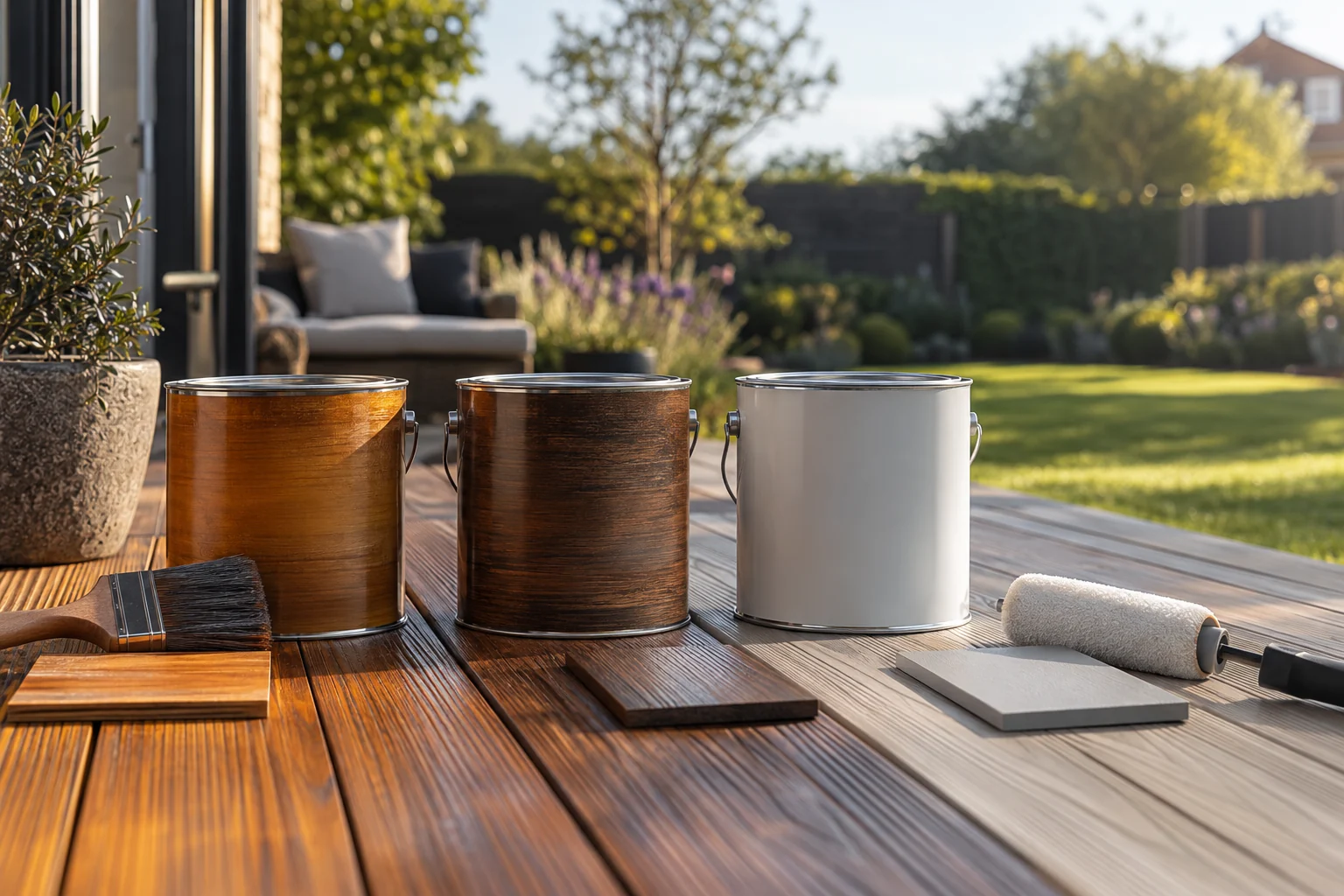
Decking oil, stain and paint are often grouped together on the same shop shelf, which is understandable but not especially helpful. They do different jobs. Oil penetrates into the timber. Stain adds colour and a protective layer. Paint forms an opaque coating over the surface. That one distinction explains most of the difference in appearance, durability and future maintenance.
The short answer
Choose oil if you want timber to look like timber and do not mind regular care. Choose stain if you want colour with some grain still visible and a middle-ground maintenance routine. Choose paint if maximum colour coverage and the longest interval between major jobs matter more than seeing the wood beneath.
There is no universal winner, despite what a very confident tin label may imply. An oil-finished deck can be the sensible choice beside a cottage garden where natural timber is part of the look. A solid stain can suit a family deck that needs more weather protection but still benefits from a softer finish than paint. Paint can be a very practical answer for tired boards that need a visual reset.
This guide looks at what each finish actually does, how long it can last, what it costs, how to apply it and how to match it to common deck materials. Since it is November, the most useful job now is assessment and cleaning on a dry day, rather than rushing to coat boards in cold, unreliable weather. Come next spring, when dry conditions settle in, you will be ready to finish properly.
Know Your Finish: What Oil, Stain and Paint Actually Do to Timber
Start with the wood rather than the colour chart. Timber is not a fixed, sealed building material. It takes in and releases moisture, expands and contracts with changing conditions, and eventually loses its fresh-cut colour in sunlight. A deck finish is there to slow down the effects of that hard outdoor life. It cannot make timber immortal. Nothing in a tin is quite that magical.
Decking oil: protection from within
Decking oil is a penetrating finish. It soaks into the wood fibres rather than sitting as a substantial film on top. That is why it tends to leave the grain clear and the surface feeling like wood rather than coating. It enhances natural timber tones and helps protect against moisture and UV exposure, whilst keeping the visual character of the boards intact.
The trade-off is simple: because it is not building a thick protective skin, it needs more frequent attention. It is best thought of as regular timber care rather than a once-and-done renovation. The good news is that an oil finish usually fades gradually rather than peeling away in strips. When it looks dry, you clean it and apply more. There is a lot to be said for a finish that does not punish you for missing one summer.
Decking stain: colour plus a protective layer
Decking stain sits on the surface and adds colour, alongside a protective layer. The important word here is pigment. Transparent stains offer low moisture protection and virtually no UV protection. At the other end, solid stains offer high protection against both moisture and UV exposure. In between are finishes that add colour whilst allowing more or less of the grain to remain visible.
That makes stain the most flexible category aesthetically. You can move a deck away from orange-toned timber, mute mismatched replacement boards or make an older deck look more deliberate without necessarily turning it into a painted platform. The more heavily pigmented the stain, however, the less visible the grain becomes. You are choosing a balance, not getting every benefit at once.
Decking paint: an opaque surface coating
Paint forms a fully opaque film over the timber. It conceals the grain, covers colour variation and can make worn boards look remarkably more cohesive. It is generally the longest-lasting of the three finish types, but it is also the most dependent on careful preparation. Once paint begins to crack or lift, water can work underneath the coating and make a small neglected patch into a more involved repair.
Oil-based paints offer the strongest protection from moisture, whilst latex paints provide the best defence against UV-related fading. In practical terms, paint is for the gardener who wants a strong, consistent colour and is happy to do the groundwork needed to keep a film finish sound.
The most useful rule to remember is this: you can apply paint or stain over a previously oiled deck, but oil cannot go over a stained or painted deck unless the existing finish has been removed completely first.
Durability Face-Off: Which Finish Actually Lasts Longest?
If you are choosing entirely on longevity, paint wins. That does not automatically make it the right answer, but it is the clear front-runner for the longest period between full reapplications. The catch is that lifespan is only one part of ownership. The preparation needed before repainting is very different from the light clean-and-refresh routine of oil.
Exposure matters enormously. A sheltered deck used occasionally will have an easier time than one facing south, surrounded by reflective paving and crossed several times a day by children, dogs and garden chairs. Rain, frost, foot traffic and ultraviolet light do not consult the back of the tin. Treat lifespan ranges as sensible planning guidance, not a promise written in stone.
Oil: the regular-care option
Decking oil typically lasts one to two years, but it commonly needs reapplication every six to 12 months depending on weather, exposure and foot traffic. That makes it the most maintenance-hungry option. A high-traffic or exposed deck will usually sit nearer the six-month end of that range.
It sounds demanding, and it can be. Yet oil's maintenance is often relatively straightforward because it does not tend to peel. You are topping up a finish that has faded or been absorbed, not necessarily removing a failed coating. For gardeners who enjoy an annual spring tidy-up, it can fit neatly into the rhythm of looking after the outdoor space.
Stain: the useful middle ground
Quality decking stain can last between two and five years before needing reapplication. Standard stain products commonly need refreshing every 12 to 24 months, particularly where the deck is exposed or heavily used. More heavily pigmented stains can last considerably longer because pigment improves resistance to moisture and UV damage.
That means "stain" is not one maintenance category. A transparent finish and a solid stain may both be called stain, but they make rather different durability promises. If reducing repeat work is a priority, a heavily pigmented or solid stain is the version to consider. If seeing grain is your main concern, accept that transparency gives up some protection.
Paint: the longevity champion
Decking paint can last 10 years or longer before full reapplication is required. In ordinary use, expect touch-ups every five to seven years, particularly in high-wear areas. That is an attractive timetable for anyone who does not wish to spend every spring on hands and knees with a brush.
But paint's long life depends on the coating staying intact. When it is sound, it provides the strongest visual barrier of the three. When it begins to peel or crack, prompt repair matters. Paint is less forgiving of neglect because lifted edges can allow water to get beneath the surface film.
| Finish type | Typical lifespan | Usual refresh cycle | Appearance |
|---|---|---|---|
| Decking oil | 1–2 years | Every 6–12 months | Natural timber tones and visible grain |
| Decking stain | 2–5 years | Every 12–24 months for standard products | Coloured finish with variable grain visibility |
| Decking paint | 10 years or longer before full reapplication | Touch-ups every 5–7 years | Fully opaque, uniform colour |
Do not confuse durability with convenience
Paint usually lasts longest between major applications, but it needs the most careful response once it fails. Oil needs doing more often, but it normally wears away quietly. The better choice is the finish whose maintenance pattern you will genuinely keep up with.
The Real Cost of Each Finish: Materials, Labour and Long-Term Spend
The price of a tin is only part of the cost. A cheaper finish that needs frequent reapplication can become the more expensive choice over several seasons, whilst a longer-lasting coating may demand greater effort and preparation when the time eventually comes to renew it. There is no need to overcomplicate the arithmetic, but it is worth looking beyond the price label.
For materials, Barrettine Decking Oil is priced from £24.89 to £46.32 for 2.5 litre and 5 litre containers. That works out at roughly £9 to £15 per litre across the stated range. Oil can be an appealing choice for a modest deck because the job is relatively approachable and future refreshes do not usually involve stripping a heavy film.
Quality decking stains cost between £32 and £65 per 2.5 litre tin. Ronseal Ultimate Protection Decking Stain, Cuprinol Anti-Slip Decking Stain and Sadolin Superdec are priced from £28 to £45 per 2.5 litre tin. Stain pricing per litre spans roughly £10 to £30, depending on the product.
For paint, Ronseal Ultimate Protection Decking Paint is priced from £29.99 to £49.69 in 2.5 litre and 5 litre sizes. Liberon Extreme Decking Paint is £30.76 for 2.5 litres. Exterior wood paint sits in a broader £15 to £40 per litre range.
Decking oil
Barrettine Decking Oil, for 2.5 litre and 5 litre containers.
Decking stain
Typical price for a quality 2.5 litre decking stain tin.
Decking paint
Ronseal Ultimate Protection Decking Paint, in 2.5 litre and 5 litre sizes.
Coverage matters as much as container size. Ronseal Ultimate Protection Decking Paint covers 8 square metres per litre. Cuprinol Anti-Slip Decking Stain covers 12 square metres per litre, while Ronseal Ultimate Protection Decking Stain also covers 12 square metres per litre. Sadolin Superdec covers 11 square metres per litre and Cuprinol Anti-Slip is also listed at 10 square metres per litre in product comparisons.
Measure the deck surface before buying. Multiply its length by width to get the square metres, then consider the number of coats required. It is an unglamorous little calculation, but much better than discovering you are short halfway across the last board. That is the moment when the weather almost always takes a turn for the worse.
Professional labour for oiling or staining a deck is generally £350 to £800 per deck. Preparation, access, deck condition and the amount of old finish to remove can all affect the eventual bill.
Over the long term, paint's extended lifespan can balance its higher-preparation nature, whilst stain sits in a useful middle position. Oil can make sense where preserving the timber's natural appearance is the priority and regular upkeep is acceptable. It is not always about spending least today; it is about choosing the maintenance cycle you can live with year after year.
Preparing Your Deck Properly: The Step Most People Skip
Most disappointing deck finishes are not really finish failures. They are preparation failures wearing a disappointing little disguise. A lovely new coating cannot bond properly to algae, surface dirt, loose fibres or old peeling paint. Nor can it dry and cure as it should when applied in poor conditions.
For an existing deck, start with a close inspection. Clear furniture, pots, rugs and leaf litter. Look along the boards rather than merely down at them: this makes peeling edges, faded traffic lanes and patchy colour easier to spot. Remove algae, mould, dirt and old flaking finish before applying anything new. A dedicated deck cleaner or diluted wood cleaner is suitable for the washing stage.
A pressure washer can be useful only if treated with restraint. Full power can raise the timber grain and damage fibres, leaving a rougher surface that makes finishing harder. This is one of those garden jobs where enthusiasm is not always a virtue. A deck is not a driveway.
Clear organic debris first
Leaves, moss, algae and trapped dirt hold moisture against the boards and make it difficult to see the true condition of the timber.
Work only when the deck is dry
Dry weather is essential for preparation and finishing. Aim for conditions between 12°C and 25°C, with no bad weather forecast.
Deal with loose coating
Any flaking or peeling old surface finish needs attention before a new paint or stain layer goes over it.
Plan around the forecast
A dry spell is more useful than a hurried job. Avoid strong winds and do not begin if poor weather is expected.
How long should new decking weather before finishing?
New pressure-treated timber should be left for a minimum of three months before finishing, with four to six months preferable. Some advice recommends leaving newly installed decking for at least six months before applying paint or stain. In the UK, where a full season of weather can make a practical difference, many builders favour allowing that longer settling period.
This is particularly relevant if your deck was installed late in the summer. November is not the time to panic-finish it simply because it looks new and bare. Keep it clean, let it weather, and plan the finish for a reliably dry period next spring or summer. The timber will not thank you in words, sadly, but it will generally be easier to coat successfully.
Good weather is part of the job
Apply oil, stain or paint in dry weather between 12°C and 25°C. Avoid strong winds and do not start if bad weather is forecast. The right product applied in the wrong conditions is still the wrong result.
How to Apply Each Finish: Brushes, Rollers and Common Mistakes
Application is not complicated, but it rewards patience. The most common errors are overloading the brush, rushing the drying interval and trying to cover too large an area in one go. A deck has many board edges, gaps and awkward corners. It is not a wall, and it will not behave like one.
Applying decking oil
Use a good-quality 7.5 to 10 centimetre brush and work with the grain across two or three boards at a time. This simple approach helps avoid obvious overlap marks and gives you control over how much finish is going onto the wood. Do not overload the brush. Excess oil will not soak in simply because there is more of it sitting there.
Oil is a good choice for a careful first-time DIYer because the finish penetrates and tends to wear gracefully. Work steadily, keep an eye on the board ends and avoid allowing pools to gather in grooves or around screw heads. The aim is even absorption, not a shiny varnished surface. If the deck looks greasy underfoot afterwards, too much finish has probably been applied.
Applying decking stain
Most decking stains are applied in two or three coats, allowing around four hours between applications in good conditions. Work in manageable sections and maintain a wet edge so that one area blends into the next. This matters particularly with coloured products, where stopping halfway along a board can leave a visible lap mark.
Heavily pigmented or solid stains may need only two coats. That does not mean thicker is better. A tidy, even coat is preferable to a heavy one that struggles to dry uniformly. Follow the product instructions for the specific stain, but build the job around enough daylight and a genuinely dry forecast.
Applying decking paint
Apply at least two coats of decking paint, using thin, even layers rather than overloading the brush or roller. Brush the edges of the boards, the ends and fiddly areas, then use a roller for larger field sections. That division of labour makes the work quicker and neater. It also saves your wrist, which is no small thing on a sizeable deck.
Decking paint generally dries to the touch in four to six hours, but allow 24 to 48 hours before using the deck. Ronseal Ultimate Protection Decking Paint has a drying time of four hours, whilst Liberon Extreme Decking Paint is listed at eight hours. Polar Decking Paint dries in one to two hours and can be recoated after four hours.
Application habits that help
- Finish full board lengths where possible.
- Use thin, even coats rather than flooding the timber.
- Keep to dry weather between 12°C and 25°C.
- Allow the stated drying time between coats.
- Leave paint 24–48 hours before regular foot traffic.
Mistakes worth avoiding
- Applying finish when rain is expected.
- Using oil over old stain or paint without full removal.
- Ignoring flaking areas before repainting.
- Overloading a brush with decking oil.
- Walking on fresh paint before it has fully cured.
At this time of year, the sensible approach is usually to clean and inspect rather than apply. Spring brings longer dry windows, more reliable temperatures and enough daylight to complete coats without trying to race sunset. There is nothing glamorous about postponing a job, but there is plenty of wisdom in it.
Matching Your Finish to Your Timber: Softwood, Hardwood and Composite
The right finish also depends on what the deck is made from. Timber density, treatment and surface condition all change how a product behaves. A finish that looks excellent on one deck can be awkward or short-lived on another, so it is worth identifying the material before committing to a colour or treatment route.
Softwood decking
Treated pine and spruce are common choices for UK decks. Softwood is generally more porous than dense hardwood and can absorb oil readily, which makes an oiled finish a natural fit where the aim is to preserve a timber look. Semi-transparent stains can also work well, adding colour whilst retaining some grain.
Paint can adhere well to softwood, particularly on boards that have become visually uneven over time. The point to remember is that timber moves with seasonal moisture changes. A film finish needs monitoring, because cracking can develop when the surface coating is under stress. That is not an argument against paint; it is simply the maintenance bargain you make with it.
Hardwood decking
Hardwoods such as ipe, teak, oak and balau are denser and can be naturally oily. Standard decking oil may not penetrate as readily, so hardwood-specific decking oils with added penetrants are the more appropriate option. Stains can work, but may take longer to absorb into dense timber.
Paint is generally not recommended for hardwood decking. It does not easily flex with the dense, stable grain and can be more prone to peeling. If you have invested in hardwood boards, an oil-based approach that respects their natural character is usually the more sympathetic route.
Composite decking
Composite boards are different again. Most do not need traditional decking oil, stain or paint because they are engineered for low maintenance. Applying a conventional oil or stain can permanently mark the surface or clog its texture. Always check the board manufacturer's guidance before putting any finish on composite material. "It worked on my old timber deck" is not a reliable test here.
| Deck material | Most natural-looking route | Useful caution |
|---|---|---|
| Treated softwood | Oil or semi-transparent stain | Paint can need monitoring as boards move with seasonal moisture. |
| Dense hardwood | Hardwood-specific decking oil | Standard oils may not penetrate readily; paint is generally not recommended. |
| Composite decking | Follow the manufacturer's maintenance guidance | Traditional oil or stain can mark boards or clog the surface texture. |
If you are changing finish type, compatibility matters more than brand loyalty. Paint or stain can go over a previously oiled deck, but an oiled finish requires all existing stain or paint to be removed first.
Reapplication Schedules: When to Refresh and How to Tell It Is Time
A calendar reminder is useful, but your deck will usually tell you when it wants attention. The trick is learning the signs early, before exposed timber becomes a bigger cleaning and preparation job. A quick inspection at the start and end of the main gardening season is more effective than waiting until the boards look thoroughly miserable.
In November, walk the deck after a dry spell and then again after rain. Look for worn traffic areas, faded colour, patches where water no longer behaves consistently and any coating lifting at edges. Make notes now if conditions are too cool or unsettled to finish. Come next spring, you will know precisely where to focus.
Oil: every 6–12 months
Refresh an oil-finished deck every six to 12 months. High-traffic and south-facing decks generally need attention at the shorter end of that cycle. Dry, grey or thirsty-looking timber is the obvious visual clue.
Stain: every 12–24 months for standard products
Look for fading colour, worn edges or water no longer beading on the surface. More heavily pigmented stains can extend to a two-to-five-year lifespan.
Paint: touch-ups every 5–7 years
Full repainting can be needed only after 10 years or longer, but deal with cracks, chips and peeling areas promptly to prevent water getting beneath the coating.
The water check
When water stops beading consistently on a stained deck, it is a useful sign that the protective finish is losing effectiveness. With oil, the timber may begin to look dry or faded. With paint, visible cracking, chipping and peeling are the warnings not to ignore.
For oil, refresh does not necessarily mean a major restoration. Clean the boards, allow them to dry fully and apply the new finish carefully. Stain often needs more attention to local wear, especially around steps and furniture legs. Paint demands the keenest eye: a small area of lifted coating is much easier to address than a whole deck of widespread failure.
South-facing decks deserve special mention. They usually receive the greatest ultraviolet exposure, so colour and moisture protection can fade more quickly. Decks under trees face a different challenge: leaf litter, damp and algae. Neither situation makes a deck impossible to maintain. It simply changes which problem is likely to arrive first.
Kit that makes this easier
A few tools that help with the jobs above. We link to the exact model on Amazon UK.
Kärcher K 2 Power Control Home
Useful for cleaning dirt and grime from a sound deck before sanding and applying a new finish. Use the gentlest suitable setting and allow the timber to dry fully before coating.

Check today's price: Kärcher K 2 Power Control Home on Amazon UK
WAGNER Fence & Decking Paint Sprayer
Designed specifically for applying suitable coatings to decking, including many fence paints, stains and wood treatments. It can make covering a larger deck quicker than working entirely by brush.

Check today's price: WAGNER Fence & Decking Paint Sprayer on Amazon UK
WAGNER Universal Sprayer W 590 FLEXiO
A versatile option for readers who want to apply suitable decking paint, stain or wood oil with a sprayer. The interchangeable attachments make it useful when a project involves different coating types.

Check today's price: WAGNER Universal Sprayer W 590 FLEXiO on Amazon UK
Pros, Cons and the Honest Verdict on Each Finish Type
There is a tendency to search for the "best decking finish", as if one answer can suit every garden. It cannot. The best finish is the one that suits the timber, the level of exposure, the appearance you want and, crucially, the amount of maintenance you will actually do.
Decking oil: best for a natural finish and easy refreshes
Why oil works
- Penetrates timber rather than forming a heavy surface film.
- Keeps natural wood tones and grain visible.
- Helps protect against moisture and UV exposure.
- Usually fades gradually rather than peeling.
- Can be reapplied without the stripping burden of a failed paint film.
Where oil asks more of you
- Needs the most frequent reapplication: every 6–12 months.
- Offers fewer colour choices than stain or paint.
- Provides less UV and moisture protection than solid stain or paint.
- Can feel greasy underfoot if applied too heavily.
Decking stain: best for colour choice without giving up everything
Why stain works
- Offers more colour choice than oil.
- Comes in varying opacities, from transparent to solid.
- Solid stains offer high moisture and UV protection.
- Quality stains can last two to five years.
- Anti-slip formulations are available.
Where stain needs thought
- Transparent stains provide low moisture protection and virtually no UV protection.
- Standard products can still need refreshing every 12–24 months.
- More pigment usually means less visible grain.
- Careful application is needed to avoid lap marks.
Decking paint: best for maximum coverage and the longest interval
Why paint works
- Fully conceals tired, uneven or mismatched timber.
- Can last 10 years or longer before full reapplication.
- Usually requires touch-ups only every five to seven years.
- Oil-based paint offers strong moisture protection.
- Latex paint offers strong defence against UV-related fading.
Where paint demands care
- Completely covers the natural grain.
- Needs sound preparation and thin, even coats.
- Cracking and peeling must be dealt with promptly.
- Requires 24–48 hours of curing time before deck use.
Choose oil if…
You like the natural look of timber, are happy to refresh it regularly and want a finish that wears away quietly rather than peeling.
Choose stain if…
You want colour options and a sensible middle ground between showing grain, weather protection and repeat maintenance.
Choose paint if…
You want a fully opaque, uniform deck and place the greatest value on long intervals between major reapplications.
Frequently asked questions
No. Oil cannot be applied over a previously stained or painted deck unless that existing finish has been removed completely.
Yes. Paint or stain can be applied over a previously oiled deck, provided the surface is properly prepared.
Wait at least three months. Four to six months is preferable, and some guidance recommends allowing six months before applying paint or stain.
Only if conditions are dry and sit between 12°C and 25°C, with no poor weather forecast. In many UK gardens, November is better used for cleaning, inspection and planning for a dry spring window.
GardenScout verdict
For the most natural-looking deck, choose oil and accept a six-to-12-month refresh routine. For a balanced compromise between colour, grain visibility and durability, choose stain, preferably with enough pigment for the exposure your deck receives. For the longest-lasting finish and complete colour coverage, paint is the winner — provided you prepare the boards carefully and repair damage before water gets underneath. Whatever you choose, do the inspection now, wait for a dry spell, and give the timber the patient preparation it deserves.
- Kärcher K 2 Power Control HomeBest for deck preparationView on Amazon
- WAGNER Fence & Decking Paint SprayerBest for decking coatingsView on Amazon
- WAGNER Universal Sprayer W 590 FLEXiOBest for larger projectsView on Amazon
Buying for a gardener? See our gifts for gardeners, checked on Amazon every day.