
10 Vegetables That Practically Grow Themselves – Perfect for Beginner Gardeners
The forgiving crops that make a first vegetable patch feel less like a horticultural exam and more like the quietly rewarding pastime it ought to be.
Why Some Vegetables Are Born for Beginners (And Which Ones Made Our List)
Vegetable gardening can appear unnecessarily dramatic from the outside. There are seed packets with tiny print, planting calendars resembling railway timetables, alarming conversations about blight, bolting and mysterious things called brassica collars. It is little wonder that a new gardener sometimes starts with herbs and stays there.
But not all crops expect the same level of attention. Some vegetables are fussy about timing, soil texture, feeding, spacing and weather. Others have a much more relaxed attitude to life. Put them in reasonable soil, give them daylight and water when conditions are dry, and they do the heavy lifting. Those are the crops worth choosing for a first season.
When we say a vegetable "practically grows itself", we do not mean you can scatter seeds on the patio in January, forget them until summer and expect a trug full of supper. Gardening has limits. Slugs have opinions. Frost has impeccable timing. A dry pot can go from damp to archaeological exhibit in an afternoon. What we mean is that these vegetables have a generous margin for error.
A beginner-friendly crop tends to do several things well. It germinates without theatrical levels of coaxing. It tolerates ordinary garden soil rather than demanding a laboratory-grade growing medium. It gives you a recognisable harvest window instead of one tense afternoon in which everything is suddenly perfect. Most importantly, it gives feedback. You can see it growing, understand what it needs and learn from it without feeling as though you have just failed a GCSE in turnips.
Quick or dependable rewards
Fast crops such as radishes and lettuce provide early proof that your efforts are working. Longer crops earn their place when the routine between planting and harvest is simple.
Comfortable in a British summer
These are crops regularly recommended for UK gardens, where a warm week can be followed by rain, wind and an abrupt return to knitwear.
Forgiving rather than flawless
A slightly late watering session or less-than-perfect spacing should not end the entire project. That is the standard here.
A harvest you can actually use
The list favours familiar, useful vegetables: the sort you can pick at lunchtime and turn into dinner without consulting an obscure cookbook.
Our ten are radishes, lettuce, courgettes, green beans, potatoes, beetroot, onions, spring onions, garlic, peas and runner beans. Yes, that is technically eleven names if you count the alliums individually. Onions and spring onions share enough habits to belong together in one slot, much as they often do in a kitchen drawer.
The list is deliberately broad. There are quick salads for containers, roots for a bed, climbers for anyone with a fence or a wigwam of canes, and slower crops that reward patience rather than daily fussing. You do not need to grow all of them. In fact, please do not attempt a full allotment's worth during your first weekend. Pick three or four that suit your space, cookery habits and appetite for watering cans.
The real beginner shortcut
Choose crops you genuinely like eating. A magnificent harvest of something you dislike is still an awkward thing to explain to the neighbours. Start with one quick crop, one climbing crop and one longer-term crop, then let the season teach you what deserves more room next year.
At-a-Glance: The 10 Beginner Vegetables Rated Across Key Growing Criteria
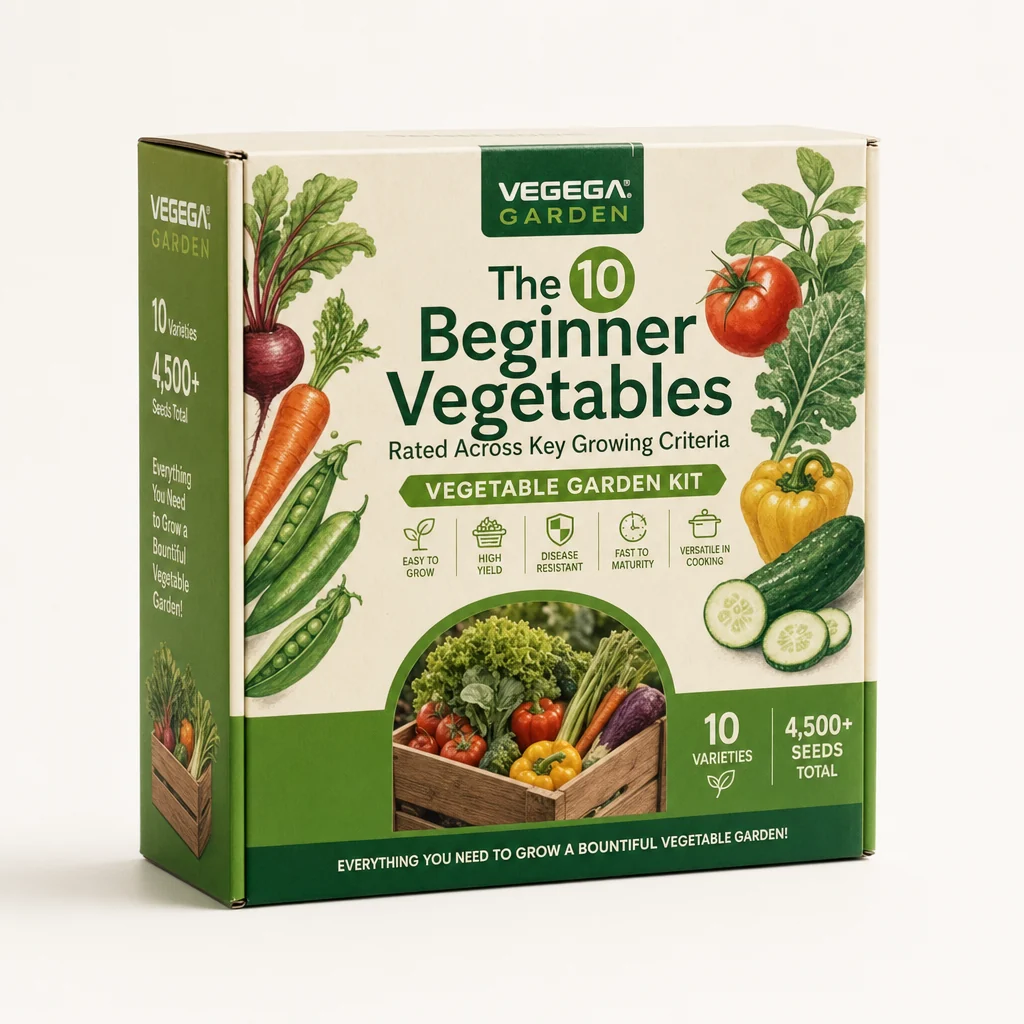
There is no universal "easiest vegetable", because a sheltered patio in Cornwall and a windy garden in northern England are not quite the same proposition. Still, some crops repeatedly appear in beginner recommendations for a reason. The guide below is a practical starting point rather than a legal contract with nature.
The difficulty scores are relative. A rating of one out of five does not mean the vegetable will materialise uninvited beside the compost bin. It means the crop is especially tolerant and straightforward compared with the others here. A three is still beginner-friendly; it simply has one extra moving part, such as support, space or a little patience.
Difficulty: 1/5
Difficulty: 1/5
Difficulty: 2/5
Difficulty: 2/5
Difficulty: 2/5
Difficulty: 2/5
Difficulty: 2/5
Difficulty: 3/5
Radishes sit at the front of the queue because they can mature in as little as three to four weeks. Lettuce follows closely, with crops ready in roughly four to six weeks. They are the immediate-gratification department of vegetable gardening, which is useful when you are staring at a tray of compost and wondering whether anything is actually happening.
At the other end, garlic is a long game, taking around nine months from autumn planting to summer harvest. Yet it remains beginner-friendly because the work is largely front-loaded: plant individual cloves, keep an occasional eye on conditions, then wait. It is less "fast" and more "pleasantly undemanding".
Growing method matters too. Radishes, lettuce, spring onions and beetroot are sensible choices for containers. Potatoes can work in a suitable growing space, whilst courgettes are much happier when given room to spread. Runner beans use height brilliantly, making them a strong option where floor space is limited but a support can be added.
"Succession sowing" simply means sowing a small amount again after an interval, rather than planting every seed at once. It is one of the least glamorous habits in gardening and one of the most useful. A small, steady harvest beats a single heroic lettuce mountain.
Radishes & Lettuce: The Fastest Wins in Your Growing Calendar
If you need early proof that gardening is not an elaborate prank, start here. Radishes can mature in as little as three to four weeks from sowing. Lettuce can be harvested in around four to six weeks. Those figures matter because the first few weeks of a new garden can feel very quiet. You water bare soil, peer at it hopefully and develop a surprisingly intense relationship with a weather forecast.
Radishes are often described as the absolute easiest plant to grow and, rather wonderfully, as practically bomb-proof. That does not mean every radish will be flawless. Roots may vary in size; a missed harvest can leave them tougher than you hoped. But as an introduction to sowing, watering and harvesting, they are difficult to beat.
They are also mercifully compact. A modest container or a slim strip at the front of a bed can accommodate them, and they do not demand the kind of space that makes you start redrawing the garden. Radishes tolerate ordinary conditions well, can be grown with some partial shade, and do not need an elaborate maintenance schedule once established.
Fast enough to hold your attention
A three-to-four-week route from sowing to possible harvest is an excellent confidence-builder. It is gardening with a brisker pace than most.
Comfortable in small spaces
Radishes and lettuces suit containers as well as beds, which makes them useful for patios, balconies and gardens where the lawn is still stubbornly occupying the best real estate.
Ideal for repeat sowing
Radishes can be sown from March through to September. Sowing a little every two to three weeks helps avoid a glut and gives you a continuing run of roots.
That repeat-sowing habit is worth learning early. It is sometimes muddled up with "cut-and-come-again", but they are not quite the same thing. Succession sowing is about making fresh sowings at intervals. Cut-and-come-again is a harvesting approach more closely associated with leafy salads, where you take a few leaves and leave the plant to continue. Both prevent the familiar beginner mistake of producing forty portions of the same thing on one glorious Tuesday.
Lettuce is the friendlier leafy crop for most first-time growers. You are not waiting for a hidden root to swell or a fruit to ripen; you can watch leaves appear and judge their usefulness as they grow. Regular picking can keep loose-leaf types productive, whilst a few plants started in sequence can make salads feel far less expensive and considerably less sad.
The limitation is water. Leafy crops are forgiving in many respects, but dry compost is not their favourite personality trait. Containers especially need checking in warm spells. The solution is not a complicated irrigation system involving pipes, timers and a suspiciously expensive trip to the garden centre. It is simply looking at the soil regularly and watering when it is drying out.
Pick before perfection becomes a problem
Harvest radishes when they are young rather than waiting for a mythical competition-sized specimen. With lettuce, pick leaves regularly once there is enough to spare. New gardeners often wait too long because the crop looks too nice to disturb. The whole point, rather inconveniently for the plant, is to eat it.
For a first container project, a small run of radishes beside a few lettuces is hard to improve on. They occupy little space, respond visibly to care and give you something to put on a plate before the season feels fully underway. That first home-grown crunch is a convincing argument for carrying on.
Courgettes & Green Beans: The Overachievers of the Beginner Patch
Courgettes are the overachievers of the vegetable plot. Give one a suitable position and it can grow with startling enthusiasm, producing more than a household had emotionally prepared for. There is a reason gardeners become oddly insistent when offering courgettes to visitors in July and August. One healthy plant can deliver a steady stream of squash, and the difference between "useful" and "why is every meal now green?" can arrive quickly.
That abundance is precisely why courgettes are excellent for beginners. Their large seeds are approachable to handle, the plants are robust, and even a plant that has not received museum-quality attention can produce an impressive harvest. You can see the plant developing. You can see the flowers. You can see the courgettes forming. Nothing is especially cryptic.
In the UK, a common route is to start courgettes indoors in April, harden them off during May and plant outside after the last frost. That is typically late May in southern England and early June further north. The date is less important than the condition: tender plants and frost do not have a productive working relationship. If conditions still feel chilly, patience is the better tool.
Why courgettes work
- Large, easy-to-handle seeds make sowing feel straightforward.
- Vigorous plants offer visible progress and generous harvest potential.
- A single productive plant can provide repeated picking through summer.
- They are immensely satisfying when you want a crop with presence.
What to plan for
- Courgettes need room; they are not shy little salad plants.
- Regular harvesting matters if you want manageable fruits.
- They are tender, so planting outside too early can set them back.
- One plant may be plenty for a small household.
Green beans offer a different sort of beginner reward. They are routinely recommended because they can produce sizeable harvests with relatively little maintenance. Bush forms keep their ambitions close to the ground, whilst climbing forms make use of supports and turn a simple frame into a living screen. Either way, beans teach a valuable lesson: regular picking usually encourages a plant to keep producing.
There is a small practical distinction. Courgettes mostly ask for space and steady care. Beans ask for a little structure if you choose a climbing type. That structure need not be elaborate. A few canes, securely positioned, can do a remarkable amount of work. The plants are content to climb; you are merely giving them somewhere sensible to go instead of allowing them to make an exploratory journey across the path.
Keep harvests moving
With courgettes and beans, check plants often once they begin producing. This is not because they need constant fussing. It is because crops can move from ideal to enormous with impressive speed, particularly when you have not looked for three days.
Neither crop is quite as instant as a radish, but both reward beginners who want visible drama. The courgette becomes a substantial plant. The bean turns an ordinary cane frame into a green structure. That sense of transformation is part of the fun, and it makes the routine jobs feel considerably less like chores.
Potatoes & Beetroot: Underground Heroes for Low-Effort Harvests
Potatoes and beetroot share one inconvenience: their most exciting bit is underground. You cannot simply watch the harvest develop in the way you can with beans or lettuce. Yet that is also part of their charm. A potato harvest has a faintly treasure-hunt quality, especially for children and adults who are pretending not to enjoy it quite as much as they do.
Potatoes are a British allotment staple, and early varieties are widely described as trouble-free. Varieties including Swift, Rocket and Foremost can be ready to harvest in as little as 10 to 12 weeks. For a beginner, that combination of reliability and a fairly brisk timetable is persuasive. You plant something that looks like a slightly disappointing potato, then a few months later discover it has been quietly multiplying underground. Quite clever, really.
The usual starting point is certified seed potatoes rather than supermarket potatoes. In February or March, they can be chitted: placed in a cool, light position to allow shoots to form. In March or April, plant them around 12cm deep and 30cm apart. The numbers may sound precise, but this is not cabinetry. Make a sensible effort, and the plant is unlikely to respond with a formal complaint.
Then comes "earthing up", the phrase that makes a simple job sound as though it requires a diploma. It just means drawing soil up around emerging shoots every two to three weeks. This protects developing potatoes from light, which can cause greening. It takes minutes, and it is forgiving of imperfect technique. You are making a mound, not restoring a listed building.
Beetroot deserves more beginner attention than it sometimes receives. It is a great root vegetable to start with, useful in containers or beds and pleasingly productive. There is a small theatrical bonus here too: beetroot foliage has enough colour and shape to look good whilst it is doing its serious work below ground.
The sensible approach is to avoid treating every root as an all-or-nothing mystery. Harvesting one beetroot is allowed. You do not have to pull every plant on the same afternoon. Taking them as they reach a useful size makes room for the rest and gives you a longer harvesting period. The leaves can be used too, which is a tidy little return on the available space.
Potatoes are especially rewarding if your aim is a substantial meal from a relatively uncomplicated crop. Beetroot is the more compact choice if you want a root vegetable without turning the entire garden over to it. Both are forgiving enough to teach good habits without punishing every small mistake.
The limitation with roots is patience. You need to resist repeatedly excavating them to check progress. It is tempting. It is also the gardening equivalent of opening the oven every ninety seconds to see if a cake is rising. Look after the foliage, follow the broad timetable and let the hidden bit get on with it.
Onions, Spring Onions & Garlic: The Maintenance-Free Allium Trio
Onions, spring onions and garlic are often grouped among the practically maintenance-free vegetables, and it is a claim that stands up well once you understand what "maintenance-free" really means. They still need planting, reasonable conditions and the occasional check. They simply do not demand an elaborate daily ritual or occupy your thoughts from breakfast until dusk.
Garlic is the calmest crop on this list. Plant individual cloves in autumn, generally October or November, give them occasional water when needed, and harvest the following July as foliage yellows. Once it is in the ground, there is not much to do. That makes it ideal for beginners who like the idea of growing food but do not necessarily wish to spend every Saturday speaking sternly to a seedling tray.
Hardneck varieties such as Christo and Chesnok Red are well suited to British conditions and are valued for flavour. The central lesson is simpler than the variety choice, though: use good planting cloves, give each one a proper position and let time do most of the work. Garlic is a crop for people who can plant in one season and enjoy a reveal in the next.
Garlic: plant once, wait well
An autumn planting and a summer harvest make garlic a useful long-term anchor in the vegetable garden. It brings a pleasing sense that next year's food has already begun.
Spring onions: a gentle introduction
Spring onions are straightforward, useful and pleasantly undemanding. They make sense for anyone who wants an allium crop without committing a large part of the garden to full-sized bulbs.
Onions: familiar and practical
Onions reward a patient approach. Their appeal is not spectacle; it is the quiet satisfaction of lifting something you use constantly in the kitchen.
Spring onions are the immediate-gratification member of this family. They take less room than bulb onions, fit neatly among other crops and are easy to use a few at a time. If a full row of onions sounds a little too committed for your first season, spring onions are a softer landing.
Bulb onions have a longer horizon, but they are still a practical beginner crop. Their simple, upright form makes them easy to accommodate around the edges of a bed. They do not sprawl, climb or attempt to colonise the patio. In a busy first garden, that restraint is rather welcome.
Think of alliums as background reliability
Use garlic, onions or spring onions to give your garden a dependable backbone, then add fast crops such as radishes and lettuce around them. One group keeps the season moving; the other quietly occupies its space without requiring a committee meeting every week.
The chief beginner trap is impatience. Garlic needs months. Bulb onions are not a quick fix either. But they are an excellent reminder that gardening does not have to be frantic to be rewarding. Sometimes the best crop is the one that leaves you alone for a while.
Peas & Runner Beans: Britain's Favourite Climbing Duo
Peas and runner beans occupy a special place in British gardening. They are familiar, generous and deeply associated with vegetable patches, allotments and the annual reappearance of bamboo canes in garages across the country. Both are often described as low-effort, high-yield crops and good choices for new gardeners. Their secret is not magic. It is support.
Peas are a wonderfully direct crop. The seeds are easy to handle, young growth is easy to recognise, and the result is unmistakable. Few garden snacks compete with a freshly picked pea. The trouble is that the gardener is often competing with themselves: it is entirely possible for a significant part of the harvest to disappear before reaching the kitchen.
Runner beans are the more dramatic relative. They are a classic British allotment crop, prolific and forgiving, and can continue producing from midsummer into autumn when provided with a basic frame to climb. That productive run gives them real value in a beginner garden. You do one modest construction job early on, then enjoy the results over a long stretch of the season.
The simplest support is the wigwam. Push six to eight canes into the ground in a circle, angle them together and tie the tops. The finished frame is sturdy, space-efficient and pleasantly rustic. It does not need to look like an architectural landmark. The beans are much less concerned with symmetry than we are.
| Growing consideration | Peas | Runner beans | Green beans |
|---|---|---|---|
| Beginner appeal | Familiar crop with easy-to-handle seeds | Prolific, forgiving and traditionally popular | Reliable harvest potential with little maintenance |
| Space strategy | Uses support to grow upward | Excellent use of vertical space on a wigwam | Available in compact or climbing forms |
| Harvest style | Pick as pods are ready | Can produce from midsummer to autumn | Regular picking supports continued production |
| Most useful lesson | Freshness is the reward | Simple structures can do a lot | Keep an eye on crops once they begin producing |
There is a useful distinction between peas and runner beans. Peas feel delicate and special. You tend to eat them quickly, perhaps straight from the pod, and they are treasured because the home-grown flavour is so immediate. Runner beans feel more industrial in the best sense: they can provide repeated meals and make a vertical support earn its place.
Both need you to think upward. That is not a drawback; it is a design opportunity. A climber lets a small garden produce more without filling every square foot of soil. It can screen a boundary, soften a fence or make a bare patch feel purposeful. In a compact space, that is a handsome return for a handful of canes.
Build the support first
Put canes or other supports in place before climbing plants need them. It is easier on you and kinder to the roots. Trying to thread supports through a determined young plant later is possible, but it is not a relaxing way to spend an afternoon.
For beginners, runner beans are perhaps the most visually satisfying choice on the list. They take a modest frame and make it look alive. Peas are the better option if you value eating a small, exquisite harvest directly from the garden. There is no wrong choice, apart from planting a climber with nothing to climb and then acting surprised when it becomes unruly.
A Low-Stress First-Season Plan That Actually Fits Real Life
The easiest vegetables become considerably easier when the whole garden is not trying to peak at once. A first season works best when you combine one or two quick crops with something that occupies a longer stretch of time. The aim is not to prove your stamina. It is to create enough success that you want to do it again.
A very workable starting collection is radishes, lettuce, a courgette, early potatoes and either peas or runner beans. That gives you a quick harvest, leaves to pick, a high-producing summer crop, something underground and a climber. Add garlic in autumn if you fancy beginning next year before this year has entirely finished.
Patio or balcony growers
Prioritise radishes, lettuce, spring onions, beetroot and compact beans. Containers make the most sense where soil is limited.
Small garden households
Pair salads and roots with one courgette and a climbing crop. You get variety without giving every spare inch to vegetables.
New allotment holders
Use potatoes, runner beans, onions and garlic as dependable foundations, then sow radishes and lettuce for early encouragement.
Watering is the routine that deserves the most attention, particularly for containers. Soil in a bed usually stays moist longer than compost in a pot, and a warm or breezy day can dry a container quickly. The answer is observation rather than anxiety. Check the surface and the compost beneath it. If it is drying out, water thoroughly rather than merely flicking a decorative splash in the general direction of the plant.
Do not feel pressured to sow every packet at once. It is often better to sow a little, wait, then sow more. Radishes are especially useful for this from March to September, with a small sowing every two to three weeks providing a more continuous harvest. Lettuce can follow the same common-sense principle: manageable batches are easier to use and easier to care for.
Finally, harvest. This sounds obvious, but it is an actual skill. Courgettes, beans, radishes and salad leaves are at their most useful when picked regularly. Gardening rewards attention, but not necessarily the heroic sort. Five minutes with a basket a couple of times a week often does more good than a grand three-hour inspection once a month.
A beginner garden does not need to be tidy to be successful. It only needs to be workable. Leave enough room to reach plants, label what you sow and accept that some experiments will be less triumphant than others. Every experienced gardener has planted something in the wrong place. Usually more than once.
Beginner Vegetable Gardening Questions, Answered
Radishes are the obvious first choice if you want speed, with potential harvests in as little as three to four weeks. Lettuce is equally approachable and gives useful leaves in around four to six weeks. If you want one crop that feels more substantial, try early potatoes or a single courgette.
Absolutely. Radishes, lettuce, spring onions and beetroot suit containers well. Peas and beans can grow vertically with a support, whilst a single courgette may work where there is enough room. The important thing is to choose crops that suit the space rather than trying to recreate a full allotment on a paving slab.
Radishes are fast, which means harvesting timing matters. Keep sowings small and regular, and harvest when roots are young and useful rather than leaving them indefinitely. The benefit of succession sowing is that a disappointing batch does not represent your entire radish year.
For many households, one well-placed plant is enough to begin with. Courgettes are vigorous and can produce more than expected through July and August. Add a second only if you have the room and a clear plan for a lot of courgette dinners.
No. The support is a small early job with a large payoff. A circle of six to eight canes tied together at the top makes a straightforward wigwam, and the beans do the visually impressive part from there.
It is not quick, but it is simple. Plant cloves in October or November, water occasionally and harvest around the following July when leaves yellow. It is an excellent crop for learning that low effort and fast results are not always the same thing.
The GardenScout Verdict
The simplest route into vegetable gardening is not buying more equipment or memorising every detail of a planting calendar. It is choosing forgiving crops. Radishes and lettuce provide quick wins. Courgettes and beans provide abundance. Potatoes and beetroot make underground growing feel wonderfully worthwhile. Onions, spring onions and garlic offer calm reliability, whilst peas and runner beans bring height, colour and a bit of British garden tradition.
Start modestly. Sow in manageable amounts. Pick things when they are ready rather than waiting for perfection. And remember that a slightly wonky radish grown by you is much more satisfying than a flawless one that has never seen your garden. That is not sentimentality. Well, not entirely.