
What Vegetables Should You Plant Each Month? A Complete UK Growing Calendar
A practical month-by-month guide to sowing, planting and planning vegetables around Britain's awkwardly brilliant growing season.

Your Month-by-Month UK Vegetable Growing Calendar: What to Plant & When
A vegetable calendar looks wonderfully decisive on paper. January: sow this. May: plant that. August: harvest everything and become the sort of person who casually gives away courgettes at the school gate. In a British garden, however, the calendar is best treated as a very useful map rather than a stern instruction manual.
Our growing season is short, changeable and occasionally theatrical. A mild week can have you reaching for seed trays in February, then a sharp frost arrives and reminds everybody who is actually in charge. Depending on where you garden, the frost-free season can span roughly seven to nine months. That difference matters. A gardener in Cornwall may be planting tender crops whilst a gardener in Scotland is still watching the forecast with narrowed eyes.
For practical planning, it helps to think of the UK in three broad climate bands. Scotland and much of northern England sit broadly in USDA-equivalent Zones 7 to 8. The Midlands and Wales are generally comparable with Zones 8 to 9. Southern England and Cornwall can fall within Zones 9 to 10. These are not magic boundaries; a sheltered city courtyard, coastal plot or south-facing wall can create its own tiny climate. Equally, a windy exposed allotment can make a mockery of the postcode.
Zone 7–8
Zone 8–9
Zone 9–10
not dates alone
the timetable
This guide uses the familiar UK growing rhythm reflected in RHS advice: start slow, accelerate hard from March, protect tender plants until frost risk has passed, then keep sowing when everyone else is busy admiring their tomatoes. The last part is the one people miss. A productive vegetable patch is not created by one heroic weekend in spring. It is a relay race.
The rule that saves the most disappointment
Check soil warmth and the forecast before following any date on a packet. Seeds do not know it is April. They only know whether the compost is warm enough, wet enough and likely to stay that way.
Use this calendar in layers. Gardeners in the south can often work towards the earlier end of a stated window. In colder northern gardens, exposed sites and frost pockets, aim later or start plants under cover. That is not falling behind. It is sensible gardening.
January: Seed Catalogues, Soil Prep & The First Brave Sowings
January is not the month for charging outside with a packet of carrot seed and blind optimism. Across much of the UK, average soil temperature sits around 2–5°C. That is simply too cold for most direct sowing. The ground may be waterlogged, frozen, or both in quick succession. Your main outdoor job is to avoid compacting it by walking all over it whilst trying to feel productive.
That does not make January a gardening dead zone. Far from it. It is the month for planning the plot, sorting seeds into vaguely sensible groups, checking what actually happened last year and deciding whether you truly need six varieties of courgette. You do not. One or two plants will very likely make their feelings known by July.
The first sowings are possible under cover. Broad beans can be started in pots in an unheated greenhouse. Onion sets can be started in module trays indoors. If you want chillies or peppers, January is the serious starting point, provided you have a heated propagator capable of holding 18–25°C. These are not crops that appreciate a chilly windowsill and a hopeful speech.
Plan before you sow
Map where tall crops, brassicas, roots and tender plants will go. Rotation and spacing are much easier to solve now than when the beds are full and you are balancing a tray of seedlings on one knee.
Start broad beans under cover
Broad beans are among the practical January candidates when raised in pots inside an unheated greenhouse rather than placed directly into cold winter soil.
Give peppers and chillies real heat
They need 18–25°C for propagation. Without that warmth, early sowing becomes an extended lesson in waiting rather than a head start.
Chillies deserve special treatment because they need the longest growing season of any common UK vegetable crop: up to 200 days. That is a very long runway in a country where summer can occasionally feel like an administrative error. Starting early gives plants time to grow, flower and set fruit before autumn light fades.
January is pepper month
If you can provide steady heat, chillies and peppers are the January sowing worth prioritising. Delay them too long and they may still make attractive plants, but the chance of a worthwhile crop narrows sharply.
For everything else, prepare rather than force the issue. Clean pots and trays, make room under cover, order missing seed and assess whether your compost has stayed dry. A tidy start is not glamorous, admittedly. But neither is explaining in May why the labels have disappeared and every tray appears to contain either lettuce or mystery weeds.
February: The Propagator Fills Up — Leeks, Salads & Early Tomatoes
February is when the year begins to feel possible again. Daylight rises from roughly 8.5 hours to 10.5 hours across the month, which is a meaningful change for both plants and gardeners. Seed trays start appearing on windowsills. The propagator gets crowded. You begin speaking about "the tomato situation" as though it is a major infrastructure project.
This is the official start of the main sowing season for many UK growers, but it remains chiefly an under-cover month. Warmth-loving crops can be started with heat of 18°C or above. Tomatoes are the headline act, including familiar choices such as 'Gardener's Delight' and 'Moneymaker'. Aubergines, celery, celeriac and leeks also belong in the February plan when you can provide suitable protected conditions.
10.5 hours
'Moneymaker'
peas, broad beans
cold frame
for small seeds
In an unheated greenhouse or cold frame, the list becomes more forgiving. Broad beans, early lettuce such as 'Little Gem' and 'Webbs Wonderful', spinach and round-seeded peas such as 'Feltham First' are all suitable candidates. The important distinction is that these crops tolerate cool beginnings better; they are not being asked to pretend an unheated greenhouse is the Costa del Sol.
Do not confuse light with heat
February offers more daylight, not automatic outdoor warmth. Tomatoes, aubergines and celery need warmth to start well. Lettuce, spinach, peas and broad beans are the more sensible choices for cool protected space.
Leeks are a particularly useful February sowing. They take their time, which is really their whole personality. Start them early enough and you can raise sturdy seedlings for planting out later in the season. Celery and celeriac likewise reward a long lead-in, although they are less tolerant of rough treatment than leeks. Give them steady conditions and avoid turning their early life into a series of dramatic temperature changes.
Keep sowings modest. A greenhouse bench can look very empty one afternoon and impossibly full three weeks later. Label everything as you go, including varieties that you are absolutely certain you will remember. You will not remember. Nobody does.
March: The Growing Season Ignites — 20+ Vegetables Now on the Planting List
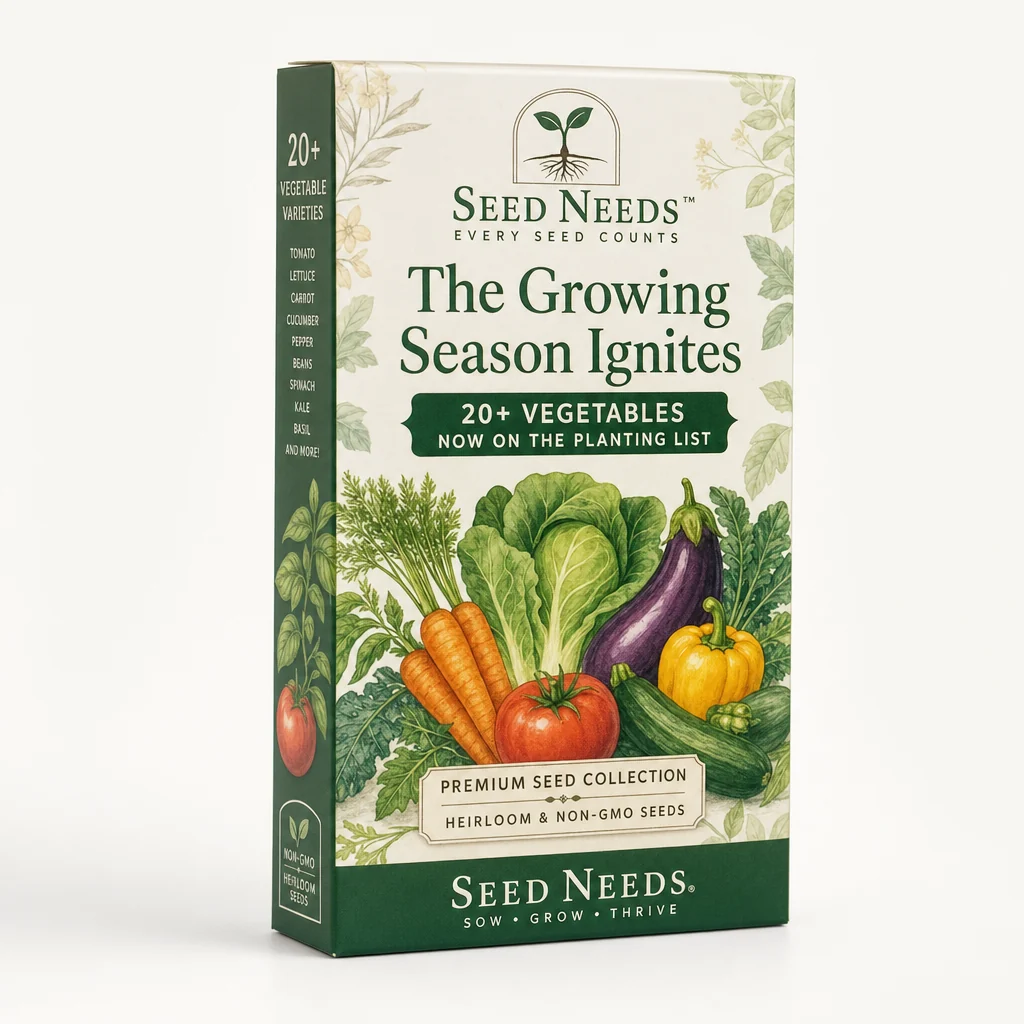
March is the busiest sowing month in the UK calendar. The RHS lists more than 20 vegetable types suitable for March sowing, and it is easy to see why. Light levels are improving, the garden starts drying out in the better moments, and there is finally a credible mix of crops for indoors, under cover and direct sowing outside.
This is also the month when restraint becomes useful. A sunny weekend can make every bed look ready. It may not be. For direct sowing, wait until a south-facing bed has reached at least 7°C and is workable rather than cold, claggy and compacted. The aim is a clean, quick germination. Seeds that sit in unsuitable soil do not earn a medal for bravery.
Once the conditions are right, early carrots such as 'Amsterdam Forcing 3', parsnips, beetroot, radishes, turnips, spring onions and peas can move onto the outdoor list. This is the beginning of the classic roots-and-salads phase: satisfying, relatively fast in the case of radishes, and a useful way of getting beds producing before the tender crops arrive.
Under cover or indoors, March is a major month for tender crops that need a head start. Cucumbers, courgettes, squash, sweetcorn, French beans and runner beans are all candidates. Their outdoor germination requirements sit around 12–15°C, which is why pretending they can simply be sown into a cold March bed is usually a poor bargain. Starting them indoors means they are ready to move once the weather catches up.
| March crop group | Best starting place | Examples | What decides the move outside? |
|---|---|---|---|
| Early roots and alliums | Outdoor bed when soil is workable | Carrots, parsnips, beetroot, radishes, turnips, spring onions | South-facing soil at 7°C or above |
| Cool-season legumes | Outdoor bed or protected start | Peas and broad beans | Conditions rather than a fixed calendar date |
| Warm-season fruiting crops | Indoors or under cover | Cucumbers, courgettes, squash and sweetcorn | They need 12–15°C soil to germinate outdoors |
| Tender beans | Indoors or under cover | French beans and runner beans | Wait for reliably warmer soil and no frost risk |
Carrots and parsnips reward attention to the seedbed. Fine seed needs close contact with the soil, not a lumpy obstacle course of clods and stones. Radishes are an easy confidence-builder and can help mark rows where slower crops are still deciding whether they fancy appearing. Beetroot, turnips and spring onions broaden the early harvest menu without needing tropical conditions.
March's common mistake
Starting tender crops outdoors because the air feels pleasant for an afternoon. Germination depends on soil temperature, and warm days do not instantly heat a cold bed. Start warm-season crops under cover instead.
If your March sowing list looks ambitious, split it into batches. A small succession of radishes, beetroot, peas and salad crops is more useful than a single enormous sowing that all matures in one slightly overwhelming fortnight. The vegetable patch should feed you for months, not stage one very brief vegetable festival.
April: Transplanting Begins & The Polytunnel Comes Into Its Own
April feels like full spring, although the soil is still catching up. Average UK soil temperatures are around 8–12°C depending on region. By the middle of the month, many southern gardens cross the useful 10°C threshold for a wider range of crops. Northern and exposed gardens may take longer. This is why the same packet can produce wildly different results in two gardens that are only a few counties apart.
Transplanting begins in earnest, but hardening off matters. Seedlings raised indoors have lived a soft life: even temperatures, no wind and no cold rain driving sideways under the tray lid. Moving them straight into an outdoor bed is less "planting out" and more "sending them on a survival course". Introduce them gradually to outside conditions before they take up permanent residence.
April is a sensible time to plant onion sets if you have not already done so; it is also the final realistic chance in this calendar. Leek seedlings, February-sown brassica seedlings, lettuce and spinach can be planted out once they are ready and the site is suitable. A polytunnel, greenhouse or cold frame is particularly useful now because it provides a buffer between tender young plants and the unpredictable wider garden.
Hardening off is not optional fussing. Take protected seedlings outside for gradually longer periods before planting. April sunshine can be pleasant, but wind and overnight cold are often the bigger shock to young plants.
Onion sets: use the window
April is the final chance to get onion sets planted in this seasonal plan. Choose a workable bed rather than trying to force them into saturated ground.
Beetroot: sow in succession
Sow every two to three weeks through to July for a more continuous harvest. It is a small habit that makes a large difference to how useful the crop feels.
Keep cool crops moving
Continue with spring onions, salad leaves, peas, broad beans, turnips and Swiss chard. These crops keep the garden productive whilst tender plants wait for warmer nights.
Outdoor sowing continues with beetroot, spring onions, salad leaves, peas, broad beans, turnips and Swiss chard. Beetroot is especially valuable for succession sowing every two to three weeks through July. The rhythm prevents the familiar feast-or-famine problem: a mountain of roots ready at once, followed by a bed containing nothing except old labels and regret.
April's temperature threshold
For many warm-season crops, 10°C is a meaningful soil milestone. Southern gardens may reach it by mid-April, but do not assume the same timing in colder areas. A protected space gives you useful breathing room.
April is also a useful month for checking the shape of your year. Have you left room for summer crops? Do you know where the winter brassicas will go? Have you planned a route through the plot that does not require stepping on a freshly prepared bed? Little decisions now prevent the chaotic version of May, when every plant suddenly appears ready at once.
May: The Last Frost Passes — Time to Plant Tender Crops Outside
May is the pivot point. The garden changes from a place of protected promise into somewhere that begins to look properly productive. For much of England, the last week of May is traditionally treated as the safer point for planting out tender crops, after the last significant frost risk. The old gardening shorthand is not a guarantee, because weather is weather, but it is a useful marker.
Once the frost threat has passed, tomatoes, courgettes, squash, cucumbers, French beans, sweetcorn and basil can go outside. Tomatoes are usually happiest in a greenhouse or a sheltered sunny position. Cucumbers benefit from a protected spot or a south-facing wall. Courgettes and squash need room, which is a polite way of saying they will attempt to colonise nearby territory if given the chance.
Why May planting works
- Tender crops can finally use outdoor space after frost risk passes.
- Long-started plants gain light and room when they need it most.
- Warm-season crops can be grouped by their need for sun and shelter.
What can still go wrong
- Late frosts remain possible, particularly outside milder southern sites.
- Unhardened seedlings can suffer from wind and temperature shock.
- A single warm day does not mean cold nights have finished.
Sweetcorn deserves one very specific instruction: plant it in blocks, not a long single row. It relies on wind pollination, so a block gives pollen a much better chance of reaching the silks. Aim for a minimum 4 × 4 grid, with plants spaced 35–45cm apart. Fewer than 16 plants risks poor cob set. This is one of those pieces of advice that sounds fussy until you see a poorly filled cob. Then it sounds like excellent advice.
Do not rush every crop out at the same moment simply because the date has changed. A sheltered south-facing wall, greenhouse, raised bed or urban garden may offer more warmth than an open plot. Equally, a cold hollow can hold frost after nearby gardens are clear. Use the calendar as your cue to assess the garden, not as a legal obligation to plant basil into a freezing wind.
June: Peak Sowing Month for Winter Harvests — Don't Miss These Deadlines
June is glorious, busy and deceptively important. By now, many gardeners are focused on growth, watering and the first proper harvests. That is understandable. It is also exactly why winter crops get missed. The beds look full, the weather is pleasant, and the thought of sowing something for February seems faintly absurd. Yet June contains some of the most time-critical sowing deadlines in the entire calendar.
Winter brassicas, including kale, purple sprouting broccoli and savoy cabbage, should be sown by mid-June if you want to preserve the winter harvest window. These crops need time to establish properly before colder, darker conditions slow them down. Miss that point and you do not merely delay the harvest a little; you can lose the practical window altogether.
Purple sprouting broccoli is the classic example. Sow it in June, transplant in July or August, then harvest from February to April. That is a nine- to ten-month growing cycle. It asks for patience, certainly, but it pays you during the "hungry gap", when the stored winter crops are dwindling and new spring sowings are still more promise than produce.
June's deadline crop
For winter brassicas, especially kale, savoy cabbage and purple sprouting broccoli, mid-June is a serious sowing deadline. Put it in the diary before summer gardening gets too distracting.
Purple sprouting broccoli
Sow in June, transplant in July or August, then harvest from February to April. Its nine- to ten-month cycle is long, but its timing is exactly what makes it valuable.
Kale and savoy cabbage
These winter brassicas belong in the mid-June deadline group if you want them positioned for winter production rather than left trying to establish too late.
Think beyond summer
Use June to reserve growing space for crops that will occupy beds after tomatoes, beans and courgettes become the centre of attention.
Winter gardening starts in summer. It feels counter-intuitive because June is warm and abundant, but crops for December to March need their head start now. The calendar is always working several seasons ahead.
June is also a good moment to keep your succession habit alive. Beds can look deceptively occupied by young plants that will be finished before late summer. Note the gaps that are coming. The gardener who plans replacement crops while harvesting is usually the gardener with food in the plot for longer.
July & August: Harvest Season Peaks — But Sowing Autumn Crops Is Urgent
July and August are the months that make all the earlier tray-washing, label-writing and forecast-checking feel worthwhile. Warm-season crops start to earn their space. Garlic is ready to lift once its foliage is around 50% yellow. First early potatoes can be ready 10–12 weeks after planting. Courgettes become astonishingly productive, especially if harvested every two to three days. In southern England, the first outdoor tomatoes may begin to arrive too.
It is tempting to treat this period as harvest-only time. That would be a mistake. July and August are also urgent months for autumn and winter sowing. The day length is already shortening, even if it does not feel like it when you are carrying a bucket of beans around in the heat. Crops sown now have enough light and warmth to establish before autumn becomes more demanding.
| July and August task | Crop or milestone | Timing guide | Why it matters |
|---|---|---|---|
| Lift | Garlic | When foliage is around 50% yellow | Gives a clear visual cue instead of harvesting by guesswork |
| Check | First early potatoes | About 10–12 weeks after planting | Helps time an early summer crop |
| Pick repeatedly | Courgettes | Every 2–3 days | Keeps plants productive and prevents surprise marrow incidents |
| Sow for next season | Spring cabbage | Sow now; transplant in September | Sets up harvests in April–May |
| Sow for autumn | Turnips, winter salads, land cress and corn salad | July sowing window | Extends production after summer crops slow down |
Spring cabbage is the standout July deadline crop. Sow it now, transplant in September, and it is positioned to harvest in April and May. It is another example of how a calendar turns a patch from a summer-only project into a year-round food source. You are planting spring food while still finding courgettes in unexpected places. Gardening does enjoy a long game.
Turnips for autumn use, winter salad leaves, land cress and corn salad, also known as mâche, should join the July sowing list. These are useful crops precisely because they shift your attention away from the peak-summer mindset. Instead of assuming the season ends when tomatoes fade, you are building a second act.
August carries the same double workload: pick what is ready and keep space moving into the next crop. If beds clear, do not leave them empty by default. Think about whether an autumn salad, late turnip or winter crop can follow. The exact crop choice depends on your location and protection, but the principle is universal: productive ground should always have a next job.
September to December: Keep the Patch Working, Then Reset It Properly
By September, the garden has entered a different rhythm. The heat and long days of high summer are gone, but the vegetable year is not over. This is where the sowings made in June and July begin to show their value. Winter brassicas are establishing, spring cabbage is ready for its September transplanting stage, and later salad sowings can make a surprising difference to what is available close to the kitchen.
The central job is to protect momentum. Harvest regularly. Clear crops once they are truly finished. Keep an eye on the winter brassicas that were sown by mid-June, because their long season is now well underway. Purple sprouting broccoli, for example, has months still to run before its February-to-April harvest window. It is not a crop for impatient gardeners, but that is the point: it is quietly doing useful work while the rest of the plot winds down.
September is also the month to transplant July-sown spring cabbage. Its eventual April-to-May harvest is far enough away that it can feel abstract. Plant it anyway. Future-you will be extremely pleased to find a crop waiting when the spring patch is otherwise still assembling itself.
Small-garden growers
Use the calendar to replace finished crops quickly. A compact patch benefits most when every bed has a next purpose.
Busy households
Prioritise repeat harvests and clear deadlines: courgettes every few days, garlic at 50% yellow foliage, winter brassicas by mid-June.
Cooler-region gardeners
Lean into protected starts, delayed planting and local weather. The later end of every window is often the sensible end.
October through December are less about frantic sowing and more about maintenance, harvesting what is available, and making the next growing year easier. Remove spent plants, keep paths usable, and avoid damaging wet soil by treating beds as a shortcut. They are not. Wet ground remembers.
This quieter season is also where notes become invaluable. Which tomatoes earned their space? Did the sweetcorn block fill properly? Were the beetroot sowings too close together? Did you miss the June brassica deadline because you were distracted by a perfectly reasonable amount of strawberries? Write it down. A vegetable calendar becomes far more accurate once it includes your own plot's history.
Your best calendar is partly homemade
Use broad UK timing as the framework, then record the first and last frosts, the warmest beds, the wettest corners and the crops that performed well. After two or three seasons, that notebook is more useful than any generic date list.
Winter is not an absence of gardening. It is the planning layer beneath the visible work. Review what you harvested, decide which protected space mattered most, and prepare for January's first careful sowings. The cycle starts again sooner than it seems.
UK Vegetable Growing Calendar FAQs & Final Verdict
March is the busiest general sowing month, with more than 20 vegetable types suitable for sowing according to RHS guidance. But preparation begins in January and February, while tender crops often need protected starts before they can be planted outside in May.
January soil temperatures of around 2–5°C are too cold for most outdoor sowing. February is mainly an under-cover month too. Broad beans, early lettuce, spinach and round-seeded peas are better candidates for an unheated greenhouse or cold frame than tender crops.
After frost risk has passed. For much of England, the last week of May is traditionally considered the safer point for tender planting. In colder or exposed areas, wait longer if necessary and harden plants off first.
Sweetcorn depends on wind pollination. Plant in blocks rather than a single row, using at least a 4 × 4 grid. Space plants around 35–45cm apart; blocks smaller than 16 plants can result in poor cob set.
The mid-June deadline for winter brassicas. Kale, savoy cabbage and purple sprouting broccoli need this early start for the winter harvest period. Purple sprouting broccoli is especially long-term: sow in June, transplant in July or August, then harvest from February to April.
Use the later end of each planting window, take advantage of protected starts and let soil temperature guide direct sowing. Scotland and northern England broadly fall within USDA-equivalent Zones 7–8, so the practical season is often shorter than in southern England or Cornwall.
The GardenScout verdict
A complete UK vegetable calendar is not about cramming every crop into every month. It is about understanding the sequence. Start peppers and chillies early. Use February and March for protected sowing. Let soil warmth govern outdoor planting. Move tender crops out after frost risk has passed. Protect the June deadline for winter brassicas. Keep sowing in July and August whilst everyone else is distracted by harvest baskets.
The most successful vegetable gardens are not necessarily the biggest. They are the ones that keep moving: one crop finishing, another beginning, and a few well-timed sowings quietly setting up next season's dinner.