
Ride-On and Lawn Tractor Mowers: Do You Really Need One?
An honest look at the point where walking behind a mower stops being character-building and starts becoming a fairly poor use of a Saturday.
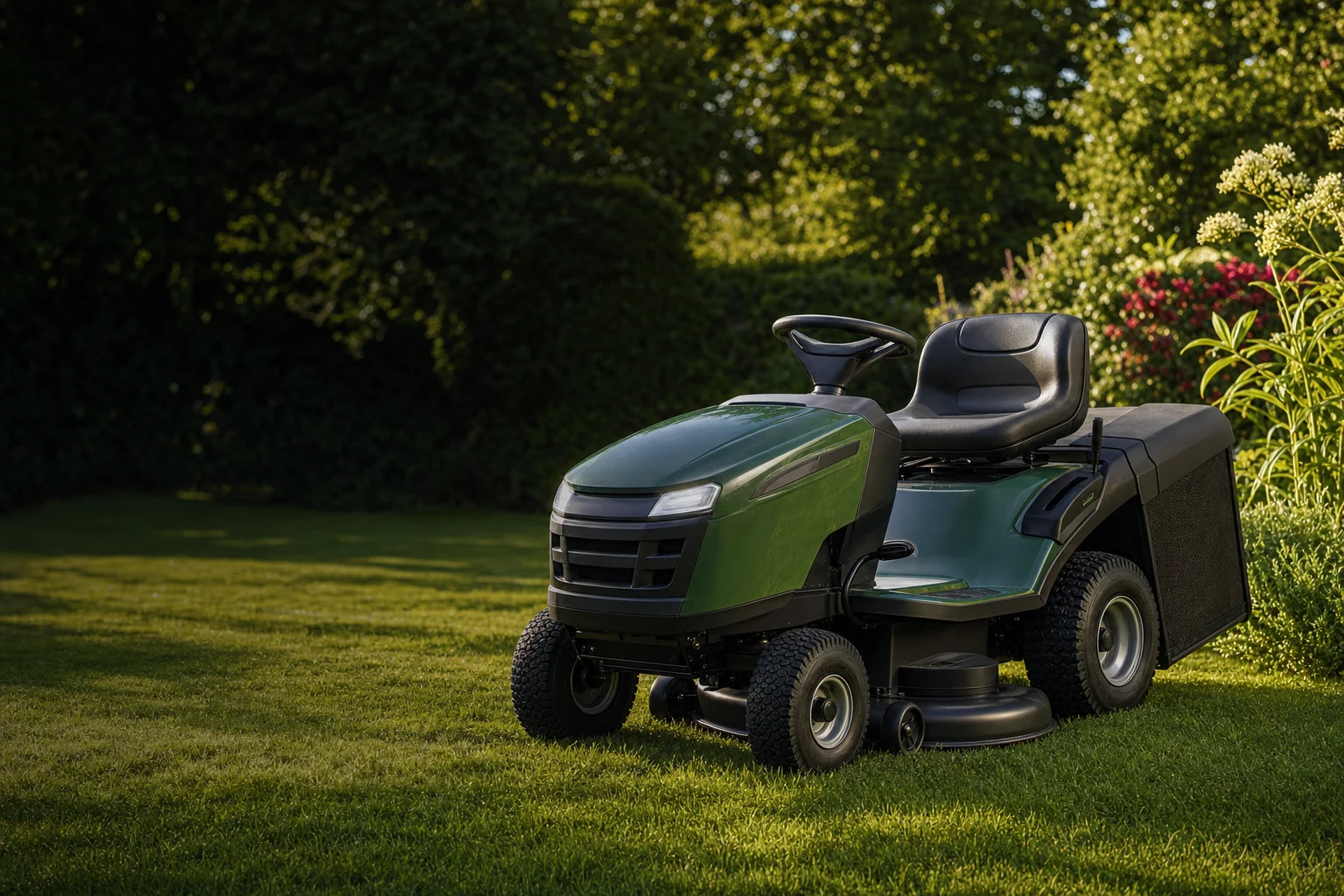
Do You Really Need a Ride-On Mower? The Honest Answer
There is a particular sort of garden problem that creeps up on you. At first, mowing takes an hour. Then a few borders are moved, a bit more lawn is laid, perhaps a paddock is brought into the routine, and suddenly the mower has become the most demanding member of the household. It wants attention every week, it does not care that it is raining, and it has no interest whatsoever in your plans for the afternoon.
A ride-on mower can be a brilliant solution. It can also be an expensive, bulky machine that spends most of its life taking up the space where you meant to store bicycles. The useful question is not "Would a ride-on be nice?" Of course it would. The useful question is whether it will genuinely reduce the work of managing your ground.
As a broad rule, gardens below roughly 0.2 hectares (0.5 acres) are still usually push-mower territory. A decent self-propelled mower is cheaper to buy, easier to store, simpler to maintain and often quicker where the lawn is broken into several fiddly pieces. A ride-on has to be fetched from the shed, manoeuvred out, and turned around at every tight corner. On a compact suburban plot, the supposed labour-saving can disappear rather quickly.
Between around 0.2 and 1.2 hectares (0.5 to 3 acres), the traditional lawn tractor starts to make a great deal of sense. This is its natural habitat: a substantial lawn, enough clear space to make wide passes worthwhile, and perhaps a cart of prunings or a rear collector to tow occasionally. It is the category for homeowners who want to mow comfortably, rather than establish a private contracting business.
Once you are caring for roughly 0.8 to 2 hectares (2 to 5 acres), you need to think beyond the label "ride-on". A garden tractor or zero-turn mower may be the more sensible tool, depending on whether the work is mainly mowing or a mixture of mowing and attachment jobs. Beyond 2 hectares (5 acres), particularly where rougher grass or paddocks are involved, paddock-grade kit or a towed mower begins to look more rational than asking a domestic lawn tractor to become a smallholding workhorse.
The threshold is time, not simply acreage
Two gardens of the same size can need entirely different machines. A clear, rectangular lawn rewards a wide deck and straightforward passes. A garden full of trees, beds, slopes, sheds and winding edges can make a smaller mower — or even a walk-behind machine — the quicker choice.
There are three names to untangle before spending anything: rear-engine riding mowers, lawn tractors and garden tractors. They are related, but they are not interchangeable. A rear-engine rider is mostly a sit-down mowing machine. A lawn tractor adds power, comfort and the ability to pull light attachments. A garden tractor is the heavy-duty member of the family, intended to work with implements as well as cut grass.
September is a very good time to assess whether your existing mower is coping. Growth may be easing as temperatures cool, but a wet autumn can still produce plenty of grass. Note how long a cut takes, where the machine bogs down, and whether storage and access are already awkward. Those answers matter far more than a glossy brochure photograph.
Ride-Ons, Lawn Tractors and Garden Tractors: Cutting Through the Jargon
"Ride-on" is a useful umbrella term, but it is not a purchasing category on its own. It simply means you sit on it. Within that broad family, machines vary enormously in what they are designed to do, how much ground they can cover comfortably and what they will tolerate being asked to pull.
Rear-engine riding mowers: the seated convenience option
A rear-engine riding mower is the smallest, simplest form of ride-on. As the name suggests, the engine sits behind the driver, and the machine's chief purpose is cutting grass. These models are less powerful and slower than lawn tractors, with a maximum cutting width of 76 cm (30 inches). They are best suited to grounds below around 0.2 hectares (0.5 acres).
That does not make them pointless. Far from it. They can be a welcome choice for somebody who finds walking a large lawn physically tiring, or who simply prefers to mow sitting down. But it is important not to mistake one for a compact tractor. It is not the machine to buy for pulling heavy implements, managing an unruly paddock or tackling years of neglected grass with heroic optimism. Machines tend to remember such optimism.
Lawn tractors: the useful middle ground
Lawn tractors are what most people picture when they say "ride-on mower". They are designed for larger lawns, generally in the 0.2 to 1.2 hectare (0.5 to 3 acre) bracket, and are built to pull lightweight attachments such as a rear bagger or small garden cart. The engine is positioned at the front, with the cutting deck underneath, and the driving position is arranged for longer mowing sessions.
The John Deere S130 and Cub Cadet XT1 LT50 both sit firmly in this category. Each uses a hydrostatic transmission, which means no conventional gear-changing routine: press the pedal, adjust speed smoothly and change direction without the usual agricultural dance involving clutch, lever and hopeful guesswork. For normal lawn care, that is a genuinely useful improvement rather than a gadget for its own sake.
A lawn tractor is still principally a mowing machine. It can tow a lightweight cart, and accessories can broaden its usefulness, but its transmission and frame are not intended for the more demanding implement work that defines a true garden tractor. If you need to cultivate, aerate substantial areas, move serious loads or use a broad range of powered attachments, buy for that reality rather than hoping a lawn tractor will grow into the role.
Garden tractors: when mowing is only one job on the list
Garden tractors have heavier-duty transmissions and are designed to work with a much wider range of attachments. They can accept mowing decks up to 183 cm (72 inches) wide, while their implement options can include tillers, aerators, seeders, snow throwers, front loaders and backhoes. That last list is a useful clue to the distinction. A garden tractor is a compact estate-management tool; it happens to mow as well.
The trade-off is cost, physical size and complexity. You need proper storage, sensible access and a real list of jobs for such a machine. Buying one solely because the idea appeals is rather like buying a horsebox for a Labrador. Magnificent, perhaps. Entirely excessive, almost certainly.
Rear-engine rider
Designed primarily to cut grass, with a maximum 76 cm (30 inch) cutting width. Best viewed as a comfort-led alternative to a walk-behind mower for smaller areas.
Lawn tractor
A larger-lawn specialist that combines mowing ability with light towing duties, such as a rear collector or small cart.
Garden tractor
The attachment-ready option, with a heavy-duty transmission intended for far more than regular lawn mowing.
| Type | Best fit | What it does well | Where it falls short |
|---|---|---|---|
| Rear-engine rider | Below 0.2 hectares (0.5 acres) | Turns mowing into a seated job; simple grass-cutting focus. | Lower power, slower progress and a maximum 76 cm (30 inch) cut width. |
| Lawn tractor | About 0.2–1.2 hectares (0.5–3 acres) | Larger lawns, longer sessions and lightweight towing jobs. | Not intended as a substitute for a heavy implement tractor. |
| Garden tractor | Large gardens, estates and mixed jobs | Heavy-duty transmission and compatibility with a broad implement range. | Needs space, a genuine workload and a more generous budget. |
John Deere S130: The Benchmark Lawn Tractor in Detail
The John Deere S130 is a sensible illustration of why lawn tractors remain popular. It has the familiar front-engine tractor shape, but its appeal is less about looking purposeful and more about making routine mowing less of an ordeal. It is widely regarded as a strong all-round choice, with a smooth ride, a tight turning circle and a maintenance approach that is unusually straightforward for a petrol machine.
Its 16.4 kW (22 hp) V-twin engine provides proper lawn-tractor power, while the 107 cm (42 inch) cutting deck keeps the overall machine at a size that is still plausible for many larger domestic gardens. That balance matters. A very wide deck is wonderful on an open field, but it can be downright annoying where you have narrow access, trees placed with the confidence of a previous owner, or borders that curve enthusiastically around the lawn.
(22 hp) V-twin
(42 in)
(17.7 in)
8.9 km/h
(2.4 US gal)
(462 lb)
The hydrostatic transmission is one of the S130's strongest practical features. John Deere uses a Kanzaki Tuff Torq hydrostatic unit, which allows an infinite choice of speeds and makes forward and reverse direction changes straightforward. In ordinary use, this means you can ease around a tree, reverse away from a border, then carry on without selecting a different gear. It sounds a small thing until you have spent an afternoon repeatedly stopping and starting an older geared mower.
The 0.45 m (17.7 inch) turning radius is another figure worth translating into garden life. It is not zero-turn performance — more on that shortly — but it is tight for a lawn tractor and useful around conventional obstacles. You will still leave uncut arcs around some trees and will still need to trim awkward edges separately. No ride-on entirely abolishes finishing work. But a tight turning radius can reduce the amount of looping, reversing and low-level muttering involved.
Storage deserves an unusually prominent place in this decision. The S130 has a transport length of 1.88 m, a transport width of 1.18 m and a transport height of 1.13 m. Measure the narrowest point of your route, not just the shed doorway. A mower may technically fit through a gate but still be miserable to manoeuvre through when you account for your hands on the steering wheel, a hedge leaning in, and the fact that gates rarely seem to open quite as far as they did when you measured them.
At 210 kg (462 lb), it is also not something you casually reposition by hand if it does not quite fit. A level, dry route between storage and lawn is a genuine quality-of-life feature. The same goes for a shed floor that can bear the machine, room to turn it before parking and enough clearance to carry out basic checks without crawling through a collection of spider webs. Gardening remains a glorious pastime, but storage is often where romance goes to die.
The 9.1 litre (2.4 US gallon) fuel tank is ample for extended domestic mowing, and the stated top travel speed is 8.9 km/h, with reverse travel up to 5.1 km/h. Its Easy Change 30-Second Oil Change System is designed to make oil-and-filter replacement less intimidating: the all-in-one unit is intended to be removed and installed in 30 seconds. That does not mean the rest of ownership is maintenance-free, of course. Blades, deck care, tyres, belts and safe cleaning still need attention. It does mean that one traditionally messy job is made less troublesome.
What works well
- 16.4 kW (22 hp) V-twin power suits substantial domestic lawns.
- Hydrostatic transmission makes speed and direction changes easy.
- 0.45 m (17.7 inch) turning radius is useful around ordinary garden obstacles.
- Easy Change oil system simplifies a key maintenance task.
- Covered by a two-year, 120-hour bumper-to-bumper warranty.
Points to consider
- Its 1.18 m transport width needs checking against every gate and storage route.
- A 107 cm (42 inch) deck is versatile, but not the fastest option for broad open acreage.
- At 210 kg (462 lb), storage position needs to be right from the outset.
- It remains a lawn tractor, rather than a heavy implement garden tractor.
Cub Cadet XT1 LT50: Power and Polish for Demanding Lawns
The Cub Cadet XT1 LT50 takes the conventional lawn-tractor idea and leans more firmly towards capacity. It has a 17.9 kW (24 hp), 747cc twin-cylinder Kohler engine and a 127 cm (50 inch) AeroForce fabricated deck. On paper, that is a modest step up from the S130. In a garden that regularly grows thick, damp or slightly over-enthusiastic grass, it can be a meaningful one.
The engine has 1.5 kW (2 hp) more output than the S130's 16.4 kW (22 hp) unit. Power figures should not be treated as a magic "better mower" score; deck design, grass conditions, maintenance and how ambitious you are with cutting height all matter. Still, the additional power gives more headroom when grass is longer, when mowing slopes, or when you want to keep a broad deck moving without constantly backing off the pace.
That wider deck is the headline difference. At 127 cm (50 inches), the XT1 LT50 cuts 20 cm (8 inches) more width on every pass than the 107 cm (42 inch) S130. In an open lawn where you can use the full width on repeated straight runs, that is a worthwhile gain. Turns, overlaps, obstacles and trimming do not disappear, but it explains why a broader deck begins to earn its keep on uncomplicated ground.
The AeroForce deck is fabricated and designed to deliver a premium cut with fine clippings, evenness and fewer clumps or stragglers. A fabricated deck is a welcome feature for anyone whose lawn is not a perfectly smooth bowling green. That said, the best way to preserve cut quality remains gloriously unglamorous: keep blades sharp, do not mow soaking wet grass if you can avoid it, and do not expect any machine to make a magnificent finish when asked to remove far too much height in one go.
Like the S130, the XT1 LT50 uses a hydrostatic transmission. There is no manual shifting routine; you press the pedal and go. This is especially welcome on a lawn with changing conditions, perhaps a gentle incline followed by a tighter ornamental area. The tractor also has a 38 cm (15 inch) adjustable high-back seat. For anyone mowing several acres, a proper seat is not indulgence. It is the difference between finishing the job and spending the next morning moving like a person who has been unexpectedly introduced to medieval farming.
The quoted turning radius is 41 cm (16 inches), a little tighter than the John Deere's 0.45 m (17.7 inches). Again, it is not a zero-turn machine. You will not pivot perfectly around a tree trunk. But the tighter figure is useful where your garden contains a handful of obstacles rather than a fully landscaped obstacle course.
The XT1 LT50 has an 11.36 litre (3 US gallon) fuel tank and is described as ideal for mowing 0.8 to 1.6 hectares (2 to 4 acres) of mostly flat terrain with a few obstacles. That "mostly flat" qualification deserves underlining. Slopes change the nature of mowing. They affect traction, stability, comfort and the sensible direction of travel. If hills are a defining feature of your land, do not assume that a bigger engine alone makes every situation suitable for a conventional lawn tractor.
(24 hp)
twin-cylinder
(50 in)
(16 in)
(3 US gal)
(15 in) high-back
The warranty package is reassuringly substantial: three years with no hour limit, a five-year frame warranty and a lifetime limited warranty on the fabricated deck shell. Warranty terms should never be your only reason for choosing a machine, but they do reveal where a manufacturer expects its product to hold up.
EGO Power+ ZT4214L: Has Battery Power Finally Come of Age?
Battery-powered garden machinery has spent years being described as "surprisingly good". It is a phrase that usually means "good, considering what it is". The more interesting development is that battery zero-turn riders are now capable of performing as well as petrol models, and in some situations better. The EGO Power+ ZT4214L belongs to that shift.
It is important to be clear about what makes this type of mower different. A zero-turn mower is steered through independently controlled drive wheels, allowing it to turn around its own footprint. In practical terms, its turning radius is theoretically zero. Compare that with the John Deere S130's 0.45 m (17.7 inch) turning radius or the Cub Cadet's 41 cm (16 inch) figure. Neither is poor; both are good for lawn tractors. But zero-turn steering changes how you work around trees, flower beds, washing lines, outbuildings and the idiosyncratic shapes found in most real gardens.
Instead of making a broad, looping turn at the end of each pass, a zero-turn mower can pivot and head straight back. Around obstacles, it can circle more closely and reduce the amount of grass left for a separate tidy-up. That is not merely about shaving minutes off the job. It can make mowing a complicated garden less tiring because there is less reversing, less lining up and less of that slightly absurd three-point turn beside the compost bins.
Battery power brings a different set of advantages. The obvious one is lower local emissions and a lower carbon footprint than a petrol equivalent. That matters increasingly in a country committed to reducing emissions, though it should not be used as a reason to buy an unnecessarily large machine. The greenest mower remains the one that suits the job, is maintained well and has a long useful life.
Noise is another major benefit. A quieter machine will be appreciated in suburban settings, near neighbouring gardens and anywhere you would rather mow without announcing your presence to three streets at once. Quieter does not mean silent: blades cutting grass still make noise, and normal consideration around neighbours remains essential. But the difference in engine sound can be striking, especially during the shoulder seasons when windows are open and every hedge seems to have acquired a person working from home behind it.
There is also no petrol to store. That means no fuel can sitting in the shed, no stale petrol worries after a quiet winter and no possibility of knocking a can over whilst reaching for the rake. Maintenance is generally reduced too, because there is no engine oil to change and fewer petrol-engine service tasks. The mower still needs care: blades need inspecting and sharpening, the deck needs cleaning, tyres and steering components still deserve attention, and batteries need sensible charging and storage. Battery machinery is lower maintenance, not no-maintenance. Nothing with grass clippings involved ever is.
Why battery zero-turns appeal
- True zero-turn ability is exceptionally useful around trees, beds and awkward garden shapes.
- Quieter operation is a real advantage in built-up areas.
- No petrol storage requirement.
- Reduced maintenance compared with a petrol engine.
- Battery power can match petrol performance in this class.
Reasons to pause
- Zero-turn steering has a learning curve if you have only driven conventional tractors.
- The mowing route still needs planning around slopes, wet ground and obstacles.
- Battery charging needs to fit your mowing routine and storage setup.
- A zero-turn is focused on mowing rather than broad implement work.
Choose manoeuvrability for the lawn you have
On a simple rectangular lawn, a conventional tractor's turning circle may be perfectly adequate. On a mature garden with twenty trees, curving beds and several outbuildings, zero-turn ability can be more useful than simply adding engine power or deck width.
There is a broader philosophical point here. A conventional lawn tractor is familiar. It has a steering wheel, pedals and a shape we all understand instinctively. A zero-turn mower may initially seem more specialised, but specialisation is not a drawback when it solves your actual problem. If your main task is cutting a large, obstacle-filled lawn efficiently, it deserves serious consideration. If your ambition is to tow, cultivate and manage an assortment of attachments, a garden tractor is likely to be the better fit.
Head-to-Head: The Numbers That Matter
Comparisons can become a bit silly if they turn every figure into a winner's medal. The S130, XT1 LT50 and EGO Power+ ZT4214L are not trying to be the same machine. One is a balanced conventional lawn tractor, one is a more powerful and wider-cut conventional lawn tractor, and one is a battery-powered zero-turn mower built around manoeuvrability and quieter running.
Still, the measurable details do help clarify the choice. The Cub Cadet has the larger engine and the wider deck. The John Deere is narrower in transport and has its notably simple oil-change system. The EGO's defining advantage is its true zero-turn steering and battery power. Which matters most depends on the property.
| Feature | John Deere S130 | Cub Cadet XT1 LT50 | EGO Power+ ZT4214L |
|---|---|---|---|
| Power type | 16.4 kW (22 hp) V-twin petrol engine | 17.9 kW (24 hp), 747cc twin-cylinder petrol engine | Battery electric |
| Cutting deck | 107 cm (42 in) | 127 cm (50 in) fabricated AeroForce deck | Zero-turn riding mower |
| Turning radius | 0.45 m (17.7 in) | 41 cm (16 in) | Theoretically zero |
| Transmission / drive approach | Kanzaki Tuff Torq hydrostatic | Hydrostatic | Zero-turn drive system |
| Best character | Balanced, accessible lawn tractor | More capacity for larger, mostly open lawns | Agile mowing around obstacles, with quieter battery operation |
Deck width is the easiest number to understand, but not always the most decisive. The XT1's 127 cm (50 inch) deck has an advantage over the S130's 107 cm (42 inch) deck when it can run in long, clean strips. That is exactly what happens on a broad lawn or a paddock-like expanse kept as short grass. It is much less useful when every pass involves avoiding a fruit tree, reversing out of a corner or folding the deck around a garden bench.
This is where turning radius becomes surprisingly important. On a straightforward rectangular acre, headland turns occur at the end of every pass. A tighter conventional turning radius reduces the room needed at each end, but the machine still follows an arc. A zero-turn mower can pivot much more directly. In a garden with twenty obstacles, the difference is magnified because the manoeuvring is happening all through the mowing pattern, not just at the edges.
It would be tempting to put a precise number on the time saved. Resist it. Real mowing speed varies with grass length, dampness, terrain, how much overlap you use, whether you collect clippings and how many times you stop to move a chair, hose or inexplicably abandoned football. The sounder conclusion is simple: the wider Cub Cadet deck helps most on open ground; the EGO's zero-turn layout helps most on intricate ground; the S130 occupies a practical middle position.
The True Cost of Ownership: What Dealers Do Not Always Tell You Upfront
The purchase price is only the first line of the calculation. It is a large line, admittedly, and nobody should pretend otherwise. In the UK, a new ride-on mower can cost from around £1,500 to more than £8,000. Entry-level compact riders generally sit around £1,500 to £2,500, standard lawn tractors commonly occupy the £2,500 to £4,500 bracket, and premium or commercial-grade machines for 3 acres and beyond can run from £4,500 to £8,000 or more.
Those ranges are useful because they show why category matters. Buying the cheapest ride-on for a large, rough property can be false economy if it is undersized for the work. Equally, buying a premium garden tractor for a neat 0.3 hectare (0.75 acre) lawn may leave a large amount of money tied up in capability you never use.
Compact riders
Typically suited to gardens up to around 0.3 hectares (0.75 acres).
Standard lawn tractors
The popular middle ground for roughly 0.4 to 0.8 hectares (1 to 2 acres).
Premium and commercial
Built for larger areas, demanding work and heavier-duty capabilities.
Then there is storage. A ride-on needs a dry, secure home with space to get in and out easily. It needs more room than its bare transport measurements suggest, because you must be able to climb on, steer, carry out checks and occasionally clean it without performing amateur contortions. If buying a ride-on means building a shed or reorganising a garage, that is part of the ownership cost even if it does not appear on the mower's price label.
Petrol models also need fuel, engine servicing and sensible winter care. The S130's oil-change system makes one job easier, while the Cub Cadet has a stated engine oil capacity of 1.89 litres (2 US quarts), but both remain combustion-engine machines. Their engines require routine attention. Battery mowers exchange much of that engine maintenance for battery charging and storage discipline, whilst retaining the usual requirements for blades, deck cleaning and general safety checks.
Consumables are rarely thrilling, but they are central to good mowing. Blades need to be kept sharp. A blunt blade tears grass rather than cutting it cleanly, leaving a ragged finish that can make a healthy lawn look tired. Decks accumulate damp clippings. Belts and moving parts need inspecting. Tyres affect traction and cut consistency. A neglected ride-on is capable of becoming a surprisingly expensive ornamental seat with a steering wheel.
Do not budget only for the mower. Budget for secure storage, routine servicing, safe cleaning, replacement wear parts and the space to maintain it properly. A machine that is awkward to access is a machine that tends to be neglected.
There is also the cost of your time. This is where ride-ons often make their strongest case. If a wide, accessible lawn takes hours to mow with a walk-behind machine and needs cutting frequently through the main season, a ride-on can give those hours back. If your lawn is small, fragmented or hard to reach, a ride-on can create extra handling time instead. Be honest about the route and the routine. Your future Saturday mornings will thank you.
Garden Tractors and Towed Mowers: When You Are Managing More Than a Lawn
A lawn turns into a land-management job gradually. One year you are mowing a big back garden. A few years later there is an orchard strip, a rougher paddock edge, a vegetable plot, a trailer full of mulch and a growing awareness that every weekend begins with something needing to be moved. At that point, a garden tractor or towed mower deserves a more serious look.
For extensive land or where the ground is not a single smooth lawn, a conventional lawn tractor can become the wrong tool. It may still cut the grass, but it is being asked to work at the outer edge of its intended purpose. A garden tractor is built for the wider list: heavy-duty transmission work, larger mowing decks and attachments such as tillers, seeders, aerators, snow throwers, front loaders and backhoes.
Deck width can reach 183 cm (72 inches) on garden tractors. That sounds wonderfully efficient, and on open land it is. But the same warning applies with even more force: wider is only better if it fits through gates, around buildings and across the terrain without scalping uneven ground or catching borders. A giant deck on a garden full of 90-degree corners is not efficiency. It is a negotiation.
Towed mowers offer a different route for paddock-scale grass. Instead of buying a riding mower that performs every task itself, you use a suitable towing vehicle with a mower designed to trail behind it. This arrangement can make sense where the priority is covering broad, relatively open grassland rather than achieving a close, striped ornamental-lawn finish. The right choice depends on what is already available to tow it, the terrain, access and the finish you expect.
Broad cutting capacity
Garden tractors can accept decks up to 183 cm (72 inches), making them a serious proposition for large, clear expanses.
Implement work
Heavy-duty transmissions allow garden tractors to take on jobs involving tillers, aerators, seeders and other attachments.
Seasonal versatility
For properties with year-round demands, compatible snow throwers and loading attachments make the tractor useful beyond the grass-growing months.
At the lower end of the garden-tractor market, you are paying for a sturdier basis for towing and attachment work than a lawn tractor offers. At the upper end, you are paying for a genuinely broad system of capability: larger decks, heavier-duty construction and the potential to tackle jobs that would otherwise require separate machinery. Neither is automatically "better". The right answer is the one that reduces the number of compromises you make every time another job appears.
Do not use a lawn tractor as a paddock mower by default
A lawn tractor is designed for maintained grass and light towing. If your land is rough, extensive or requires regular implement work, begin with the question "What work must this machine do?" rather than "What is the cheapest thing I can sit on?"
Before You Buy: The Checks That Prevent Expensive Regret
It is tempting to start with horsepower and deck width. Start with a tape measure instead. Measure gates, paths, shed doors, pinch points beside the house, turns into the garage and the space where the mower will actually be parked. Then measure again. The second measurement is generally the one that saves you from discovering that the mower fits the garden beautifully but cannot reach it.
For the S130, the relevant transport dimensions are 1.88 m long, 1.18 m wide and 1.13 m high. Those are useful reference points even if you are considering another model. A ride-on is a sizeable object, and the turning space around it matters as much as the doorway itself. A machine stored nose-first against a wall with no room to manoeuvre will make every mowing session more laborious than it needs to be.
Next, walk the lawn as though you were driving it. Identify slopes, tree roots, drainage dips, low branches, rough patches, narrow bridges between borders and places where wet grass tends to collect. Think about where clippings will go. Consider whether you need to tow a small cart or collect leaves in autumn. Decide whether the lawn is really one open area, or several awkward patches connected by small gateways.
Finally, be realistic about mowing standards. A formal lawn beside a house needs a different finish from a paddock margin or an orchard run. A ride-on can save immense effort, but it does not remove the need for edging, trimming and occasional detail work. There will still be a strimmer involved. I am sorry. The strimmer always gets invited.
Choose a compact rider if…
You have less than around 0.2 hectares (0.5 acres), want to sit rather than walk, and mostly need a straightforward grass-cutting machine.
Choose a lawn tractor if…
You maintain roughly 0.2 to 1.2 hectares (0.5 to 3 acres), have accessible lawn space and would benefit from light towing capability.
Choose a garden tractor or towed mower if…
You manage extensive or mixed-use ground and need a machine that can work with serious attachments, not just mow regularly.
Frequently Asked Questions
GardenScout Verdict
You probably need a ride-on mower when your lawn is large enough, open enough and demanding enough that a walk-behind machine regularly steals hours from your week. For most larger domestic gardens, the lawn tractor is the sensible sweet spot. The John Deere S130 is a balanced choice where manoeuvrability, manageable dimensions and easy maintenance matter. The Cub Cadet XT1 LT50 makes a stronger case where wider, more open lawns reward its 127 cm (50 inch) deck and extra engine power. A battery zero-turn such as the EGO Power+ ZT4214L is the compelling modern option for complex lawns where quiet running and true zero-turn agility will be used every single cut.
For paddocks, estates and mixed smallholding jobs, step up to a garden tractor or consider a suitable towed mower. Buy the machine for the work you actually do, measure every access point before committing, and remember: the mower may be ride-on, but the ownership is still hands-on.