
How to Prune Lavender So It Stays Bushy and Doesn't Go Woody
The calm, reliable way to cut English and French lavender — with one important rule that stops a tidy-up becoming a funeral.
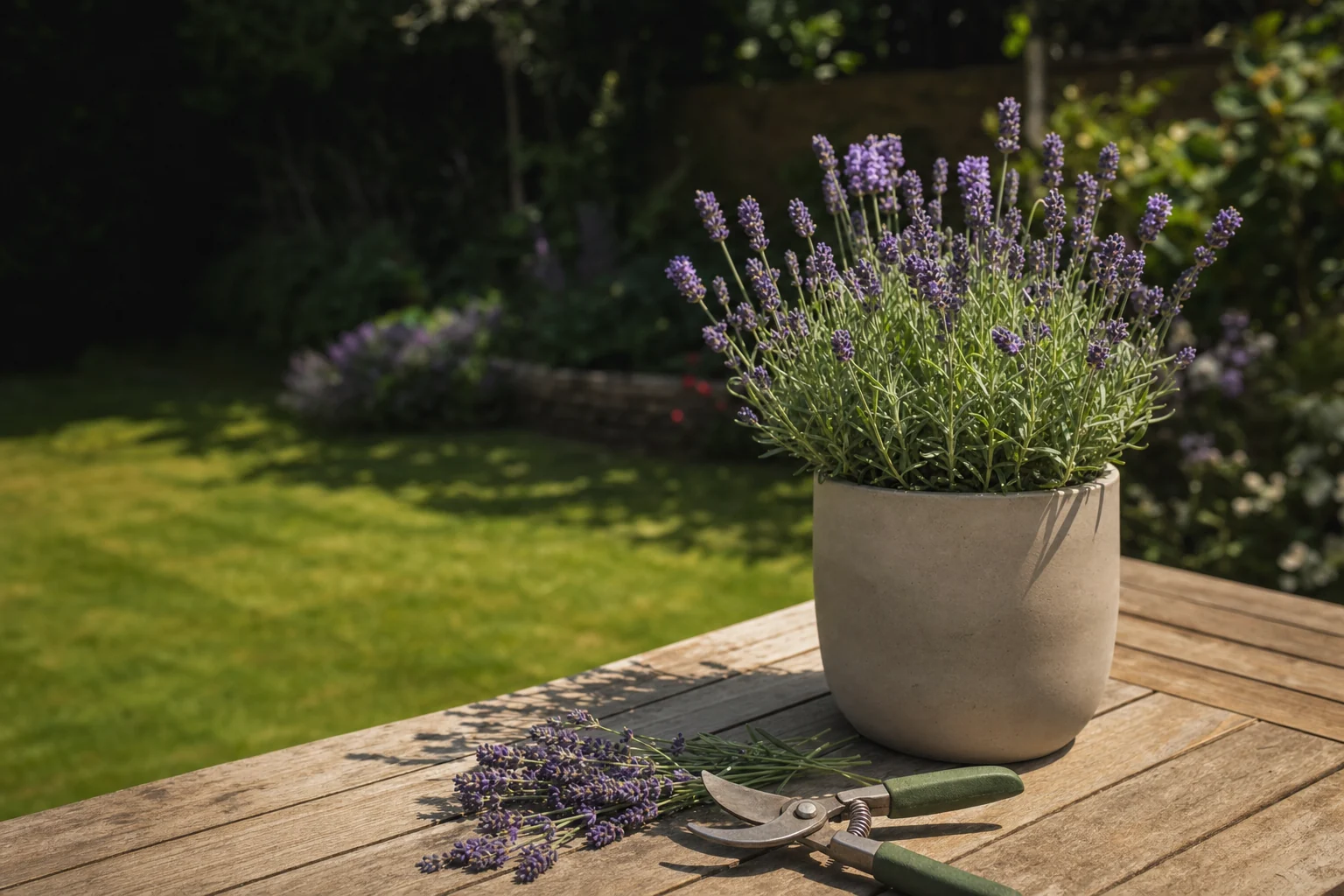
Why Your Lavender Looks Like a Pile of Sticks (And What to Do About It)
Lavender is very good at making us feel briefly competent. It arrives looking neat, silvery and fragrant, produces a cloud of flowers, attracts every bee in the postcode, and generally suggests that you have your life together.
Then, a few years later, it becomes a sprawling bundle of brown stems with a small tuft of leaves somewhere near the top. The middle opens. The flowers become fewer. One side begins leaning into the path as though it has given up on the arrangement entirely. You are left wondering whether it needs feeding, watering, a pep talk, or perhaps an exorcist.
Usually, it needs pruning. Or, more accurately, it needed pruning last summer.
Woodiness is not normally a pest or disease problem. Lavender is a small Mediterranean shrub, and shrubs naturally make woody stems as they age. The trouble begins when that woody framework is allowed to rise higher each year. Eventually, most of the plant is brown, bare and unable to make the fresh leafy shoots that carry flowers.
The encouraging bit is that routine pruning prevents much of this. A properly cut lavender stays compact, dense and floriferous for far longer than one left to get on with it. The less encouraging bit is that lavender has firm opinions about where it can be cut. Ignore them and it can respond with the horticultural equivalent of silent treatment: no new growth at all.
The rule worth remembering
Keep every routine cut in living, leafy growth. English lavender can tolerate a stronger annual prune than French or Spanish lavender, but neither type should be casually hacked back into a large area of bare old wood.
As it is now September in the UK, this is also a useful moment to pause before reaching for the secateurs. In much of the country, the main pruning window for English lavender has just passed. If your plant has already been cut after flowering, excellent. Leave it to settle. If it has not, remove only clearly spent flower stems and avoid a big reshaping job now, particularly in colder areas. The main corrective work can wait until spring growth is visible.
The first job is identification. That sounds fussy. It is not. English lavender and French lavender are often sold under the same cheery label, yet pruning them in exactly the same way is one of the quickest routes to losing the latter.
English vs French Lavender: Know Your Plant Before You Pick Up the Secateurs
"Lavender" is often used as if it describes one plant with one set of rules. It does not. For pruning purposes, the important divide is between English lavender, Lavandula angustifolia, and the plants commonly called French or Spanish lavender, principally Lavandula dentata and Lavandula stoechas.
English lavender is the one most British gardens know well. Familiar cultivars include Hidcote and Munstead. It has narrow, usually silver-grey foliage, fairly simple flower spikes carried on long stems, and its main display is generally in early to mid-summer. It is the hardiest group and the best long-term choice for a sunny border in much of the UK.
French lavender is a slightly confusing common name. L. dentata has noticeably toothed leaf margins. L. stoechas, often also called Spanish lavender, has the unmistakable showy bracts at the top of each flower head: the little "rabbit ears" people understandably fall for at garden centres. These plants often flower for much longer, from late spring through summer and sometimes into early autumn, especially where conditions are kind.
The difference is not academic. English lavender generally responds well to a firm annual trim of its current season's growth. French and Spanish lavenders need a much gentler hand. They do not reliably regenerate from old, leafless wood, so cutting back hard can be terminal.
Not sure which you have? Wait until it flowers. Long, simple spikes point towards English lavender. Flower heads topped with conspicuous coloured bracts indicate L. stoechas. Serrated foliage is the useful clue for L. dentata. Until you know, prune lightly and stay well above bare wood.
This is particularly important with older plants, where the foliage can be sparse and the original plant label disappeared several moves ago. We have all inherited a mystery shrub from a previous owner. Sometimes it is a pleasant surprise. Sometimes it is a lavender with very strong feelings about secateurs.
The Science of Woodiness: Why Lavender Turns Into a Tangled Shrub
Lavender becomes woody because it is supposed to. As stems mature, their soft green tissue undergoes lignification: the gradual formation of tougher, brown, structural wood. This lets the plant support itself, survive dry spells and persist as a shrub rather than behaving like a floppy annual.
The issue is not wood itself. A small woody crown is normal and healthy. The issue is the height of the woody zone. Left unpruned, each stem grows longer, flowers near its tips, then hardens below. The following year, fresh growth starts slightly higher up. Repeat that process a few times and the plant becomes a raised canopy perched on a cage of sticks.
That shape is neither attractive nor especially productive. Old woody stems make fewer useful flowering shoots. They can split as the plant spreads, especially when rain, wind or a winter dusting of snow lands on an open centre. The bare interior also leaves nowhere for the plant to make a graceful recovery if the top growth is lost.
Pruning redirects growth
Removing part of the leafy outer growth encourages the plant to make branching shoots lower down in the green zone, rather than extending a handful of long stems.
A rounded shape is practical
A low dome sheds rain better, resists wind more effectively and keeps new leafy growth closer to the woody base.
Little and often beats panic
A regular annual routine is much safer than ignoring a plant for years and then attempting an ambitious rescue cut on a Sunday afternoon.
In practical terms, you are trying to maintain a cushion of foliage above the old crown. It is that leafy cushion which gives you somewhere safe to cut every year. If you allow it to disappear, there is no spare growth left to work with.
Think "green dome", not "mini hedge"
Lavender looks best and stays healthiest when cut into a soft mound. Avoid shearing it vertically like a box hedge. Straight sides encourage an awkward, bare base and put the heaviest flowering growth at the widest point.
Good pruning does not stop ageing forever. French lavender often has a relatively short life even in Mediterranean conditions, whilst an English lavender in excellent conditions can live and flower for many years. The goal is not immortality. That would be asking rather a lot of a shrub. The goal is to keep it compact and useful for as long as it is happy to be there.
The English Lavender Pruning Calendar: Two Cuts That Change Everything
English lavender benefits from two distinct interventions each year. The first is a light spring tidy, timed to the plant rather than the calendar. The second is the essential post-flowering prune, carried out once the main show has finished in summer.
Cut one: the main summer prune
This is the important one. In the UK, English lavender usually finishes its main flush of bloom in late July or August. Once the flowers have faded, remove the spent stems and reduce the current year's leafy growth to restore a compact dome.
In a normal year, aim to finish this work by mid-August in northern England and Scotland, and by late August in southern England. The wider principle matters more than an exact date: complete a substantial prune at least six weeks before the average first frost in your area. The plant needs time to make and firm up any new growth before winter arrives.
That is why September can be awkward. In warmer southern gardens, a modest tidy may still be sensible if the plant is actively growing and conditions are settled. In colder or exposed gardens, leave serious reshaping alone. Cut off the obviously dead flower wands if they are bothering you, but do not remove a large amount of foliage now just because it looks scruffy. Lavender can be a little scruffy. So can the gardener. Winter is not the time to make major aesthetic decisions.
Cut two: the spring tidy
Come next spring, wait until fresh green shoots are visible from the stems or base. Do not rush out on the first bright day in February with a coffee and a sense of renewal. Lavender may still be dormant, and old stems can look deceptively dead after winter.
Once you can see where the plant is actively growing, remove winter damage, dead tips and any stems that clearly have no life in them. Then lightly shorten the remaining green growth if needed to preserve the rounded shape. This should be a tidy, not a second major haircut.
Use growth as your signal. Spring pruning starts when new shoots appear, not on a fixed date. A cold inland garden and a sheltered urban courtyard may wake up at very different times.
Why two cuts? The summer prune stops the plant becoming leggy after flowering and keeps the woody core low. The spring tidy removes what winter has damaged without forcing a dramatic response from a plant that may still be deciding whether it is safe to grow.
One thing not to do is make your main prune in late autumn or winter. Fresh shoots stimulated by a late cut may not harden before frost, and soft growth is more vulnerable to cold damage. This can leave the plant looking worse in spring, not better. Lavender is not a lawn. It does not need a final "just one more cut" before the weather turns.
Step-by-Step: How to Prune English Lavender Without Killing It
For a healthy English lavender, the actual pruning takes only a few minutes. The thinking beforehand takes longer, which is probably a good thing. Most mishaps happen when we start cutting before looking.
Use sharp bypass secateurs for individual stems. Bypass blades make a clean slicing cut; anvil types can crush softer growth. Large, established mounds can be shaped with sharp hedge shears, but secateurs are better when you need to work carefully around woody areas. Gloves are useful, if only because the stems can be surprisingly scratchy. Wipe blades with isopropyl alcohol or a suitable diluted bleach solution between plants, particularly if one looks unhealthy.
- Look for the woody crown. Part the foliage and find the brown, hard stems near the base. This is the danger zone. Your routine cuts should stay above it.
- Find the green working zone. Identify the leafy growth growing from those stems. You want to leave a generous amount of foliage below every cut.
- Remove spent flower stems. Follow each flower stem down into the leafy plant and cut it out. This instantly improves the appearance and makes the next stage easier to judge.
- Reduce the leafy growth. Shorten the current season's green growth by roughly one-third to two-thirds, depending on how vigorous the plant has been. Keep cuts around 5–8 cm (2–3 in) above the woody crown.
- Shape a rounded cushion. Trim the sides slightly more than the centre if needed, creating a low dome rather than a flat-topped block.
- Stop and inspect. You should still see leafy material beneath the cut line all around the plant. If you are exposing bare brown stems, you have gone too far.
The 5–8 cm safety margin
For normal English lavender pruning, keep your cut around 5–8 cm (2–3 in) above the woody crown, within leafy growth. It is a simple guide, but it prevents the most costly error: removing the plant's remaining viable buds.
Do not worry about making every cut individually beautiful. Lavender is forgiving of a slightly shaggy finish, and a healthy plant will soon soften the outline. What matters is the overall shape and, crucially, leaving green growth behind.
If the plant is particularly large, work in stages. Take off the flower stems first, step back, then lightly reduce the mound. It is much easier to remove another small amount than to stick leaves back on a plant. I have checked. They do not take.
French Lavender's Golden Rule: When Less Is Genuinely More
Here is the contrast in one sentence: English lavender rewards a firm annual prune; French and Spanish lavender can be killed by the same treatment.
French lavender, including Lavandula dentata, and Spanish lavender, Lavandula stoechas, do not reliably regenerate from old bare wood. If you cut them back to a framework of leafless stems, there may be no viable buds left to restart the plant. It is a particularly frustrating mistake because the plant can look as though it has been tidied beautifully for a fortnight, then quietly declines.
These lavenders also have a longer, less tidy flowering season. Rather than one concentrated summer performance, they can continue producing blooms through summer and into early autumn. That makes a single dramatic "after flowering" cut less appropriate. Deadhead individual faded flower heads throughout the growing season, and give the plant a light overall trim after its main flush has passed in late summer.
For that annual trim, remove no more than around one-third of the leafy growth. Stay firmly in green, leaf-bearing stems. If there is a bare woody section, treat it as a boundary rather than a challenge.
Do with French lavender
- Deadhead faded flower heads regularly through its long season.
- Lightly shorten leafy shoots after the main flowering flush.
- Keep a soft, compact shape whilst every cut remains in green growth.
- Protect plants from prolonged winter wet and severe frost.
Do not do with French lavender
- Cut into bare, leafless old stems.
- Shear it hard to make it match a neighbouring English lavender.
- Perform a rejuvenation cut on a woody old plant.
- Expect a neglected plant to rebuild from a brown framework.
There is no clever workaround for a very woody French lavender. If it has become sparse, bare and top-heavy, replacement is often kinder and more successful than rescue. That may sound ruthless, but these are not especially long-lived shrubs in the first place. Starting again with a young plant in excellent drainage, then pruning lightly from year one, is usually the better gardening decision.
A long flowering season changes the routine
With French and Spanish lavender, keep deadheading as flowers fade rather than waiting for every bloom to finish at once. Save the light all-over trim for after the strongest flush, and never sacrifice leafy shoots to make the plant look artificially neat.
English vs French Lavender Pruning: A Head-to-Head Comparison
If you remember only the broad pattern, make it this: English lavender gets two seasonal cuts and can be pruned relatively firmly in its leafy growth. French and Spanish lavender get ongoing deadheading plus one light annual trim. Both dislike being cut into bare wood, but French lavender is far less likely to forgive it.
| Pruning question | English lavender L. angustifolia |
French / Spanish lavender L. dentata / L. stoechas |
|---|---|---|
| Routine frequency | Two cuts: a light spring tidy and a main post-flowering summer prune. | Deadhead through the season, then give one light trim after the main flowering flush. |
| Main pruning time | Late July to August, once the principal flowering display has finished. | Late summer, after the main flush, whilst avoiding removal of active flowers unnecessarily. |
| How much to remove | Roughly one-third to two-thirds of current year's green growth, depending on vigour. | About one-third of leafy growth at most. |
| Safe cutting position | About 5–8 cm (2–3 in) above the woody crown, retaining foliage below cuts. | Only within leaf-bearing green stems; never into leafless old wood. |
| Late-season caution | Avoid heavy pruning close to frost, when fresh growth cannot harden. | Be particularly cautious: less hardy plants are vulnerable to cold and winter wet. |
| Woody old plant | A high-risk rejuvenation cut can be attempted as a last resort. | Do not hard prune; replacement is normally the realistic option. |
It is worth noting that labels can be unhelpful. A plant sold as "French lavender" may be a stoechas type, whilst another may be dentata. For pruning, the shared message is reassuringly straightforward: admire the flowers, remove them as they fade, and do not cut back into a bare skeleton.
Rescuing a Woody Lavender: Honest Advice on What Can (and Can't) Be Saved
A woody lavender is one of those garden problems that invites optimism. There are a few green shoots, so perhaps it can be brought back. There is a large bare centre, but perhaps a very hard prune will shock it into action. It is tempting. Gardening is built on hope, after all.
Start by identifying the plant. If it is French or Spanish lavender, do not perform a hard renovation. A bare woody base is not a source of dependable new growth for these plants. Remove dead flower stems, tidy only what is leafy, and decide whether the plant still earns its place. If it does not, replace it. There is no prize for keeping a shrub alive purely because you feel guilty.
For English lavender, there is a possible last-resort option. If the plant is leggy, gappy and mostly woody, you may attempt a hard rejuvenation prune. This means cutting stems back into bare wood, rather than stopping in the usual green zone. It carries a significant risk, and success is not guaranteed.
Only for English lavender, and only as a gamble: a hard cut into bare wood is not standard care. Attempt it only on a plant you are prepared to lose, ideally when it is actively growing and capable of responding. Never use this method on French or Spanish lavender.
Before taking that risk, inspect the plant closely. Are there small green shoots low down? Do any stems show signs of life nearer the base? Is the woody crown solid rather than split, rotten or loose in the soil? If there is living growth below the intended cut line, your chances are better. If the entire plant is a brown, brittle frame with foliage only at the very tips, replacement is often the sensible route.
For a rescue attempt on English lavender, cut one or two stems first rather than committing to the whole plant. Then wait and watch. If low buds begin moving into growth, you can gradually reduce the rest. If nothing happens, you have your answer without turning the whole border into a monument to enthusiasm.
Prevention is genuinely easier
Once the leafy layer has lifted far above the crown, no pruning trick is guaranteed. A young English lavender pruned every year is vastly easier to manage than an old one asked to reinvent itself.
Common Lavender Pruning Mistakes (And Exactly How to Avoid Them)
Lavender is not difficult, but it is specific. Most failures come from a handful of repeat offences.
Mistake: treating French lavender like English lavender
Fix: identify the plant before pruning. French and Spanish types should be deadheaded and lightly trimmed only in green growth. Never hard prune them into old bare stems.
Mistake: doing the big cut in autumn
Fix: complete English lavender's main prune after flowering in late July or August. Do not stimulate tender late growth when frosts may be close.
Mistake: waiting for spring to do everything
Fix: spring is for tidying winter damage once new growth appears. It does not replace the main late-summer shaping prune.
Mistake: cutting straight across like a hedge
Fix: keep the plant domed. A rounded mound avoids an over-wide top and helps preserve foliage close to the base.
Mistake: blaming insects for every decline
Fix: first check pruning history, drainage and whether the woody zone has crept too high. Those are much more common causes of a poor-looking lavender.
Another easy mistake is overfeeding. Lavender evolved in lean, free-draining conditions and does not need rich, lush soil to thrive. Excessively soft growth can make a plant floppy rather than compact. A neat pruning routine works best when it is not trying to correct a plant grown in conditions it dislikes.
Finally, resist the urge to prune because a plant looks untidy after winter. Brownish stems, sparse foliage and delayed spring growth can all be normal. Wait until new shoots reveal what is alive. Patience is not glamorous, but it is cheaper than replacing a plant you accidentally pruned into retirement.
Lavender Growing Conditions: Getting the Basics Right So Pruning Works
Pruning is important, but it cannot compensate for a lavender planted in cold, sodden soil. If a plant repeatedly fails to bulk up after cutting, or loses branches over winter, look down as well as up. The roots are usually trying to tell you something.
Lavender wants a sunny position and freely draining soil. In its natural habitat, water moves away readily from the roots. In a wet British winter, especially on heavy clay, water can linger around the crown and roots for far too long. The result may be yellowing, dieback or a plant that simply never returns with the same vigour.
On clay-heavy ground, raised planting is often the simplest answer. Lift the root zone above the surrounding wet soil and incorporate plenty of horticultural grit when planting. Containers are also an entirely valid choice, particularly in wetter regions or gardens with poor drainage. A pot lets you control the growing medium and move a less hardy French lavender to a sheltered spot when winter becomes properly unpleasant.
Spacing matters too. Lavender needs air around its foliage. Crowding it beneath larger shrubs or forcing it against an overgrown hedge creates damp, shaded conditions and encourages an open, stretched habit. Give it sunlight from above and room around the sides. This is not a plant that enjoys being tucked into a gloomy gap because there happened to be one left.
Pruning works best on a happy plant
A lavender in sun, sharply drained soil and a reasonably open position will produce the healthy green growth you need for safe annual pruning. A plant sitting in winter wet has far less capacity to recover, however carefully you cut it.
Quick Questions Gardeners Ask About Pruning Lavender
The GardenScout takeaway
For bushy English lavender, make the main cut after flowering in late July or August, keep it rounded, and always leave a leafy layer above the woody crown. For French and Spanish lavender, deadhead generously but prune lightly: old bare wood is a one-way street. Get those two approaches right, give the plants sun and drainage, and your lavender should remain a fragrant mound rather than an increasingly ambitious pile of sticks.