
Cordless Pole Pruners for Tackling High Branches Safely
Battery pole saws and pruners that reach the tree limbs you can't — without ever climbing a ladder. I've put the leading models head-to-head to help you choose wisely.
Why a Cordless Pole Saw Beats a Ladder Every Time
Let me start with a confession: for years I did my high pruning the daft way — one hand gripping a wobbling ladder, the other swinging a manual lopper above my head, and my heart pounding somewhere near my ears. It worked, right up until the day a rung shifted under my boot and I decided there had to be a better way. There is, and it's called a cordless pole saw.
The whole point of one of these tools is beautifully simple. A cordless pole saw lets you prune branches from the ground without climbing a ladder. You stand on firm, level earth, extend the shaft up into the canopy, line up your cut and let the chain do the graft. No teetering, no white-knuckle balancing act, no asking a nervous family member to "just hold the bottom steady". It is, in my view, one of the genuinely transformative bits of garden kit to have appeared in the last decade.
What's made the difference is battery technology. Brushless motors and lithium cells have moved these tools from feeble novelties to properly capable machines that will happily saw through hardwood limbs. The market now spans several established manufacturers running very different battery platforms — you'll find serious 56V systems, versatile 40V and 36V setups, and lighter, friendlier 20V and 18V tools — each pitched at a slightly different sort of gardener.
Throughout this guide I'll be drawing on recent test data from spring 2026, walking you through the models that currently lead the field, and being honest about where each one shines and where it falls short. Whether you've got a single overgrown apple tree or a whole boundary of leylandii bearing down on you, there's a tool here to suit.
Before You Read On
The single most important number when buying a pole saw isn't the bar length — it's the total reach. A tool that reaches 15 feet lets a person of average height comfortably cut branches around 18 feet off the ground. Work out how high your problem branches actually are before you spend a penny.
The Contenders at a Glance
Before we dive into the detail, here's the shortlist. These are the models that stood out in testing conducted between March and May 2026, and between them they cover every budget and use case I can think of.
| Model | Voltage | Bar Length | In A Nutshell |
|---|---|---|---|
| EGO PS1001 | 56V | 10" | Top-pick with carbon fibre shaft and LED cut line indicator. |
| DeWalt DCPS620 | 20V MAX | 8" | Lightweight, balanced and lower entry cost. |
| Echo DPPF-2100 | 56V | 10" | Fixed-shaft, heavier, but high-output performance. |
| Milwaukee M18 FUEL | 18V | 10" | Heavy-duty modular Quik-Lok attachment platform. |
| Makita 18V X2 | 36V | 10" | Dual 18V LXT batteries with wide ecosystem. |
| Greenworks 40V | 40V | 8" | Budget-friendly entry-level option. |
| Ryobi RY40560 | 40V | 8"–10" | Practical occasional-use tool. |
| Husqvarna 330iKP Combi | 36V | 10" | Attachment-capable with 15+ compatible tools. |
| WORX WG349 | 20V | 8" | Budget pole saw, 8.8 lbs, adjustable head. |
| Stihl HTA 135 | AP System | Pruner head | Premium, longest extension in testing. |
A quick word on how to read that table. Voltage is a rough proxy for grunt, but only a rough one — a well-designed 18V FUEL tool from Milwaukee will out-cut a poorly designed 40V one all day long. Bar length tells you the maximum diameter of branch you can sensibly tackle in a single pass. And that "in a nutshell" column is doing a lot of heavy lifting; the rest of this article exists to unpack it.
Our Top Pick: The EGO PS1001
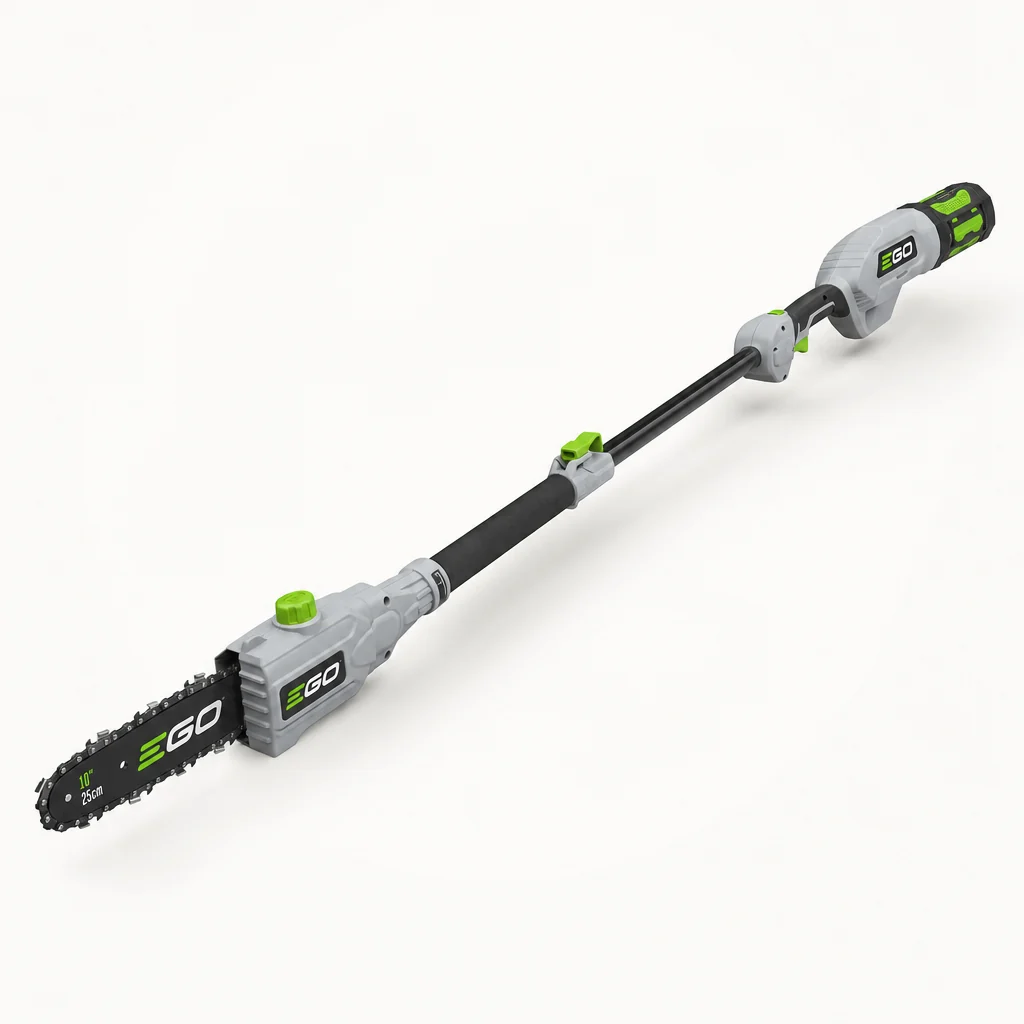
If you asked me to hand one of these tools to a friend and say "just buy this, you'll be happy", it would be the EGO PS1001. It's the model that most consistently impressed me, and it earns its top-pick status through a combination of clever engineering and genuine day-to-day usability.
At its heart sits a 56V 2.5Ah ARC Lithium battery driving a brushless motor. That brushless motor is the key to why the EGO feels so refined in use — it delivers power efficiently and with noticeably lower vibration than the cheaper brushed tools further down this list. Paired with the 10-inch bar and a fine 1/4-inch chain, it produces smooth, accurate cuts that don't tear and snag the way a coarser setup can.
The star of the show is the telescopic carbon fibre shaft. It extends to give you up to 13 feet of total reach, and if that's not enough you can fit the optional EP1000 extension pole (sold separately) to push you all the way up to 17 feet. That's genuinely impressive coverage for a homeowner-grade tool. The carbon fibre isn't just there for show, either — it reduces weight by up to 30% compared to similar tools, which makes an enormous difference when you're holding the thing aloft for the tenth minute in a row.
Then there's the party trick that no rival matches: the LED Cut Line Indicator. EGO were first to fit one of these, and it projects a guide onto your cutting point so you can work accurately even in the gloom of a shaded canopy or on an overcast British afternoon. It sounds like a gimmick until you've used it, at which point you wonder why every pole saw doesn't have one.
Carbon Fibre Shaft
Up to 30% lighter than comparable tools, and it carries a lifetime warranty — a rare thing indeed.
LED Cut Line Indicator
The first of its kind, letting you cut accurately in low-light conditions such as dense shade.
Tool-Free Chain Tensioning
Adjust the chain by hand in seconds — no fumbling for a scrench up a tree.
Platform Compatibility
Works with all EGO 56V ARC Lithium batteries, so it slots straight into an existing EGO collection.
The runtime figure of up to 100 cuts on a full charge is more than most people will ever need in one session. On my typical afternoon of tidying up a couple of overgrown fruit trees I barely dented the battery, and if you already own EGO 56V kit you've got spare packs to swap in anyway. Add a shoulder strap hook for when you want to rest the weight, and you've got a tool that's been thought through by people who clearly use them.
Pros
- Carbon fibre shaft cuts weight by up to 30%
- Unique LED cut line indicator for shaded work
- Extends to 13 ft, or 17 ft with the EP1000 pole
- Up to 100 cuts per charge from the 56V system
- Lifetime warranty on the shaft
- Tool-free chain tensioning
Cons
- The 17 ft extension pole is an extra purchase
- 56V platform is a premium ecosystem to buy into
- 10-inch bar limits you on very thick limbs
The Best Lightweight Option: DeWalt DCPS620
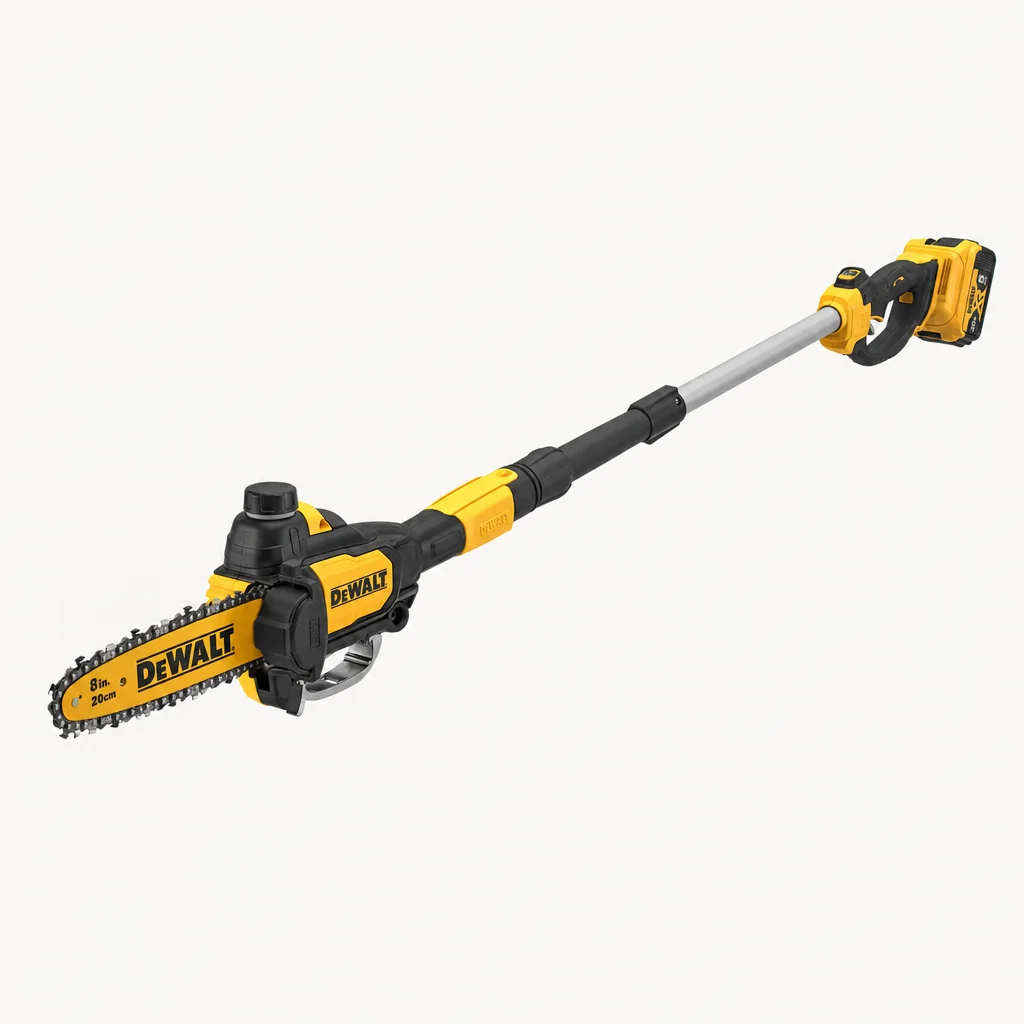
Not everyone wants a big 56V machine, and this is where the DeWalt DCPS620 makes a compelling case. Running on the enormously popular 20V MAX platform, it's the model I'd point towards anyone who already owns DeWalt cordless kit or who simply wants something a bit less intimidating to swing about.
Despite the modest voltage, DeWalt haven't skimped on reach. The maximum pole length is 10 feet, and with a person of average height that translates into a maximum reach of 15 feet up into the tree. That's genuinely competitive with far pricier tools, and it's driven by an XR brushless motor that punches above its weight.
At just 8.4 lbs it's one of the lightest serious tools here, and that matters more than any spec sheet lets on. Weight is the enemy when you're pruning overhead; every extra pound is fatigue that builds up in your shoulders and eventually starts affecting your cut accuracy. The DeWalt's featherweight feel means you can keep going long after a heavier tool would have you setting it down for a breather.
DeWalt have clearly thought about the practicalities, too. There's a directional motor exhaust that blows wood chips away from you rather than into your face — a small mercy you appreciate the first time you cut directly overhead. The auto-oiling mechanism keeps the chain lubricated without you having to think about it, and the inline motor design means the powerhead doesn't block your view of the cut. A metal branch hook helps you tug down partially cut limbs, and a two-stage trigger stops accidental starts.
The chain itself is a 0.043-inch gauge with a 3/8-inch pitch, running at a chain speed of 6.5 metres per second. Runtime comes in at up to 96 cuts per charge measured on 4-inch by 4-inch pressure-treated pine — a realistic benchmark rather than a wishful one. It ships with an 8-inch bar and chain, but you can swap that out for a 10-inch bar and chain if you regularly meet thicker branches.
The DeWalt DCPS620 is part of a large battery ecosystem. If you already own 20V MAX tools, the running cost of adding this saw is essentially just the bare tool — a serious saving that's easy to overlook when comparing headline prices.
Raw Output Champions: Echo, Milwaukee and Makita
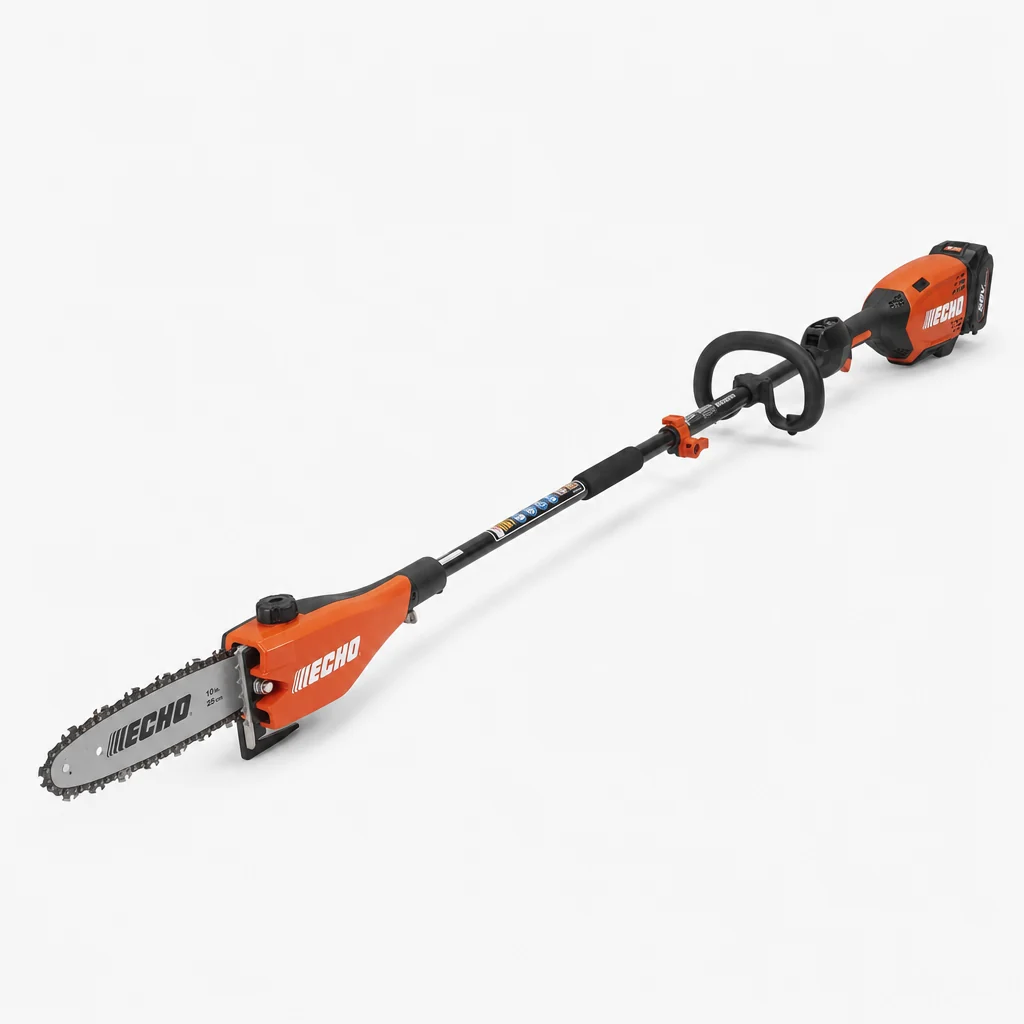
Some jobs simply demand more brute force, and three models in particular are built for gardeners who prune hard and often. These are the tools I'd reach for if I were dealing with dense, established hardwood rather than the soft growth of a young ornamental tree.
Echo DPPF-2100 56V Power Pruner
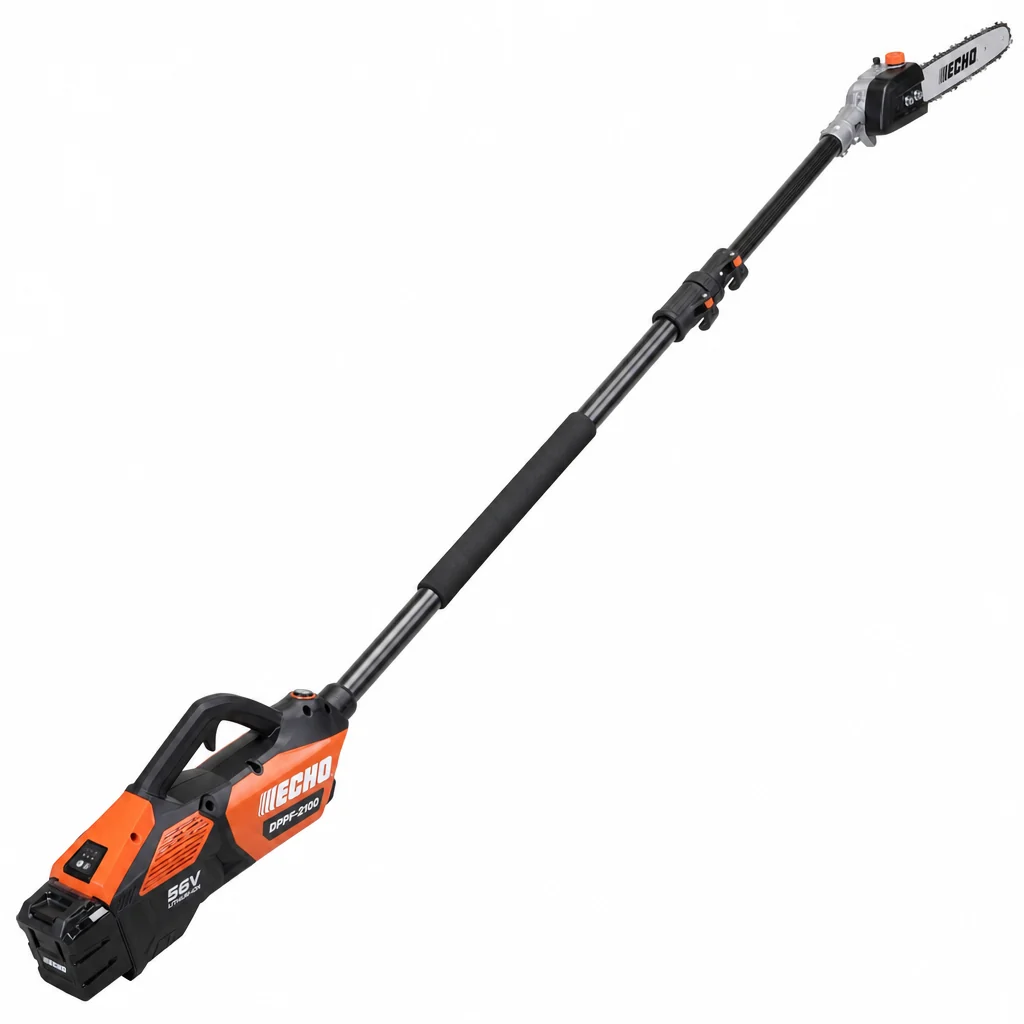
The Echo is an unapologetically serious bit of kit. Its DC brushless motor spins between 9,400 and 9,800 RPM with variable, two-speed modes, running off Echo's eFORCE 56V series lithium-ion batteries. This is a fixed-shaft design rather than a telescoping one, which is a deliberate choice — a fixed shaft is inherently more rigid and transmits your effort into the cut with less flex.
Reach stands at up to 12 feet, or 15 feet with the optional 3-foot extension. It measures a substantial 2,163 mm (85 inches) in length and tips the scales at 5.3 kg (12 lb) without the battery, so this is not a tool for the faint of arm. The cutting hardware is proper professional stuff: an 80-TXL chain with a .325-inch low-profile pitch and 0.043-inch gauge on a sprocket-nose 10-inch bar. A side-access chain tensioner makes adjustments easy, and the automatic adjustable oiler keeps maintenance low.
Milwaukee M18 FUEL Pole Saw (Quik-Lok)
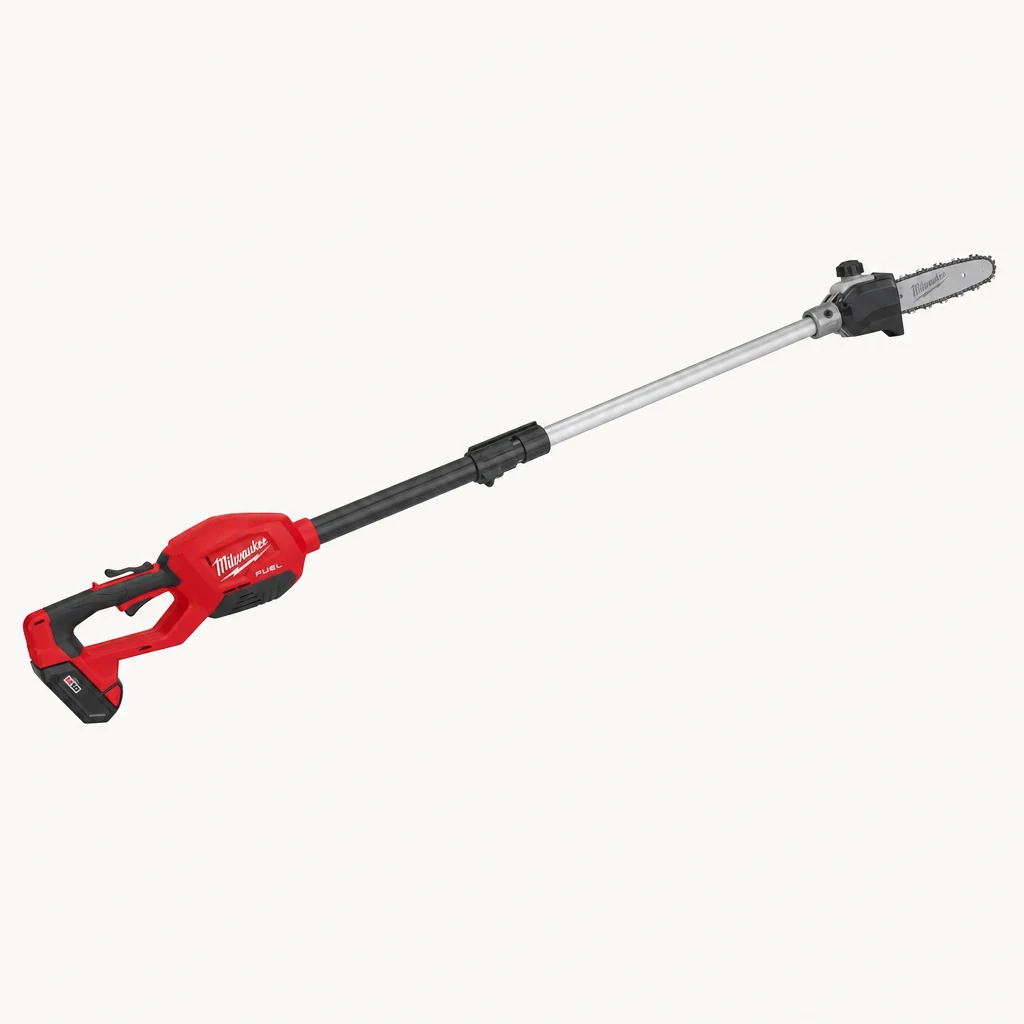
Milwaukee's approach is all about versatility wrapped around genuine power. The M18 FUEL cordless solution cuts hardwood branches, reaches full throttle in under one second, and delivers up to 150 cuts per charge — the highest cut count of any tool here. That headline figure comes courtesy of an 18V 8Ah battery, and a rapid charger tops that pack back up in just under two hours.
The magic, though, is the Quik-Lok environment. The kit comprises a brushless powerhead, a 10-inch pole saw cutting head attachment and a 36-inch extension pole, but that same powerhead and shaft can connect to 13 different attachments — everything from a string trimmer to a leaf blower to a brush cutter. You swap between them by loosening a knob and pressing a button, with no tools required. Fully assembled the saw weighs 16 pounds, which is hefty, so the included shoulder strap that distributes the weight and improves control isn't a luxury — it's essential.
Makita 18V X2 (36V) LXT Pole Saw
Makita's clever trick is combining two 18V LXT batteries to produce a 36V output, giving it more cutting headroom than a single-battery tool while keeping you inside the vast Makita LXT ecosystem. It runs a 10-inch bar and slots neatly into a collection of tools many tradespeople and keen gardeners already own. If your shed is already full of Makita blue, this is the obvious route to a capable pole saw without buying into yet another battery platform.
That chart tells a clear story about endurance. The Milwaukee's 8Ah pack and efficient FUEL motor give it a commanding lead on cut count, though remember it's also carrying the most weight. The EGO and DeWalt sit close together in the high-90s-to-100 range, which for the vast majority of domestic pruning sessions is more than sufficient — you'll want a rest long before the battery does.
Ecosystem Thinking
The single biggest saving you can make on a cordless pole saw is buying into a battery platform you already own. Milwaukee M18, Makita LXT, DeWalt 20V MAX and EGO 56V are all ranges with dozens of compatible tools. Buying a "bare" tool without batteries can slash the price dramatically if you've got packs already.
Budget and Occasional-Use Options
Not everyone needs a professional-grade machine, and there's no shame in that whatsoever. If you've got a modest garden and only reach for a pole saw a handful of times a year, spending big is money wasted. These four models keep the cost sensible without leaving you stranded halfway up a tree.
Greenworks 40V 8"
The budget-friendly entry-level pick. Its 40V platform and 8-inch bar deliver moderate reach and power — perfectly adequate for lighter, occasional trimming around a smaller plot.
Ryobi RY40560
A practical occasional-use tool with a bar available in 8-to-10-inch configurations, and full compatibility with the widely-owned Ryobi 40V platform.
WORX WG349
A genuinely lightweight budget saw at just 8.8 lbs, running on a 20V platform with an 8-inch bar and a handy three-position adjustable head.
Husqvarna 330iKP Combi
An attachment-capable 36V system supporting 15+ compatible tools. Its reach is lower than a dedicated saw, but the versatility is superb for a mixed garden.
Of this group, the WORX WG349 is the one I'd most readily recommend to a first-timer or someone nervous about weight. At 8.8 lbs it's easy to handle, and that three-position adjustable head is more useful than it sounds — being able to angle the cutting head means you can attack awkwardly-positioned branches without contorting the whole pole. It won't win any power contests against the 56V heavyweights, but for cleaning up a hedge line or trimming back a couple of overhanging limbs it's ample.
The Greenworks and Ryobi both make the most sense if you're already invested in their respective battery platforms, which are among the most popular in the budget cordless space. And the Husqvarna 330iKP Combi is a different beast entirely — think of it as a modular hub for the whole garden rather than a dedicated pruner, trading ultimate reach for the ability to swap in string trimmers, edgers and more.
Occasional-use tools genuinely last longer if you look after them. Store the battery indoors over winter rather than in a cold shed, keep the chain oiled, and give the bar a wipe-down after each use. Neglect is what kills budget kit, not the price tag.
The Premium Reach King: Stihl HTA 135
At the top of the tree — quite literally — sits the Stihl HTA 135. This is a premium battery-powered pruner running on Stihl's AP System, and it earned its place in this guide by posting the highest extension in field tests: a genuinely impressive 11.5 feet from the tool itself. Combined with the reach of your own arms, that puts it among the most capable tools for getting at truly high branches.
Stihl's reputation in the professional arboriculture world precedes it, and the HTA 135 feels every bit the tool a landscaper or serious estate owner would choose. The AP System battery platform is built for demanding, sustained use, and the build quality is exactly what you'd hope for at the premium end. If your problem branches are consistently at the very limit of what other tools can reach, and you want a machine that will still be going strong in a decade, this is where you look.
The trade-off, as ever with Stihl, is that you're buying into a premium platform and paying premium prices to do it. For a homeowner with average pruning needs it's arguably more tool than necessary — but if you fall into the "buy once, cry once" camp and value reach above all else, the HTA 135 is hard to beat.
Head-to-Head: How the Leaders Stack Up
Numbers on their own only tell you so much, so let me put the three tools I'd most likely recommend side by side. This is where the real character of each machine comes through.
| Specification | EGO PS1001 | DeWalt DCPS620 | Echo DPPF-2100 |
|---|---|---|---|
| Voltage | 56V | 20V MAX | 56V |
| Bar Length | 10" | 8" (10" swappable) | 10" |
| Max Reach | 13 ft (17 ft w/ pole) | 15 ft | 12 ft (15 ft w/ ext.) |
| Cuts Per Charge | Up to 100 | Up to 96 | — |
| Shaft Type | Telescopic carbon fibre | 10 ft pole | Fixed shaft |
| Weight | Lightweight (carbon) | 8.4 lbs | 12 lb (no battery) |
| Standout Feature | LED cut line indicator | Directional chip exhaust | Two-speed variable modes |
Reading between the lines here is instructive. The DeWalt actually wins on outright reach at 15 feet, which surprises people given its modest 20V rating — clever pole design trumps raw voltage. The EGO counters with its carbon fibre lightness and that LED indicator, plus the option to extend all the way to 17 feet. The Echo brings the most rigid platform thanks to its fixed shaft and the professional-grade chain, at the cost of considerable weight.
My honest take? For most readers the EGO is the sweet spot — light, capable and clever. Choose the DeWalt if you prize low weight and maximum reach, or already own 20V MAX kit. Reach for the Echo if you prune hard, value rigidity, and don't mind the heft.
Staying Safe Up There
The entire premise of a pole saw is safety — keeping you on solid ground instead of up a ladder — but that doesn't mean you can switch your brain off. Cutting overhead brings its own hazards, and a little care goes a very long way.
Always Wear Head and Eye Protection
Branches, chips and sawdust all come straight down towards you when cutting overhead. A helmet and safety glasses are non-negotiable — the DeWalt's directional exhaust helps, but it's no substitute for goggles.
Plan Your Escape Route
Know which way a cut branch will fall, and make sure you can step clear. Never stand directly beneath the limb you're severing.
Watch for Power Lines
An extended pole can reach surprisingly far. Keep well clear of any overhead cables — a carbon fibre or aluminium pole offers no protection whatsoever.
Two Hands, Firm Footing
Keep both hands on the tool and stand on level ground. The two-stage trigger on tools like the DeWalt exists precisely to stop accidental activation — respect it.
Fatigue is the hidden safety risk with pole saws. As your arms tire, your accuracy drops and your grip weakens. Use the shoulder straps included with tools like the EGO and Milwaukee, take regular breaks, and stop the moment you feel your control slipping.
How I Rated the Field
Pulling all of this together, here's my overall assessment of where the category sits in 2026. This rating reflects the class as a whole through the lens of its strongest performers — a genuinely mature, capable category that's come a very long way.
Safety scores highest, and rightly so — the whole point of these tools is to keep you off ladders, and they deliver on that superbly. Reach is a close second thanks to tools like the Stihl HTA 135 stretching to 11.5 feet and the EGO reaching 17 feet with its extension. Weight is the category's soft spot; even the lightest tools ask a fair bit of your shoulders once you're a few minutes into a cut, and the heavyweights like the 16 lb Milwaukee demand a shoulder strap and a bit of stamina.
Who Should Buy What
Different gardeners, different needs. Here's my quick steer depending on the kind of person you are and the garden you're wrestling with.
The All-Rounder
Buy the EGO PS1001. The carbon fibre shaft, LED cut line and 13-to-17 ft reach make it the most polished choice for the widest range of jobs.
The Weight-Conscious
The DeWalt DCPS620 at 8.4 lbs with 15 ft reach is the easiest serious tool to handle overhead for long stretches.
The Heavy Pruner
The Echo DPPF-2100 and its rigid fixed shaft, or the Milwaukee M18 FUEL with 150 cuts per charge, for demanding, sustained work.
The Occasional User
The WORX WG349 or Greenworks 40V keep costs sensible for a garden that only needs pruning a few times a year.
The Reach Seeker
The Stihl HTA 135 posted the highest extension at 11.5 ft — the tool for genuinely lofty branches.
The Multi-Tasker
The Husqvarna 330iKP Combi or Milwaukee Quik-Lok systems, with 13–15+ compatible attachments each, do the whole garden.
Frequently Asked Questions
The Verdict
Cordless pole saws have grown up. What was once a compromise category is now full of genuinely excellent tools, and the fundamental promise — pruning high branches whilst keeping both feet safely on the ground — has never been better delivered.
My overall pick remains the EGO PS1001. Its carbon fibre shaft shaves up to 30% off the weight of rivals, the LED cut line indicator is a genuine first-of-its-kind advantage in shaded canopies, and with reach of 13 feet (17 with the optional pole) plus up to 100 cuts per charge, it covers almost every domestic job with ease. The lifetime warranty on the shaft is the reassuring cherry on top.
If weight is your priority or you already own the platform, the DeWalt DCPS620 is superb — 8.4 lbs, 15 feet of reach and a thoughtful set of features. Serious pruners should look at the rigid Echo DPPF-2100 or the endurance-leading Milwaukee M18 FUEL, whilst those chasing maximum height want the Stihl HTA 135 and its class-leading 11.5-foot extension. And for occasional use, the lightweight WORX WG349 proves you needn't spend a fortune to get the ladder out of your life for good.
Whatever you choose, do yourself a favour: put the ladder in the shed, pop on a helmet and goggles, and prune the smart way. Your shoulders — and your nerves — will thank you.