
How to Get Rid of Aphids Without Reaching for Chemicals
Ladybirds, soap sprays, smart planting and a little bit of hands-on gardening: a calmer way to deal with greenfly and blackfly.
The Tiny Terrors Taking Over Your Garden: Understanding Aphids
Aphids have an extraordinary talent for appearing precisely where you were feeling smug about a plant. Roses putting on a lovely flush of growth? Aphids. Broad beans looking vigorous? Aphids. The one lettuce you have been nurturing like a tiny green heirloom? Naturally, aphids.
In everyday British gardening language, the usual culprits are greenfly and blackfly. Those names are useful because they tell you what you are likely to see, but they are not especially precise. Green aphids can range from pale, almost yellow-green to a much clearer leaf-green, whilst blackfly are often a deep green, brownish shade or nearly black rather than the glossy jet black their name suggests. Both are sap-feeders, both favour soft new growth, and both can build from a small cluster to an alarming crowd with rather rude speed.
The basic problem is not that an occasional aphid has landed on a plant. Gardens are full of occasional insects, and that is how a healthy garden is supposed to work. Trouble starts when a colony settles on a tender shoot and reproduces faster than predators, weather and your own attention can bring it back into balance. A few aphids can be ignored. A stem thick with them, attended by ants and beginning to curl at the tip, needs intervention.
Aphids feed by inserting fine mouthparts into plant tissue and drawing out sap. In the process, growing leaves can become puckered, twisted or stunted. Flower buds may fail to open well. The damage often looks worse at the freshest part of the plant because that is where aphids prefer to gather. A distorted rose tip or a folded brassica leaf is therefore not simply cosmetic. It is a useful early-warning sign.
Then there is honeydew: the sticky residue aphids leave behind. It can make leaves shine as if someone has misted them with sugar water. Sooty mould may grow on that sticky surface, turning foliage darker and reducing the plant's ability to make the most of available light. Ants can also become involved, protecting aphid colonies because they are interested in the honeydew. This is not a charming wildlife collaboration. It is a very efficient pest-management arrangement, just not one that benefits you.
Before treating anything, look closely. Not every curled leaf, sticky surface or misshapen shoot is caused by aphids. Finding the insects themselves means you can choose a response with confidence rather than spraying first and asking questions later.
The encouraging bit is that aphids are soft-bodied, exposed and comparatively easy to disrupt. They have none of the armour of a beetle and none of the disappearing act of a slug. They sit in plain sight, usually on the exact bit of plant you were about to inspect anyway. Chemical-free control is not a consolation prize here. For many ordinary infestations, it is the sensible first move.
Know Your Enemy Before You Fight It: Identification at a Glance
You do not need a laboratory, a magnifying headset or the sort of notebook normally reserved for railway enthusiasts. A careful look at a shoot tip will do. Aphids are small, but their behaviour makes them easy to recognise: they crowd together, remain fairly still and favour sheltered seams, leaf undersides and the fresh end of a stem.
Greenfly
Usually pale to mid-green, greenfly often collect on rose shoots, brassicas, lettuces and any fresh, juicy-looking growth. Check the undersides of leaves as well as the obvious stem tips.
Blackfly
Dark aphids are especially familiar on broad beans, runner beans, dahlias and nasturtiums. On beans, their favourite place is usually the tender growing point, where the colony can look like a moving dark stain.
The small twin tubes
Many aphids have a pair of tiny projections towards the rear of the body. These are called cornicles. You may not always see them clearly, but they are a useful clue when you do.
Winged visitors
Some aphids develop wings and move between plants. A winged aphid is a useful prompt to inspect nearby crops, especially those producing a fresh flush of growth.
One common mistake is confusing aphids with the creatures you actually want to keep. Ladybird larvae look nothing like the polished red-and-black adult most of us know. They are elongated, dark and often marked with orange. Hoverfly larvae resemble little pale or greenish grubs and move slowly across leaf surfaces. Neither is a reason to panic. If you see a predator amongst an aphid colony, that is the garden beginning to solve the problem for you.
Start at the growing tip
If time is short, inspect the newest leaves and shoot tips first. They are where aphid trouble commonly begins, and they are where a quick intervention is likely to make the greatest difference.
Also look for the supporting cast. Ant activity moving up and down a plant can point towards honeydew above. Curled leaves can conceal colonies. A patch of shine on the leaf below a shoot may mean aphids are feeding overhead. This detective work sounds elaborate when written down, but in practice it becomes a quick habit. Kettle on, garden wander, squint at the roses. It is a perfectly respectable use of ten minutes.
Lady of the Garden: Recruiting Ladybirds and Other Natural Predators
Ladybirds are the headline act in the aphid-control world, and quite rightly. An adult ladybird hunting along a stem is one of the more satisfying sights in gardening: compact, purposeful and entirely uninterested in whether the plant is a treasured rose or a slightly neglected pot by the shed. Its larvae are even more useful, although they do not receive the same level of public relations support. Frankly, they deserve better.
Rather than treating every aphid sighting as an emergency, give predators a chance to find the colony. This works best where the infestation is localised and the plant is otherwise coping. A garden with varied planting, flowers that remain available through the season, a few undisturbed corners and no broad-spectrum chemical routine is much more likely to support ladybirds, lacewings, hoverflies and other helpful hunters.
Hoverflies are particularly worth encouraging. The adults are harmless pollinator lookalikes, frequently mistaken for small wasps because of their stripes. They do not sting. Their larvae, meanwhile, are committed aphid eaters. A hoverfly larva working through a colony does not look dramatic; it looks like a tiny slug taking its time. But the result can be dramatic enough.
The easiest way to welcome hoverflies is to give the adults flowers they can comfortably feed from. Flat, open blooms are especially approachable. Phacelia, limnanthes, herbs allowed to flower and a broad mix of simple-shaped plants all make the garden more useful to adult insects. The aim is not to turn every border into a wildflower meadow unless you fancy doing so. It is simply to avoid creating a landscape of isolated, single-species crops with nothing in it for the creatures that might help you.
Ladybirds and their larvae
Leave them to patrol established aphid colonies where possible. Avoid washing or spraying the whole plant if useful predators are already working through the affected area.
Hoverflies
Grow a mixture of nectar-rich flowers nearby. Adults need food as well as somewhere to lay eggs, so a bare vegetable patch is less inviting than a patch with flowers woven through it.
Other hunters
Lacewings, spiders and small predatory insects are all part of the bigger picture. A slightly untidy, layered garden often provides them more shelter than a perfectly stripped-back one.
There is a limitation, of course. Predators are not an instant reset button when a broad bean tip is already heavily coated in blackfly. They need time to arrive, reproduce or simply find the feast you have accidentally laid on. For a severe cluster, remove the worst of the aphids first, then let predators deal with the survivors and the inevitable stragglers. It is less glamorous than expecting nature to send a tiny emergency response team, but it works with the garden rather than against it.
Predators work best after the first tidy-up
Think of ladybirds and hoverflies as maintenance support, not a fire brigade. Knock back a heavy colony with your fingers, water or a carefully used soap spray, then allow beneficial insects to mop up what remains.
Soap, Water, and Science: Making and Using DIY Spray Solutions
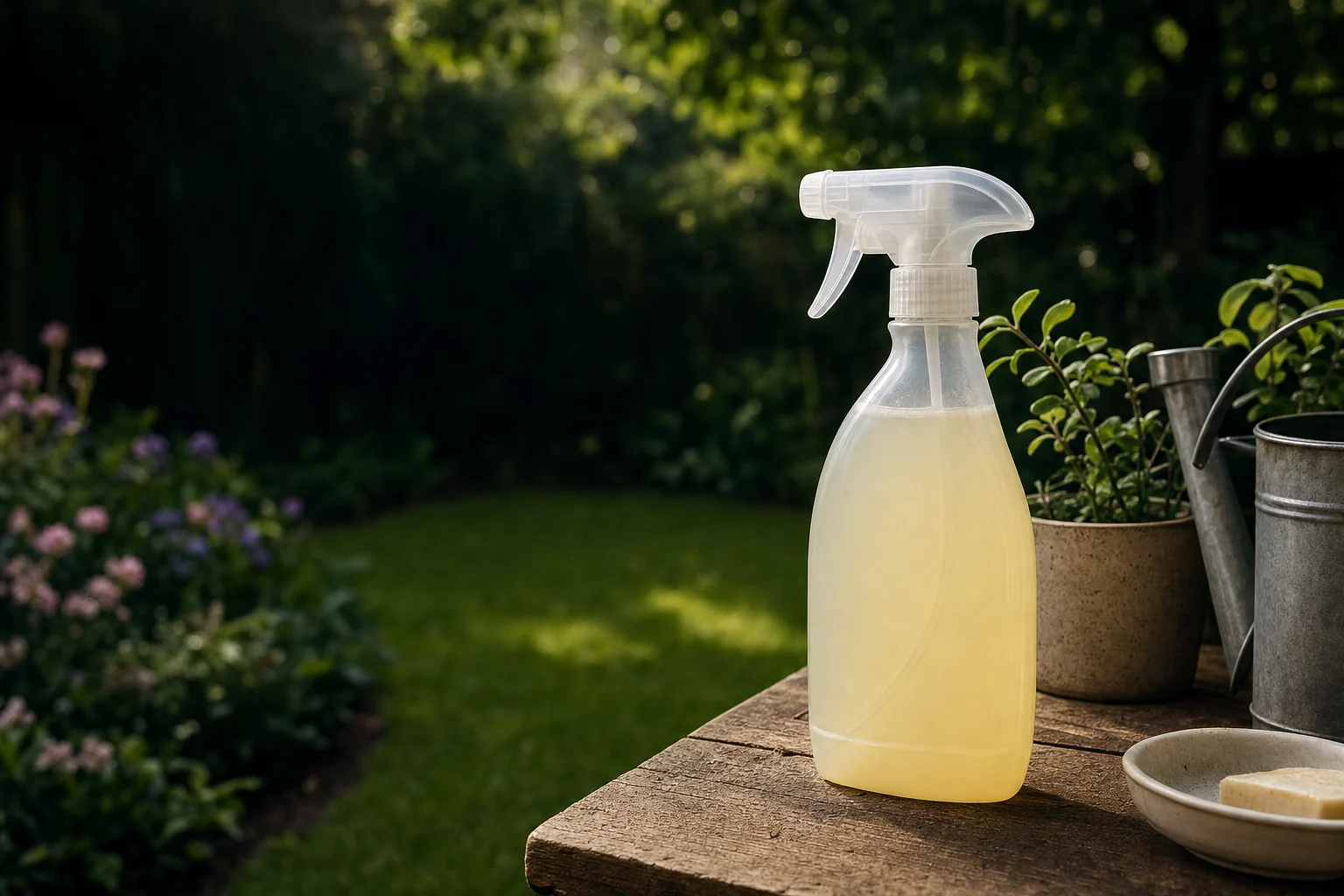
A simple soap spray is one of the most practical non-chemical-feeling tools available to a gardener, though it still deserves careful handling. It works by contact, rather than travelling around inside the plant. That matters. You have to hit the aphids, especially those tucked beneath leaves, and you should not expect a spray applied to one side of a plant to somehow resolve a colony hiding on the other.
For a basic homemade option, gardeners commonly mix a small amount of plain liquid soap with water in a hand sprayer. The important word there is plain. Products containing strong degreasers, bleach, added fragrance or other aggressive ingredients can damage foliage. Plants are quite reasonable about this. They did not ask to be washed up.
My preferred approach is deliberately unexciting. Mix a mild solution, test it on a small, inconspicuous part of the plant, and wait to make sure the leaf does not react badly. If it is happy, spray the affected areas thoroughly but selectively. Do not soak every flower, every bee and every clean leaf in the vicinity just because the sprayer is already in your hand. Precision is the point.
Apply in cooler parts of the day rather than when foliage is hot and the sun is strong. This reduces the chance of stressing the plant and gives you a better opportunity to reach insects before the spray dries. Turn leaves over. Get close to shoot tips. Treat it like cleaning a muddy bike chain rather than watering a lawn: methodical attention beats enthusiastic volume.
Why soap spray is useful
- It is targeted and can be used exactly where aphids are visible.
- It is a practical option for pots, houseplants and small outbreaks.
- It encourages inspection, which often reveals whether the problem is improving.
- It does not rely on a plant absorbing a treatment through its tissues.
Where it falls short
- It only works where the spray makes contact.
- Dense, curled foliage can hide plenty of survivors.
- Some plants are more sensitive than others.
- It can also affect helpful insects if used indiscriminately.
Washing-up liquid is often mentioned in old gardening advice, but formulations vary wildly. If you use a household product, the safest instinct is restraint. Unscented, uncomplicated soap is preferable to anything designed to strip grease from oven trays or leave a tropical perfume in your kitchen. And if a plant reacts badly to the test patch, stop there. No point winning the battle against aphids by upsetting the lettuce.
Spray the pest, not the whole garden
Soap solutions are contact tools. Their strength is precision. Inspect for ladybird larvae, hoverfly larvae and pollinators before spraying, and leave unaffected areas alone.
The Garden as a Team Sport: Companion Planting Strategies That Actually Work
Companion planting has accumulated a fair amount of mythology over the years. It is sometimes discussed as if placing one herb beside another will create an invisible force field around a cabbage. It will not. Gardens remain gloriously complicated places, and aphids remain determined little freeloaders.
That said, companion planting can be genuinely useful when it is approached as part of a wider system. Aromatic plants can change the scent and structure of an area. Flowering plants can provide food for beneficial insects. Sacrificial plants can draw attention away from something more valuable. None of those strategies means aphids will never arrive. They can make an infestation easier to detect, easier to concentrate and easier to manage.
| Planting approach | How it helps | Best use | What to watch for |
|---|---|---|---|
| Nasturtiums | Can become a more attractive landing place for aphids than nearby crops. | Used as a trap crop close to vulnerable vegetables or flowers. | Inspect regularly and remove heavily infested growth before it becomes a launch pad. |
| French marigolds | Add scent, colour and flowers that can make mixed planting more insect-friendly. | Threaded through vegetable beds and containers. | They support a strategy; they are not a standalone aphid cure. |
| Flowering herbs | Offer nectar and pollen for beneficial insects once allowed to bloom. | At bed edges, in pots, or among ornamentals. | Leave enough flowers for insects rather than harvesting every stem. |
| Mixed planting | Breaks up large blocks of one crop and creates a more varied habitat. | Small gardens where every plant needs to earn its keep. | Good spacing and airflow still matter. |
Nasturtiums are the classic example. They are cheerful, edible, beautifully unbothered by being grown in an imperfect garden, and often noticeably attractive to aphids. That makes them useful as a sacrificial planting. Put them near a crop you want to protect, watch them carefully, and deal with colonies on the nasturtium rather than letting them develop unnoticed. The crucial part is the watching. A trap crop that is never inspected is simply a very comfortable aphid hotel.
French marigolds make more sense as part of a mixed bed than as an isolated row planted miles away from everything else. They introduce flowers, foliage and variety among crops such as tomatoes and brassicas. More broadly, the patch becomes less like a buffet laid out in neat monoculture and more like a busy, layered space. That tends to be useful for the garden's wider insect life, even if it is not a magic shield.
Keep companions close enough to matter
Planting works through proximity. A flowering plant on the other side of the garden may still be lovely, but it is less likely to influence what happens around a particular crop.
Use trap crops as monitoring stations
Make a habit of checking the plants aphids favour. They can reveal an incoming problem before your vegetables or prized roses are heavily affected.
Do not sacrifice airflow
Companion planting should not turn beds into an impenetrable thicket. Plants still need light, room and sensible watering at their roots.
I find companion planting works best when it is allowed to be both useful and attractive. Herbs going to flower, nasturtiums spilling from a pot, marigolds tucked between crops: none of it needs to look like an experiment in agricultural theory. You are building a garden that is nicer for beneficial insects to visit, whilst making your own inspection routine more interesting. That is a fair bargain.
Physical Warfare: Low-Tech Removal Methods That Gardeners Swear By
Sometimes the best aphid control is your thumb. There, I said it. Gardening has plenty of elegant ideas, but it also has moments when the most efficient response is to pinch off the worst bit of stem, squash a cluster between finger and thumb, and move on with your day.
On plants such as broad beans, the soft growing tip is often the obvious concentration point. Removing a badly affected tip can take an enormous amount of pressure off the plant immediately. Broad beans are particularly forgiving of this kind of decision, and it is often easier than trying to clean every aphid from tightly packed new leaves. On roses, a gentle wipe or pinch can be enough for an early colony.
Finger-and-thumb removal
Best for small clusters on accessible stems. Wear gloves if you prefer, especially around prickly plants. It is direct, fast and requires no preparation.
Water blast
A firm jet of water can dislodge aphids from stems and leaf undersides. Support delicate stems with one hand and use enough force to move the insects, not flatten the plant.
Pruning out the worst growth
Where a tip is severely distorted or densely covered, removing it can be cleaner and kinder than repeatedly treating a part of the plant that is already struggling.
Yellow sticky monitoring cards
These can help reveal winged insect activity around plants. Treat them as an early-warning device, not a complete answer to an established colony.
The water method is particularly satisfying because it is so simple. Aim the hose or a sprayer at the colony, check underneath leaves, and repeat as needed. Aphids are not especially good at returning to the exact tender shoot they were removed from. The technique is more effective on sturdy plants than on delicate seedlings, obviously. A lettuce seedling should not receive the sort of blast you would use to clean paving slabs. Context, as ever, is everything.
Physical methods are not a one-and-done event. Recheck plants after a short interval, because eggs, hidden aphids and newly arrived winged adults can restart the colony. Regular small interventions are easier than one heroic rescue mission.
For a serious cluster, act before you research it to death
When a growing tip is visibly covered, remove or dislodge the colony first. You can refine the wider garden strategy afterwards. Aphids are not impressed by a beautifully organised spreadsheet.
Soil Health and Plant Vigour: Why Healthy Plants Resist Aphids Better
Aphids are drawn to soft, lush growth. This is one reason they so often appear after a plant has been fed generously, watered generously and generally encouraged to behave as though it is entering a vegetable-growing competition. Fast growth is not automatically bad. But growth that is excessively soft can be especially appealing to sap-feeding pests.
The practical lesson is not "never feed your plants". It is "feed with purpose". A plant in a container, a hungry vegetable crop and a shrub in poor soil have different needs. What causes trouble is the reflex to add strong feed every time a plant looks remotely peaky, particularly when the result is lots of tender growth rather than a balanced, sturdy plant.
Organic matter, sensible mulching, adequate drainage and measured feeding all contribute to more resilient growth. They also make gardening less frantic. Rather than repeatedly correcting one extreme with another—drought followed by soaking, starvation followed by a flood of feed—you create steadier conditions at the roots.
Vigour is not the same as softness
A sturdy plant with balanced growth is a better target than a stressed one, but a wildly overfed plant can produce exactly the tender shoots aphids love. Aim for consistent care rather than constant intervention.
Watering matters as much as feeding. Allowing roots to sit in persistently waterlogged conditions can weaken plants, whilst repeated drought stress can also make fresh growth uneven and vulnerable when watering resumes.
There is another useful benefit to healthier soil and sensible spacing: you can see what is happening. Plants crammed together become a maze of hidden leaf undersides and crowded stems. Good airflow is usually discussed in relation to fungal issues, but it helps pest management too. You can spot an aphid colony, reach it with water, and see whether predators are present. A garden should feel full, not impossible to inspect.
Mulch can be helpful for moisture consistency, provided it is kept sensibly away from the immediate base of stems. Compost and other organic materials improve soil structure over time. None of this produces a dramatic before-and-after photo by Tuesday afternoon, which is perhaps why it is less fashionable than a bottle with a bold label. But the unglamorous foundations are often what make the direct methods work better.
Method vs. Method: How the Key Control Approaches Stack Up
No single approach wins every aphid battle. A rose in a patio pot, a row of beans in an allotment, a lettuce under cover and a houseplant by a bright window are different situations. The useful question is not "what is the one best method?" It is "what is the most proportionate response for this plant, at this stage, with this level of infestation?"
| Method | Speed | Best for | Main limitation |
|---|---|---|---|
| Natural predators | Gradual | Keeping a garden in balance over time. | Not an immediate solution for a severe colony. |
| Soap spray | Prompt where it contacts pests | Localised outbreaks on accessible foliage. | Needs careful application and repeat checks. |
| Companion planting | Preventative | Building a varied, insect-friendly growing area. | Cannot clear an established infestation alone. |
| Physical removal | Immediate | Visible colonies on robust plants. | Requires you to spot the problem early. |
| Physical barriers | Preventative | Protecting vulnerable crops from incoming pests. | Must be fitted well and monitored. |
| Cultural controls | Long-term | Reducing conditions that favour soft, stressed growth. | Benefits build steadily rather than overnight. |
For most outdoor gardens, the strongest approach is a combination. Start by inspecting plants regularly. Remove the heaviest colonies physically. Use a targeted soap spray if needed. Encourage predators by growing flowers and avoiding unnecessary broad-spectrum treatments. Keep feeding and watering sensible. It sounds like several jobs, but they overlap: once you are looking closely at plants, you are already doing much of the work.
The chemical-free advantage
- Methods can be scaled to the size of the problem.
- They encourage regular plant observation.
- They can protect beneficial insect activity.
- They avoid treating unaffected areas without a clear reason.
The honest trade-off
- They need patience and repeat checks.
- Timing matters: very large colonies are harder work.
- Weather and plant type influence what is practical.
- There is no substitute for noticing the first signs early.
Physical barriers deserve a brief mention here. Mesh and fine coverings can prevent some pests reaching crops, particularly when used from the start. They are most useful as prevention, not something hurriedly draped over a plant after winged aphids are already inside. Check under covers regularly, because a protected growing space can become a protected aphid space if you are not careful. A tiny greenhouse with no predators and lots of soft growth is, from an aphid's perspective, a boutique hotel.
Greenhouse and Indoor Growing: Special Considerations for Enclosed Spaces
Greenhouses, conservatories and indoor growing spaces change the aphid equation. Warmth, shelter and a steady supply of tender foliage can allow colonies to develop with very little interruption. There is no rain to knock them from leaves, no breeze to disturb them, and often fewer predators passing through. A windowsill basil plant can go from "doing rather well" to "why are the stems moving?" surprisingly quickly.
That does not mean enclosed growing requires a harsh response. It means inspection becomes more important. Make it part of watering: turn a few leaves over, check shoot tips and look at the plants nearest doors, vents and other entry points. Winged aphids can arrive from outdoors, and a single overlooked plant can become the source of a wider problem.
Biological controls can be especially useful under cover because the environment is more contained. Beneficial insects and parasitoids are often used in protected growing systems, but they should be treated as living organisms rather than a product you can forget on a shelf. They need suitable conditions, and they are best introduced with a clear understanding of the pest present and the environment you are managing.
For a small indoor outbreak, isolation is underrated. Move the affected plant away from others if practical. Rinse it carefully, wipe visible colonies from tougher leaves and prune badly affected tips. Then inspect neighbouring plants. Houseplants often have dense foliage and plenty of hidden nooks, so one quick glance is rarely enough.
Under cover, routine beats rescue
In an enclosed space, build aphid checks into watering and ventilation. Catching a colony on one shoot is easy. Discovering it across every tomato, chilli and houseplant is less of a relaxing afternoon.
Ventilate growing spaces when conditions allow, avoid overcrowding plants and do not overfeed them into a rush of soft growth. These small choices make inspection easier and reduce the perfect-storm conditions aphids enjoy.
Common Questions About Chemical-Free Aphid Control
The GardenScout Verdict: Build a System, Not a Spray Routine
Aphids are irritating, but they are not a reason to turn the garden into a chemical exclusion zone. Their weaknesses are unusually useful to the home gardener: they congregate visibly, they prefer accessible new growth, they can be dislodged, and they have plenty of natural enemies. The trick is to respond in proportion.
For a light infestation, inspect, squash or rinse the affected area, and leave any predators already at work. For a more obvious outbreak, prune the worst growth, use a carefully tested soap spray where it is needed, and keep checking. For repeat problems, look at the bigger picture: are plants being overfed, overcrowded or grown in a space with no flowers, no habitat and no predator activity?
Patio and balcony gardeners
Focus on close inspection, hand removal and a small hand sprayer. Containers put problems right in front of you, which is occasionally useful for once.
Vegetable growers
Mix crops with flowers, check beans and brassicas frequently, and use netting or physical removal before a colony takes over tender growth.
Greenhouse growers
Prioritise routine checks, airflow, isolation of affected plants and appropriate biological control where the enclosed environment supports it.
Ornamental gardeners
Accept a few aphids where plants are coping, then intervene on distorted tips before sticky honeydew and sooty mould become the bigger issue.
Final thought
The best chemical-free aphid control is rarely one clever trick. It is a small routine: inspect new growth, act quickly on heavy clusters, welcome ladybirds and hoverflies, grow a varied garden, and avoid encouraging masses of soft growth in the first place. It is calmer, more observant gardening. And it works rather well.