
How to Get Rid of Ants in the Lawn and Patio
When ants actually matter, when they really don't, and how to weigh up humane barriers against chemical baits for those stubborn nests under your paving.
Right, let's start with something that might surprise you: most of the time, the ants in your lawn and patio aren't doing anything wrong. I've spent a good few summers watching colonies bustle between paving slabs, and the honest truth is that the urge to eradicate them is often more about our discomfort than any genuine damage. Ants aerate soil, prey on other pest larvae, and quietly tidy up organic debris. They are, by and large, gardeners' allies.
But — and it's an important but — there are scenarios where ant activity tips from "harmless background hum" into "genuine problem." Loose, sandy spoil heaping up between your patio slabs. Bald, dying patches in an otherwise healthy lawn. Streams of ants making a beeline for the kitchen. Or, worst of all, an invasive species establishing a supercolony in your borders. In those cases, intervention is warranted, and the choice of method matters enormously.
This guide walks you through the whole decision tree — from identifying when ants matter, through the gentlest humane deterrents, all the way to the heavy-hitting granular baits that target entire colonies. I'll be candid about what works, what's largely folklore, and where the trade-offs lie. By the end, you'll know exactly which approach suits your situation and your conscience.
When Ants Matter (And When They Genuinely Don't)
Before you reach for any product whatsoever, the single most valuable thing you can do is work out whether the ants are actually a problem. This is where most people go wrong — they nuke a perfectly benign colony and disrupt the local ecosystem for nothing.
The vast majority of garden ants in a typical British lawn are simply going about their business. They build their nests, forage for aphid honeydew and dead insects, and cause no meaningful harm to grass or paving. A small mound here and there is, frankly, not worth a chemical campaign.
A handful of ant hills in your lawn is not an infestation. It's a sign of healthy, well-drained soil. Before treating, ask yourself honestly whether the ants are causing damage or just causing you mild irritation.
The picture changes when scale enters the equation. Some species form genuinely enormous colonies. Pavement ant colonies can number around 100,000 individuals, and that volume of underground excavation is exactly what causes slabs to shift and sand to wash out from your patio joints. Big-headed ants are even more dramatic — they're notably invasive, and their colonies can swell to over a million ants. That's no longer a curiosity in the lawn; it's a structural and ecological concern.
So here's my rule of thumb, refined over several seasons of letting the small stuff slide and tackling the genuine offenders:
Leave them alone if…
You see occasional small mounds, the grass around them is still healthy, and they aren't entering the house. These ants are net beneficial.
Act if…
Sand is heaping up between your paving slabs, slabs are visibly destabilising, lawn patches are dying back, or you've got persistent trails marching indoors.
Act decisively if…
You suspect an invasive supercolony species — fire ants, big-headed ants, or rapidly expanding pavement ant populations. These warrant colony-level treatment.
Understanding the Enemy: Identifying Your Ants
The reason identification matters so much is that not every product kills every species — and some of the most popular granular treatments explicitly exclude certain ants from their label claims. Get this wrong and you'll waste a season treating ants that are immune to your chosen product.
Here's a quick field guide to the species most likely to drive you to your shed in search of a solution:
Pavement ants
The classic patio nuisance. They nest beneath slabs and paths, pushing up little volcanoes of excavated sand at the joints. Colonies of around 100,000 mean they can genuinely undermine your hard landscaping over time. These are the ones most patio-focused baits are designed around.
Fire ants and harvester ants
More of a concern in warmer climates, these are aggressive moundbuilders. Fire ants in particular deliver a painful sting and form conspicuous mounds in lawns. There are dedicated baits formulated specifically for them — a generic lawn insecticide won't always be the right tool, as we'll see.
Big-headed ants
The heavyweight of the invasive category. With supercolonies exceeding a million ants, these outcompete native species and are notoriously difficult to shift with spot treatments. Colony-targeting baits are essentially the only viable approach.
Pro Tip
Spend ten minutes watching where the ants actually go before you buy anything. Follow the trail back to the nest entrance. Knowing the exact nest location — and whether it's under a slab, in the lawn, or against the house foundation — completely changes which product and application method will work.
The Humane Approach: Barriers, Deterrents and Repellents
If you've decided the ants do need managing but you'd rather not deploy synthetic insecticides, there's a respectable arsenal of humane methods. These don't kill the colony — they persuade ants to relocate or avoid an area — which is exactly why they appeal to gardeners who'd prefer to coexist where possible.
The core principle is disruption. Ants navigate using pheromone trails, and strong scents or physical barriers interfere with that navigation, encouraging them to route elsewhere.
Scent-based repellents
A surprising range of kitchen-cupboard and essential-oil ingredients act as effective ant repellents when used as barriers: vinegar, cinnamon, cayenne pepper, chilli powder and powdered citrus peels all disrupt the scent trails ants rely on. On the essential-oil side, peppermint, cedarwood, tea tree, vetiver and orange are the standouts. Diluted into a spray or applied along entry points, they create a scent boundary ants are reluctant to cross.
Physical barriers
This is my favourite humane technique for patios because it's cheap, permanent and tidy. Spread a thick layer of gravel or coarse sand around the area where ants are most active. This is particularly effective near gardens, patios and walkways where ants like to travel. The loose, shifting medium makes tunnelling and trail-laying genuinely difficult, and ants tend to give up and reroute.
Essential-oil sprays
Peppermint, cedarwood, tea tree, vetiver and orange oils, diluted in water, form a fragrant scent barrier. Reapply after rain.
Kitchen deterrents
Vinegar, cinnamon, cayenne, chilli powder and powdered citrus peel disrupt pheromone trails without harming the colony.
Gravel and coarse sand
A thick band of loose gravel or coarse sand makes tunnelling and trail-following impractical. Ideal around patio edges and pathways.
There's also a halfway house worth knowing about. Plant-based formulas such as Nature's Dome use geraniol, cinnamon and cottonseed oil to deter ants whilst remaining gentler than synthetic insecticides. The concentrate format is genuinely economical — three concentrate vials each make up a full 16 oz spray bottle, giving you 48 oz of finished solution in total. It sits neatly between pure home remedies and full chemical baits.
Humane methods — pros
- No synthetic insecticides near edibles, pets or children
- Cheap, often using ingredients you already own
- Won't harm beneficial insects or soil life
- Gravel barriers are permanent once installed
Humane methods — cons
- They deter rather than eliminate — the colony survives
- Sprays wash away and need frequent reapplication
- Largely ineffective against large supercolonies
- Results are gradual and never guaranteed
The Chemical Approach: Colony-Targeting Baits and Granules
When the humane route hasn't shifted a determined colony — or when you're dealing with the sheer numbers of pavement ants or an invasive species — bait systems and granules become the practical choice. The clever thing about modern baits is that they don't just kill the foraging ants you can see. They're carried back to the nest and shared, taking out the queen and the wider colony. That's the difference between a temporary dent and an actual solution.
Below I've broken down the leading granular products by what they actually do, because the differences between them are more significant than the packaging suggests.
Amdro Ant Block (Home Perimeter)
This is the perimeter specialist, and it's the one I'd reach for if ants are using the edge of the house as a highway. It's a dual-action bait that both attracts and kills, powered by the active ingredient hydramethylnon. One 24 ounce bottle covers up to 1,080 linear feet — enough to treat the perimeter of an average home more than five times over.
What impresses me about Amdro is its breadth and longevity. It targets and kills 15 species of ants, including Fire, Carpenter, Argentine and Odorous ants, plus 23 other species on the label. A single application of the odourless granular product provides up to three months of protection, and you can expect to see fewer ants within one week. It's rated for lawns, landscaped areas, ornamental gardens, porches, driveways and sidewalks, which makes it genuinely versatile around the patio.
Terro Fire Ant Bait
If fire ants or harvester ants are your problem, this is the targeted answer. It's attractive and deadly specifically to imported red fire ants as well as harvester ants. The 2 lb bag treats up to 30,000 sq ft, and the long-lasting granules provide control for up to 2 months.
The speed here is the headline. Used as a direct mound application, ants start dying within 24 to 36 hours, with full colony destruction happening within 3 to 14 days. You can apply it directly to the mound or broadcast it throughout the yard, and the convenient shaker bag makes even distribution easy.
Terro Perimeter Ant Bait Plus (T2600)
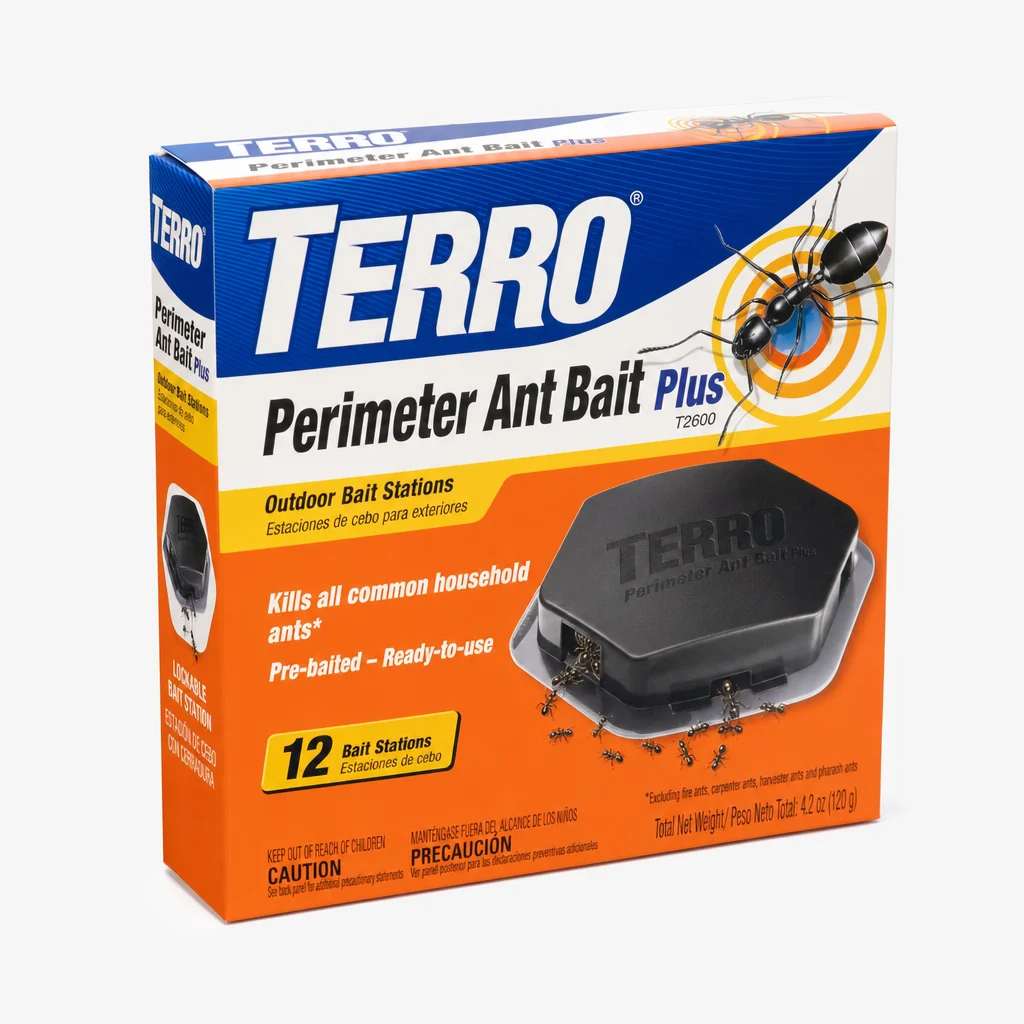
This is the patio and foundation product, supplied as a 2-pack of 2 lb bags for 4 lbs in total. It's formulated to kill insects outdoors and helps prevent carpenter ants, cockroaches, crickets, earwigs, silverfish, slugs and snails from coming inside. The weather-resistant granules provide long-lasting protection for up to 4 weeks.
With the T2600, you can walk on the treated patio once the product has settled. The granules are stable and won't degrade quickly, but check the area every 1–2 weeks and reapply if ants are still present.
Terro Ant Killer Plus (T901)
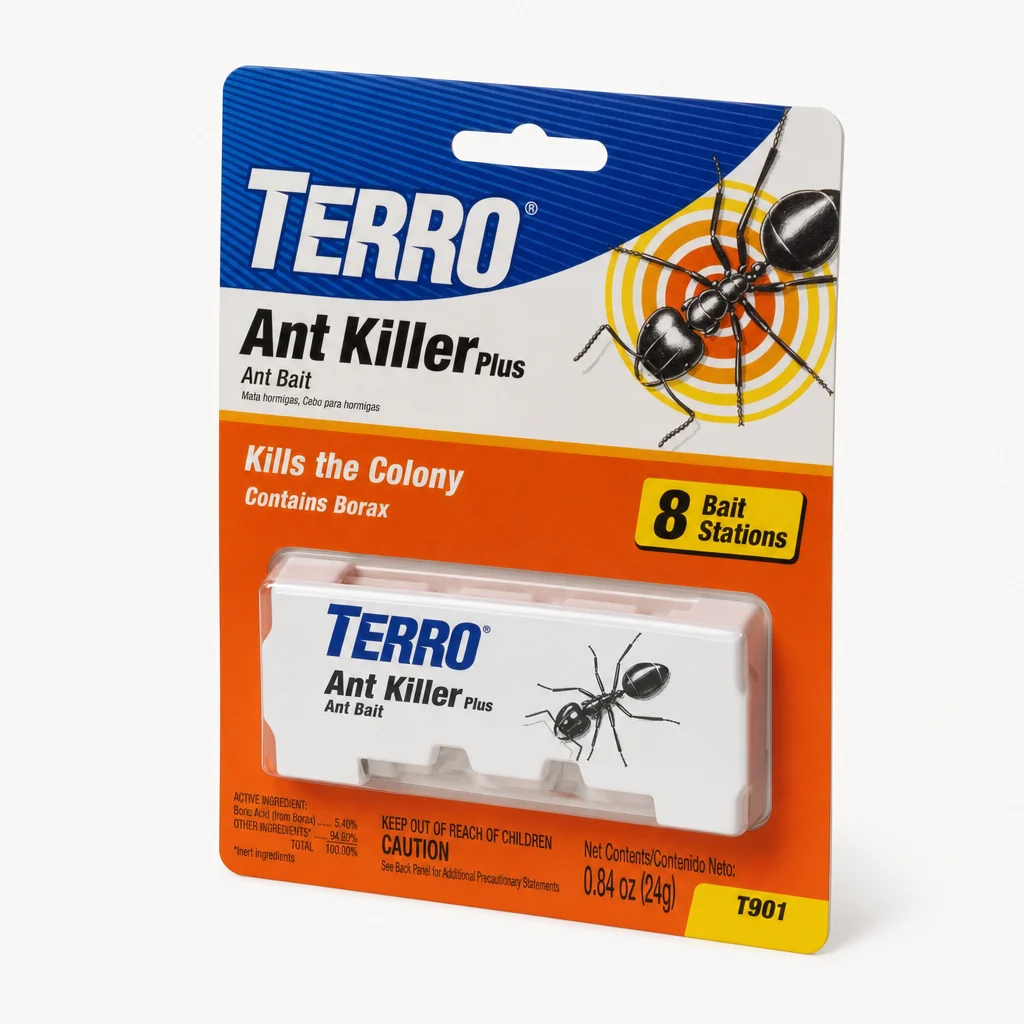
The fast-acting all-rounder. Supplied in a 3 lb resealable shaker bag, these granules eliminate insects within 24 hours and kill ants, fire ants, cockroaches, fleas and other insects. The flexibility is the appeal — use it as a band treatment around house foundations, broadcast on lawns, or as a spot treatment directly on ant hills.
Spectracide Triazicide Insect Killer for Lawns
This is the one to consider if you're treating a whole lawn rather than just a perimeter or a single nest. Available in 10 lb and 20 lb bags, it kills a wide range of lawn-damaging insects including ants, crickets, armyworms, chinch bugs, roaches and ticks. It provides season-long control against ants when applied at a rate of 2 lb per 1,000 sq ft. A 10 lb bag treats up to 12,500 sq ft, whilst the 20 lb bag covers up to 25,000 sq ft.
Crucial label caveat: Spectracide Triazicide explicitly excludes harvester and pharaoh ants from its ant control claims. If those are your species, this is the wrong product. The granules must be distributed evenly and watered in lightly immediately after application.
How the Chemical Options Compare
Laying the granular products side by side makes the right choice much clearer. They're not really competitors so much as specialists for different jobs — pick the one whose strengths match your specific situation.
| Product | Best for | Coverage / Size | Speed | Protection |
|---|---|---|---|---|
| Amdro Ant Block | House perimeter, 15 species | 1,080 linear ft (24 oz) | Fewer ants within 1 week | Up to 3 months |
| Terro Fire Ant Bait | Fire & harvester ants | 30,000 sq ft (2 lb) | Dying in 24–36 hrs | Up to 2 months |
| Terro Perimeter Plus (T2600) | Patios & foundations | 4 lb (2 × 2 lb) | Settles, then walkable | Up to 4 weeks |
| Terro Ant Killer Plus (T901) | Versatile spot/band use | 3 lb shaker bag | Within 24 hrs | Multi-purpose |
| Spectracide Triazicide | Whole-lawn coverage | Up to 25,000 sq ft (20 lb) | Water in after applying | Season-long |
To put the practical reach of these products in perspective, here's how their treated areas stack up — a useful way to judge value when you're matching product to plot size:
Humane vs Chemical: The Honest Trade-Off
This is the crux of the whole guide — the decision the editorial brief rightly puts front and centre, especially for those nests tucked under paving. There's no universally correct answer, only the right answer for your circumstances. Let me lay out how I actually think about it.
The humane route wins on ethics, safety and environmental impact. If you've got pets snuffling around the patio, children playing on the lawn, or vegetable beds nearby, the case for gravel barriers and essential-oil sprays is strong. The downside is equally real: deterrents move ants on, they don't eliminate them, and against a 100,000-strong pavement colony or a million-ant supercolony, scent sprays are simply outmatched.
The chemical route wins on decisiveness. A colony-targeting bait carried back to the queen ends the problem at source, often within days for fire ants and within weeks for slower-acting perimeter baits. The trade-off is the obvious one — you're introducing a synthetic insecticide into your garden, with all the care over pets, wildlife and edibles that demands.
My recommended middle path
For a nest under paving that's actively undermining the slabs, I lean towards a targeted bait applied precisely at the nest entrance rather than broadcast across the whole area. You solve the structural problem at source whilst minimising the spread of chemical across your garden. Then maintain with a gravel barrier to discourage recolonisation. Best of both worlds.
Application: Getting It Right Under Paving
Nests under paving are the trickiest scenario because you can't easily reach the heart of the colony. The ants are doing the equivalent of mining beneath your floor. Here's how I approach it methodically.
Step one — confirm the nest
Look for fresh sand or fine soil pushing up between specific joints. That's your nest entrance. Don't treat randomly; treat where the spoil is appearing.
Step two — choose your weapon
For under-paving colonies, a granular bait that the ants will carry below the slab is ideal. The Terro Perimeter Ant Bait Plus is purpose-built here — its weather-resistant granules survive on an exposed patio, and crucially you can walk on the treated patio once the product has settled. Apply along the joints where activity is highest.
Step three — be patient and recheck
Baits work by being shared throughout the colony, so resist the urge to sweep everything up after a day. Check the area every 1–2 weeks and reapply if ants are still present. With the perimeter granules you're looking at up to 4 weeks of protection per application.
Step four — maintain the gains
Once the colony is suppressed, fill the joints with fresh kiln-dried sand and consider a gravel barrier at the patio edge. This makes recolonisation far harder and means you may never need to bait again.
For lawn-wide ant problems rather than a single patio nest, the calculus changes. Spectracide Triazicide at 2 lb per 1,000 sq ft, watered in immediately, gives season-long control — but only for the species on its label, which excludes harvester and pharaoh ants.
Who Should Choose What
To cut through all of the above, here's the shortcut. Find the description that fits you and you've got your answer.
The coexister
You've got a few harmless lawn mounds and no real damage. Leave them be, or use gravel barriers and essential-oil sprays if they stray onto the patio. No need for chemicals at all.
The perimeter defender
Ants are using the edge of your house as a motorway. Amdro Ant Block covers the perimeter five times over from one bottle and handles 15 species for up to three months.
The fire-ant sufferer
Aggressive stinging mounds in the lawn. Terro Fire Ant Bait targets fire and harvester ants specifically, with ants dying in 24–36 hours.
The patio protector
A nest is undermining your slabs. Terro Perimeter Ant Bait Plus is weather-resistant, walkable once settled, and built for paving and foundations.
The whole-lawn campaigner
Ants across the entire lawn alongside other turf pests. Spectracide Triazicide gives season-long, multi-pest control over up to 25,000 sq ft.
The eco-conscious gardener
You want results without synthetic insecticides. A plant-based formula like Nature's Dome — geraniol, cinnamon and cottonseed oil — bridges the gap, with each vial making a 16 oz bottle.
Frequently Asked Questions
The Verdict
Getting rid of ants in the lawn and patio is far less about firepower than it is about judgement. The most useful skill is knowing when to do absolutely nothing — most garden ants are harmless allies, and reaching for granules out of reflex disrupts your soil ecosystem for no good reason.
When intervention is genuinely warranted — destabilised paving, dying lawn, supercolony species — match the tool to the job. Amdro Ant Block is the perimeter specialist with 15-species coverage and three months of protection. Terro Fire Ant Bait is the fast, targeted answer for fire and harvester ants. Terro Perimeter Ant Bait Plus is the weather-resistant, walkable choice for nests under paving. And Spectracide Triazicide handles whole-lawn campaigns across up to 25,000 sq ft.
My honest closing advice: start humane, escalate only if needed, and for under-paving nests use a precisely placed bait followed by a gravel barrier to lock in the result. That blend of restraint and decisiveness gives you a clean patio and a healthy garden — without declaring all-out war on a creature that's mostly minding its own business.