
Garden Rake Types Explained: Leaf, Landscape and Spring-Tine
Three rake types, three genuinely different jobs. Here is how to choose the one you need, rather than collecting three wrong ones in the shed.
Stop Buying the Wrong Rake: What This Guide Will Save You
Most gardens contain at least one rake that has become a shed ornament. It leans behind the mower, collects a cobweb or two, and comes out once a year for a task it handles with all the enthusiasm of a teaspoon in a gravel driveway. This is not because rakes are complicated. It is because several very different tools have been handed the same name.
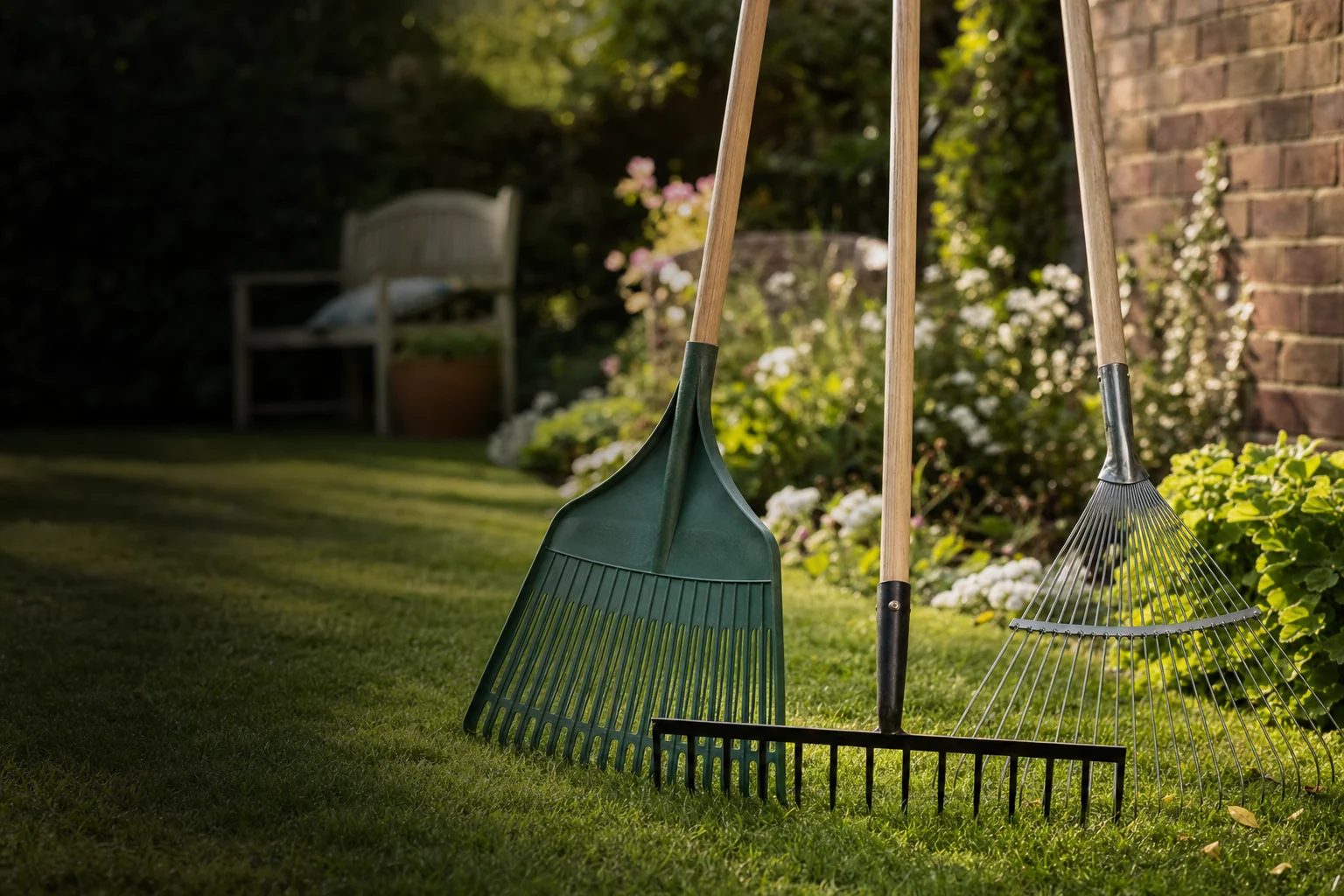
A leaf rake gathers loose material from the surface. A landscape rake shapes, spreads and levels soil or aggregate. A spring-tine rake reaches into the lawn surface to pull out thatch, moss and tangled debris. They may all have a handle and a row of tines, but that is roughly where the family resemblance ends.
The common mistake is buying a supposed all-purpose rake. It sounds economical. It rarely is. A broad leaf rake will not grade a seedbed neatly because its flexible tines float over the surface. A rigid landscape rake will move leaves, certainly, but it is about as elegant at the job as using a dining chair to sweep the kitchen. And a spring-tine rake used as a casual leaf collector can be needlessly aggressive on grass.
The better approach is not to own every rake under the sun. It is to identify the job your garden asks of you most often. If autumn leaf fall is your recurring nuisance, choose a leaf rake. If you are making beds, spreading soil, topdressing or smoothing a patch of ground, choose a landscape rake. If the lawn feels clogged at its base with moss and old organic matter, the spring-tine rake earns its keep.
The short version
Choose by what the tines must do. Flexible, curved tines are for gathering. Short, rigid teeth and a flat edge are for levelling. Pointed steel tines are for dragging material out of a lawn. Start there and the right rake becomes rather obvious.
This guide covers the three types in detail: what each is made to do, where it shines, and—equally useful—where it is the wrong tool. That final bit matters. A tool's limitations are not a flaw. They are usually the clue that you are looking at a specialist rather than a compromise.
The Rake Family at a Glance: Three Tools, Three Completely Different Jobs
Before getting into materials, widths and lawn thatch, it helps to put the three rake families side by side. The visual differences are useful, but the working differences are what should decide the purchase. Think of the head as the business end. Its width tells you how much ground it can cover, whilst its tine shape tells you what it can sensibly pick up or move.
| Feature | Leaf rake | Landscape rake | Spring-tine rake |
|---|---|---|---|
| Typical head form | Wide, triangular or fan-shaped head | Broad, level head with teeth on one side | Rake-style head with pointed metal tines |
| Head width | 10–30 inches; 18–24 inches are common for domestic use | Under 8 inches to 46 inches or more; 24–36 inches is a standard landscaping range | Varies by design; commonly offered with 18 or 24 tines |
| Tines | Usually 20–30 thin, flexible tines that curve down | Short, rigid steel or aluminium teeth | Thin, pointed steel tines |
| Common tine materials | Metal, plastic or bamboo | Steel or aluminium | Steel |
| Primary job | Collecting leaves and loose garden debris | Grading, levelling and spreading material | Dragging out lawn thatch, moss and debris |
| What it should not be asked to do | Serious soil grading or deep lawn scarifying | Delicate leaf gathering across grass and planting | Routine broad-area leaf gathering where a leaf rake is gentler |
The leaf rake is the least intimidating of the trio because its purpose is immediately visible. The wide fan skims across the lawn, paths and borders, gathering whatever is sitting there. Its flexibility is deliberate. It allows the head to follow a surface without behaving like a comb being dragged through the earth.
The landscape rake is the worksite-looking one. It has a long, straight head rather than a fan, and it is built around control of the ground itself. Its short teeth can pull soil into place and break up small clods, while the flat reverse face found on many designs helps smooth the surface. This is the tool for making an area look as though you planned it that way.
The spring-tine rake sits between the two in appearance, which is why it is routinely misunderstood. It is not simply a sturdier leaf rake. Its pointed metal tines are designed to get down among the grass and pull out the unwanted layer sitting at soil level. That action is scarifying by hand. It is useful. It can also be a little forceful, so it deserves a more considered approach than an afternoon of casual leaf sweeping.
A rake can weigh less than one pound or more than four pounds depending on its size and construction. For leaf work, lightness can make repeated passes more comfortable. For soil work, a little more substance can help the head stay composed against the ground.
There is no universal winner here. A garden with mature trees and a simple lawn may be perfectly served by a leaf rake and a spring-tine rake. A new garden, vegetable plot or regular topdressing routine makes the landscape rake far more relevant. The point is not to find the most impressive-looking tool. It is to buy the tool that prevents the most recurring irritation.
Leaf Rakes: The Classic Gather-and-Pile Workhorse
The leaf rake is the familiar fan-shaped tool most people picture when somebody says "rake". Its job is pleasingly plain: gather leaves, grass clippings and loose garden debris into manageable piles without digging into the soil below. It does this with a broad triangular head, generally carrying between 20 and 30 thin flexible tines.
Those tines are not merely spread out for appearances. Their flexibility helps the rake pass over grass, paving and other surfaces while the downward curve at their tips helps catch and pull leaves towards you. The shape gives you coverage without turning every pass into an excavation. That is the distinction. A good leaf rake moves material across a surface; it does not try to remodel the surface while doing it.
Width is the first sensible decision. Leaf-rake heads range from around 10 inches to 30 inches wide, but most domestic models fall into the 18- to 24-inch bracket. For many home gardens, 20 to 22 inches is the sensible middle ground. It is broad enough to make a lawn or patio feel less endless, yet narrow enough to work around borders, shrubs and the awkward strip between the shed and fence that somehow gets all the leaves.
Go smaller if you are working in confined spaces or among closely planted beds. A narrow head may require more passes across an open lawn, but it is easier to thread around pots and stems without knocking over half your carefully arranged border. Go wider if you have open ground with long, clear runs. The advantage is coverage, not magic: a wider rake shifts more material at once, but it also becomes more cumbersome when the terrain is uneven or full of obstacles.
Leaf-rake construction varies considerably. The head can be metal, rubber or plastic, while handles may be metal, wood, plastic or fibreglass. That mix affects weight, feel and long-term sturdiness. Heavy steel leaf rakes can approach four pounds, which may be welcome when dealing with compacted debris but is less charming after a long afternoon of repeated pulling. At the other end, very light rakes are easy to carry and manoeuvre, though the materials are not always as robust.
The most important choice is still the tines. Metal tines are durable and can be a sensible option where autumn debris is wet and compacted. Plastic tines make for a lightweight, affordable rake suited to dry leaf work, but they are less durable. Bamboo tines are lightweight and have the obvious appeal of a natural material, though they too are best treated as a light-duty option rather than a tool for rough, regular work.
Spring-type leaf rakes are among the most durable and versatile choices for light clean-up. The wording matters: light clean-up. Even a sturdy leaf rake is not a substitute for a landscape rake when you need to spread topsoil, pull a seedbed level or move gravel. It may manage a little of that work in a pinch, just as a butter knife can open a paint tin. Neither is the version of events you should plan around.
Where a leaf rake excels
- Fast collection of dry leaves and loose surface debris.
- Flexible tines follow grass and paving without deliberately digging in.
- A 20–22-inch head balances coverage with manoeuvrability for many home gardens.
- Multiple tine materials allow you to prioritise durability, low weight or natural construction.
Where it falls short
- Flexible tines do not provide the rigid edge needed for proper levelling.
- It is not designed to pull thatch and moss from within the lawn surface.
- Very wide heads can be awkward around borders and closely planted areas.
- Plastic and bamboo versions are less durable than metal-tined alternatives.
A leaf rake also rewards a small adjustment in technique. Pull it towards you in steady, overlapping strokes, building several modest piles rather than one heroic heap that spreads sideways every time you try to move it. In dense fallen leaves, the rake will collect better if you work from the outside of an area towards a central point. It is a simple habit, but it prevents the oddly common experience of raking the same leaves across the lawn for twenty minutes.
For routine garden tidying, this is often the only rake that needs to be within arm's reach. Just do not confuse "most frequently used" with "suitable for everything". That is how sheds fill up with bent tines and quiet resentment.
Tine Material Matters More Than You Think: Metal vs Plastic vs Bamboo
With leaf rakes, shoppers often focus on width first and material second. Width is important, but the tine material largely determines how the rake feels in use and how much abuse it is likely to tolerate. A fan rake is really a collection of springy fingers. Change what those fingers are made from and you change the character of the whole tool.
Metal tines are the durability-first option. They are generally heavier than plastic or bamboo, but they are better suited to more demanding leaf work, including wet and compacted material. They have the resilience expected of a rake that will be pulled through piles which have been rained on, walked on, and pressed into the lawn by a fortnight of weather. British autumn does enjoy setting that sort of challenge.
Plastic tines are attractive because they keep the tool light and tend to make it an affordable entry point. For dry leaves on a reasonably clear lawn or path, that can be exactly enough rake. The limitation is durability. Plastic is less robust than metal, so it makes most sense when the work is genuinely light rather than when you are trying to drag sodden leaf mulch out from under hedges.
Bamboo is another lightweight option. It brings a natural, eco-conscious feel and is well suited to light seasonal tasks. Its limitation is much the same in practical terms: it is less durable than metal and best reserved for gentle work. Bamboo is a charming material. It simply should not be expected to behave like steel after a hard season of clearing.
The chart is not a laboratory scorecard. It is a buying shorthand. There is no single material that wins every situation because leaf rakes are not bought for a single imaginary garden. A tiny paved courtyard with a few dry leaves asks almost nothing of a rake. A large lawn beneath mature trees asks quite a lot. The rake needs to match the reality, not the gardening fantasy where every leaf obligingly lands in one crisp pile.
Buy for the worst ordinary day
If your garden regularly produces damp, matted leaf fall, choose metal tines rather than hoping a lightweight rake will cope when conditions are at their least cooperative. If your task is simply dry, occasional debris, a lighter plastic or bamboo rake can be entirely sensible.
There is a handling difference as well. A heavier metal-tined rake can feel more planted during a pull, particularly when it is gathering a substantial pile. A lightweight rake is easier to carry, lift and use around delicate plants, though it may feel less composed when material gets denser. Neither sensation is inherently better. The question is whether you are raking for ten minutes after a breezy day or doing repeated clear-ups across a larger garden.
Storage deserves a mention because it is the unglamorous thing that often separates a rake that remains useful from one that becomes annoying. Keep the head out of prolonged contact with wet ground, avoid leaving any rake buried under heavier tools, and do not use the tines as a hook for dragging objects they were never intended to move. This is hardly thrilling advice. It is also the difference between treating a tool as a tool and using it as a very slow route to buying another one.
For most gardeners who want one dependable leaf rake, metal or spring-style construction is the broadest answer. Plastic and bamboo remain valid choices where lightness and low-intensity use matter most. The mistake is not choosing either of them. The mistake is asking them to take on the job of a heavier-duty rake and being surprised when they protest.
Landscape Rakes: The Unsung Hero of Soil Prep and Levelling
The landscape rake is arguably the most misunderstood member of the rake family, largely because its name sounds wonderfully broad and wonderfully vague. It is not a general garden tidy-up rake. It is a levelling and grading tool. If you are preparing soil, spreading material, evening out a rough patch or trying to make a seedbed look less like a battlefield, this is the rake you want.
Its head is usually long and straight rather than fan-shaped. On one face are short, rigid tines or teeth, commonly made from aluminium or steel. These pull material, distribute it and help deal with irregularities at the surface. The other side is generally flat for grading, with some designs adding a dedicated levelling blade for finer smoothing. That two-sided character is the central reason to choose a landscape rake over a conventional garden rake.
The tool's purpose becomes especially clear during soil preparation. The tined side can pull loose soil from a high spot into a low spot, break up surface clods and distribute material across a bed. Turn the head or reverse your action, and the flat side can skim over the surface to leave it more even. It is not glamorous work, but it is the sort that makes every later job easier: sowing, laying turf, adding a top layer or simply avoiding an oddly bumpy patch that catches the mower wheel.
Aluminium heads are popular because they keep large rakes relatively light, while steel offers ruggedness. Both materials should be resistant to rust and corrosion when properly made for outdoor tool use. Handle materials vary too, with wood, fibreglass and aluminium all used. It is worth considering the whole tool rather than staring only at the teeth. A broad head can create considerable leverage where it meets the handle, which is why bracing matters.
Bracing can run from the head to the handle, or wrap around the handle for a stronger structure. That reinforcement is not decorative. When a wide rake head catches a compacted patch of material, the connection point takes the strain. A well-braced tool is the one to look for if regular soil work is in your plans.
Short rigid teeth for pulling material
Landscape-rake teeth are made to engage loose soil and other surface materials. Their job is control, not delicate collection.
A flat face for grading
The reverse side typically provides a flat edge to smooth and level the area after the tines have done the heavier shaping work.
A broad head for efficient passes
Standard landscaping heads in the 24–36-inch range cover useful ground without moving into the giant professional widths available beyond that.
Bracing where the work happens
Bracing between head and handle can add meaningful durability, particularly on rakes intended for repeated grading and spreading.
A useful example of the compact end of this category is a Leonard landscape rake with a 17-inch-wide, quarter-inch-thick steel head. It has 16 tapered tines, each measuring 2½ inches long and spaced ¾ inch apart. That illustrates an important point: not every landscape rake is a vast tool for open ground. Narrower heads exist for controlled work where a 30-inch span would be more nuisance than help.
It also shows why the word "landscape" can be misleading. A large head does not automatically make a tool more capable in a domestic space. A rake that cannot turn comfortably in the working area is not saving time. It is merely presenting you with an arm workout and a new appreciation for fence posts.
What the landscape rake does not do particularly well is gather leaves from grass. Its teeth are rigid and its head is straight, so it tends to push, drag or snag rather than sweep up a generous soft pile. It can move loose debris from hard ground if needed, but that is a secondary convenience rather than its purpose. If leaf clearance is your main task, save yourself the effort and choose a leaf rake.
Choosing Your Landscape Rake Width: The Numbers That Actually Determine the Right Buy
Width is the single most consequential landscape-rake specification. More than handle material, more than colour, more than whatever impressive adjective is printed on the label. A head that suits the area makes levelling steady and almost satisfying. One that is too narrow makes every job feel longer than it should. One that is too wide turns a straightforward pass into a negotiation with every bed edge and pathway.
Landscape-rake widths can begin below 8 inches and extend to 46 inches or more. That is a huge spread because landscape work itself ranges from tidying a raised bed to preparing substantial open ground. The standard range for landscaping rakes is 24 to 36 inches, but "standard" does not mean "right for every garden".
Under 24 inches, a landscape rake starts to make particular sense in raised beds, smaller vegetable plots and narrow borders. You lose speed on open ground because each pass covers less area, but you gain precision. That matters when you are working near established plants, edging, timber frames or paths. A narrower tool can be placed exactly where it needs to go without needing a three-point turn at the end of every stroke.
Between 24 and 30 inches is a very sensible domestic zone. It offers enough width to make topdressing and medium seedbed preparation reasonably efficient, whilst staying manageable for one person in a typical garden plot. It is also broad enough to reveal why a landscape rake is different from a conventional bow or garden rake: it can pull a noticeably wider swathe of material into line.
At 24 to 36 inches, you are into the standard landscaping range. That is useful where the ground is open, access is clear and the project rewards longer, smoother passes. The extra width can save time during broad grading, but only if you have room to use it. On a small plot full of corners, containers and shrubs, the theoretical speed advantage can vanish very quickly.
Measure the narrowest route to the area you need to rake, not merely the area itself. A broad head is no use if it constantly catches on bed edging, gates or tightly spaced planting on the way there.
It is tempting to think a head twice as wide will complete the job in half the time. In clear, even conditions, a wider pass obviously covers more ground. But gardens are not factory floors. Soil can be uneven, material can bunch up, and every obstacle reduces the benefit of a very broad tool. Control matters because levelling is an accuracy task. The aim is not merely to move soil; it is to leave the surface in a better state than you found it.
Consider what you will spread as well. Fine material such as topdressing benefits from a controlled, even pull. Looser soil may need a more assertive pass with the toothed side before smoothing. A wide head helps where the material is already distributed across open ground. A narrower head can be easier when you are moving material into small gaps and working around structures.
The correct choice therefore comes down to your garden geometry. Choose a narrower landscape rake for precision and restricted spaces. Choose a 24–30-inch model as a practical middle ground for many home projects. Consider the upper end of the usual landscaping range only when the space is genuinely open enough to reward it. Bigger is not always better. Bigger is occasionally just bigger.
Spring-Tine Rakes: The Lawn's Best Friend—and the Most Misunderstood Rake in the Shed
The spring-tine rake, often called a lawn rake, has a silhouette close enough to a leaf rake to cause endless confusion. Look closer and the intention changes. Instead of broad, flexible tines made to skim over a surface, it uses thin pointed metal tines designed to reach down into the lawn and drag out embedded debris.
Its core job is scarifying by hand. Scarifying means removing thatch: the layer of dead grass clippings, moss and other debris that builds up at the soil surface around the base of grass plants. This layer can become a barrier between the weather above and the lawn roots below. Water and nutrients struggle to reach where they are needed, grass growth can be inhibited, and moss is encouraged to form.
That is why a spring-tine rake deserves its own category. It is not trying to make the lawn look tidier for an afternoon. It is trying to improve what is happening at ground level. The tines flex enough to grab stubborn, matted material without bending out of shape, while their pointed ends allow them to work into the surface rather than simply glide over it.
Why it earns a place
- Pointed steel tines can pull out thatch, moss and accumulated debris from the lawn surface.
- Scarifying helps address material that can prevent water and nutrients reaching grass roots.
- Steel tines flex to catch stubborn, matted debris without readily bending out of shape.
- 18-tine and 24-tine versions allow a choice between control and wider coverage.
Why it needs restraint
- It is more aggressive than a leaf rake and is not the first choice for casual surface tidying.
- It will not level soil as effectively as a landscape rake with a flat grading face.
- Working a large lawn by hand takes effort because the rake is deliberately engaging the surface.
- A broader 24-tine version offers coverage, but less close control around tight lawn edges.
The choice between 18 and 24 tines is a practical one. A 24-tine version makes sense for open-ground autumn clean-up where coverage matters. More tines give you a broader working sweep, which is useful when you have clear access and a generous lawn area. An 18-tine version gives more control in tighter spots and around bed edges, where you do not want to catch border plants or work too close to a boundary.
Neither configuration turns the spring-tine rake into a leaf rake, though it can pull loose debris as part of its work. The difference is depth. A leaf rake is concerned with material resting on top. A spring-tine rake is concerned with material sitting among the grass stems, close to the soil surface. Using the latter for every loose leaf is unnecessary. Using the former to solve a dense thatch problem is usually ineffective.
The visual clue to remember
If the rake's tines are fine, pointed steel and intended to pull through the turf, it is a lawn-management tool. Treat it as scarifying equipment, not simply as a tougher-looking leaf rake.
There is a pleasingly direct payoff when a lawn is suffering from thatch and moss. You can see what comes out. It is rarely beautiful. In fact, it often looks like the lawn has produced a collection of small, damp wigs. But that unpleasant material is exactly what was sitting at the base of the grass, where it could interfere with the lawn's access to water and nutrients.
For gardeners who care about a lawn but do not need every tool to be motorised, a spring-tine rake is a valuable bit of kit. It is manual, focused and uncomplicated. It does one job well. The secret is simply knowing that the job is lawn maintenance rather than leaf collection.
The Thatch Problem: Why Spring-Tine Rakes Earn Their Place in UK Lawns
Thatch is one of those garden problems that can be easy to miss because it lives in the gap between "the lawn looks a bit tired" and "something is definitely wrong here". You may see moss, bare patches or grass that seems less vigorous than it ought to be, but the issue is often not just what is visible above the surface. It is the accumulated layer down at the base of the grass.
Dead clippings, moss and other organic debris collect there and form thatch. When this layer becomes significant, it can inhibit grass growth by preventing water and nutrients from reaching the roots effectively. It can also encourage moss. For gardeners who have looked at a mossy lawn in spring and wondered how it became such a determined green carpet, that is the connection worth understanding.
The spring-tine rake tackles that layer mechanically. Its thin pointed metal tines work through the grass and pull debris outward. Unlike a leaf rake, which is built to scoop up what is loose on the surface, the spring-tine rake is intended to engage the lawn at a lower level. The action is more purposeful, and it should feel that way.
There is no need to make the process mystical. If your lawn has developed bare patches or moss, scarifying is the maintenance task designed to remove the thatch behind those symptoms. The removed material may include dead clippings, moss and the debris that has collected on the soil surface. Clearing it gives water and nutrients a clearer route towards the roots.
The moss-watchful gardener
Choose a spring-tine rake if moss is appearing and you want to address the debris layer at the lawn surface rather than merely clear fallen leaves.
The small-lawn owner
An 18-tine rake gives useful control around tight edges, borders and restricted areas where precision is more useful than a wide sweep.
The open-ground gardener
A 24-tine version is suited to broader fall clean-up where coverage matters and there is room to make longer passes.
How forcefully you work matters. A spring-tine rake is meant to remove unwanted material, not turn an ordinary lawn into exposed soil. Work methodically rather than trying to achieve everything in one frantic pass. You are looking to lift the matted debris that does not belong, not wage a personal war against every blade of grass. Gardens have a way of remembering over-enthusiasm.
It is also useful to separate the task of scarifying from the task of leaf clearing. If the lawn is covered in a simple layer of dry leaves, clear those with a leaf rake first. That is faster and gentler. Bring in the spring-tine rake when the problem is thatch, moss or embedded debris at the base of the grass. The two tools can work in the same garden without duplicating each other.
Thatch is not just an appearance issue. It can inhibit grass growth by restricting the path of water and nutrients to the roots, while also encouraging moss formation. That is the reason scarifying is a lawn-care task rather than a cosmetic extra.
For some lawns, a spring-tine rake will be an occasional tool. That is fine. Its value is not measured by how often it leaves the shed, but by whether it addresses a problem that the leaf rake and landscape rake cannot. A rake that solves one specific recurring issue is far more useful than a general-purpose tool that only half-solves three.
How to Use Each Rake Without Fighting It
The best rake can still feel useless if it is used against its design. Fortunately, the basic technique for each type follows directly from the shape of the head. Once you stop expecting a rake to do a different rake's job, the work becomes simpler and usually quicker.
Using a leaf rake: skim, gather, consolidate
Set the leaf rake on the surface and draw it towards you in overlapping strokes. Let the flexible tines do the gathering. They should sweep leaves together rather than gouge into the lawn or border. Keep your piles modest and move them as you go; a pile that becomes too large is more likely to scatter when the wind gets involved, which it generally will at the exact wrong moment.
Use a narrower head where space is tight and a wider head where the ground is open. If you are working around plants, slow down near stems and pots. The advantage of flexible tines is that they are forgiving, but no rake is clever enough to distinguish a fallen leaf from your favourite newly planted perennial.
Using a landscape rake: pull, assess, smooth
Start with the tined face to pull and distribute material. Work in measured passes rather than randomly attacking the most obvious mound. Once the material is roughly where it needs to be, use the flat side to skim and level the surface. This two-stage approach is what makes the tool so useful. The teeth move material; the flat edge refines the finish.
Do not rush the last smoothing passes. The landscape rake can only leave behind what your movements tell it to leave behind, and abrupt changes of direction tend to create ridges. Steady pulls and small corrections are more effective than trying to fix everything with one dramatic sweep. The dramatic sweep is satisfying, admittedly. It is just not always productive.
Using a spring-tine rake: engage the lawn, then clear the debris
With a spring-tine rake, the aim is to let the pointed steel tines work into the lawn surface and drag out the thatch, moss and debris that has accumulated there. Work over an area in controlled passes, then collect the material you have lifted. This is more demanding than ordinary leaf raking because the rake is deliberately engaging what sits among the grass.
Use the tine count to guide the setting. A 24-tine rake is useful when you have open ground and want coverage. An 18-tine version offers more control around edges and in tighter spaces. In both cases, remember that you are scarifying, not merely sweeping. That simple shift in expectation makes the tool make sense.
Leaf rake: stay on the surface
Its curved, flexible tines are intended to catch loose leaves and debris while avoiding unnecessary digging.
Landscape rake: work the profile
Use the teeth to distribute material, then the flat side to grade it into a smoother, more even finish.
Spring-tine rake: reach into the turf
Pointed metal tines drag out the organic debris layer that can collect at the base of grass plants.
There is a wider lesson here. Garden tools feel far more competent when you give them a clearly defined role. The leaf rake becomes a quick clean-up tool. The landscape rake becomes the one you reach for before a bed, seed or soil project. The spring-tine rake becomes a lawn-maintenance tool rather than an alarming object you only find when searching for something else.
Garden Rake Questions, Answered
Not properly. A leaf rake can collect loose debris, a landscape rake can grade and level material, and a spring-tine rake can pull thatch from a lawn. There is overlap at the edges, but the head and tines of each are designed for a distinct purpose.
Leaf-rake heads run from 10 to 30 inches wide. Domestic models are commonly 18 to 24 inches, and 20 to 22 inches offers a useful balance of coverage and manoeuvrability for many home gardens.
Choose metal for durability and more demanding leaf work, particularly where leaves are wet or compacted. Plastic is lightweight and suitable for dry leaf work but less durable. Bamboo is lightweight and best suited to light seasonal use.
The teeth on one side pull and distribute material. The flat reverse face is used for grading and smoothing the surface. Some models include a levelling blade for even finer finishing.
No. A spring-tine rake uses thin, pointed metal tines to reach into the lawn and drag out thatch, moss and debris near the soil surface. It is intended for scarifying rather than ordinary surface leaf collection.
Choose 18 tines when control matters in tighter spaces or around bed edges. A 24-tine version is useful for open-ground fall clean-up where wider coverage matters more.
The GardenScout Verdict: Buy for the Job in Front of You
If there is one takeaway from the rake aisle, it is this: "rake" is a category, not a promise that every model will manage every task. The leaf rake, landscape rake and spring-tine rake are not competing versions of the same thing. They are three specialists that happen to share a handle.
For leaves, grass clippings and loose debris, choose a leaf rake with flexible, downward-curving tines. A 20–22-inch width is a particularly practical balance for many home gardens, and metal tines are the durable choice where leaf fall is wet or compacted. Choose plastic or bamboo when the task is lighter and low weight matters more.
For preparing soil, spreading material and making a surface level, choose a landscape rake. Its short rigid teeth and flat grading side are exactly what a fan rake lacks. Focus on width: under 24 inches favours precision, 24–30 inches is a strong domestic compromise, and the broader 24–36-inch landscaping range makes most sense where you have open ground to work.
For moss, thatch and debris caught around the base of grass plants, choose a spring-tine rake. Its pointed steel tines are made for scarifying, helping remove material that can restrict water and nutrients from reaching lawn roots while encouraging moss. An 18-tine head gives close control; 24 tines favour broader open-ground coverage.
The sensible three-question buying test
Am I gathering loose material? Buy a leaf rake. Am I shaping soil or spreading material? Buy a landscape rake. Am I pulling moss and thatch out of grass? Buy a spring-tine rake. Answer honestly, and you will almost certainly buy fewer wrong tools.
That is the whole trick. Ignore the vague promise of "general purpose", look at the tines, and choose the tool whose design matches the task you actually repeat in your garden. Your shed may still contain an assortment of mysterious things. At least the rake will no longer be one of them.