
The Best Drip Irrigation Kits for Beds, Pots and Greenhouses
A hands-on guide to timer-driven micro-irrigation — how to plan a system for a small garden, and which kits genuinely earn their place on the spigot.
There's a particular type of guilt familiar to anyone who keeps a small garden: you go away for a long weekend in July, and you come home to a row of tomatoes that look like they've been through a desert crossing. I've done it. We've all done it. And after enough years of hauling watering cans up and down a too-narrow path, I finally surrendered to the obvious solution — a proper timer-driven drip irrigation system.
The good news is that micro-irrigation has come a long way from the fiddly, leaky tangle it used to be. The modern generation of quick-connect kits genuinely lets you water raised beds, a cluster of patio pots, and a greenhouse bench from a single outdoor tap, on a schedule, whilst you're somewhere else entirely. The slightly less good news is that "drip irrigation kit" is now a hugely broad category, and the difference between a great choice and a frustrating one comes down to matching the kit to your specific layout, water pressure and plant types.
So in this guide I'm going to do two things. First, I'll walk through the kits that consistently come out on top for beds, pots and greenhouses — what each is actually good at, where they fall short, and the real specifications that matter. Second, and just as importantly, I'll show you how to plan a system so you don't end up buying twice. Let's get our hands dirty.
How Timer-Driven Drip Irrigation Actually Works
Before we get into specific kits, it's worth understanding the anatomy of a system, because every kit on this list is just a different combination of the same core parts. Once you can picture the chain, the buying decisions get much easier.
Water enters from your outdoor tap or spigot. From there it passes through a backflow preventer (which stops dirty garden water siphoning back into your drinking supply), then a pressure regulator (which drops mains pressure down to the gentle level drip emitters are designed for), and then into the mainline tubing — usually 1/2-inch poly tube that snakes around your beds. From the mainline you branch off with thinner 1/4-inch micro tubing that delivers water to individual emitters, drippers, micro-sprayers or misters right at the root zone.
The magic ingredient for the small-garden owner is the timer. Screw a battery timer onto the tap, set a watering window, and the system does the rest — typically early morning before the heat of the day, when evaporation is lowest and plants drink most efficiently.
Backflow preventer
A non-negotiable safety part that keeps garden water out of your potable supply. Better kits, like the DIG GE200, include a 3/4-inch unit in the box.
Pressure regulator
Drip emitters want low, steady pressure. The DIG GE200 ships with a 3/4-inch 25 PSI regulator, which is bang in the sweet spot for most domestic taps.
Emitters and drippers
The business end. Pressure-compensating (PC) drippers deliver the same flow whether they're first or last on the line — crucial for even watering on long runs.
The timer
A battery tap timer turns a manual kit into a "set and forget" system. Some kits, like the Raindrip R560DP, include one; many do not.
Many of the most popular kits — the DIG GE200, the Carpathen, and the MIXC 230FT among them — do not include a timer. That's not a fault; it just means you'll add a tap timer separately to automate things. Only a handful of kits bundle one in.
The Quick Specifications Overview
Here's a snapshot of the headline numbers that tend to decide things for a small garden. I've pulled out the figures that genuinely affect your buying decision — coverage area, what's in the box, and the operating pressure your tap needs to deliver.
Best Overall: The DIG GE200 Drip & Micro Sprinkler Kit
If I had to point a first-time buyer at a single kit and walk away confident they'd be happy, it would be the DIG GE200. It's the one that consistently earns "best overall" honours, and having looked closely at what it includes, that reputation is well-deserved. This is a genuinely complete starter system rather than a bag of bits that assumes you already own half the parts.
The headline figure is coverage: up to 700 square feet, which is far more than most small gardens will ever need. That generous spec means you can plumb a couple of raised beds, a border, and a row of pots and still have tubing left over. What I like most is the hybrid approach — it's not purely drip or purely spray, but both.
What's in the box
The GE200 ships with a properly thought-through parts list. You get a 3/4-inch backflow preventer, a 3/4-inch 25 PSI pressure regulator, and a 3/4-inch swivel adapter — so the entire tap-end assembly is sorted out of the box. There's a substantial 200 feet of 1/2-inch mainline tubing (.600 ID x .700 OD) plus 50 feet of 1/4-inch micro tubing for the branch runs.
For emitters, you get 20 one-GPH pressure-compensating button drippers — ideal for individual plants and pots — alongside 11 micro sprayer assemblies mounted on 13-inch stakes. The sprayers come in a mix of patterns: three 360-degree heads, four 180-degree heads, and four 90-degree heads. That pattern variety is exactly what makes the GE200 so versatile. Use the 90-degree sprayers along a wall or fence, the 180-degree ones at the edge of a bed, and the 360s in the middle of an open planting.
Mixed delivery, one kit
Twenty PC button drippers for pots and individual plants, plus eleven adjustable-pattern micro sprayers for seedling beds and densely planted areas.
Complete tap-end assembly
Backflow preventer, 25 PSI regulator and swivel adapter all included — no separate shopping trip for the bits that protect your water supply.
Long runs covered
200 ft of 1/2-inch mainline is plenty to route around several beds, with 50 ft of 1/4-inch micro tube to reach each plant.
The GE200 operates on water pressure alone and is designed for manual operation — it does not include a timer. To make it automatic, add a battery tap timer at the spigot before the backflow preventer. It connects to any 3/4-inch faucet, spigot or standard garden hose.
Pros
- Huge 700 sq ft coverage — comfortably handles a whole small garden
- Both drip emitters and adjustable micro-sprayers in one kit
- Complete tap-end assembly (backflow preventer + 25 PSI regulator) included
- Pressure-compensating drippers give even flow across long runs
- Generous 200 ft mainline + 50 ft micro tubing
Cons
- No timer included — you'll buy one separately to automate
- Sheer parts count can feel overwhelming on a first build
- Overkill if you only need to water a handful of pots
Best With a Timer Built In: Raindrip R560DP
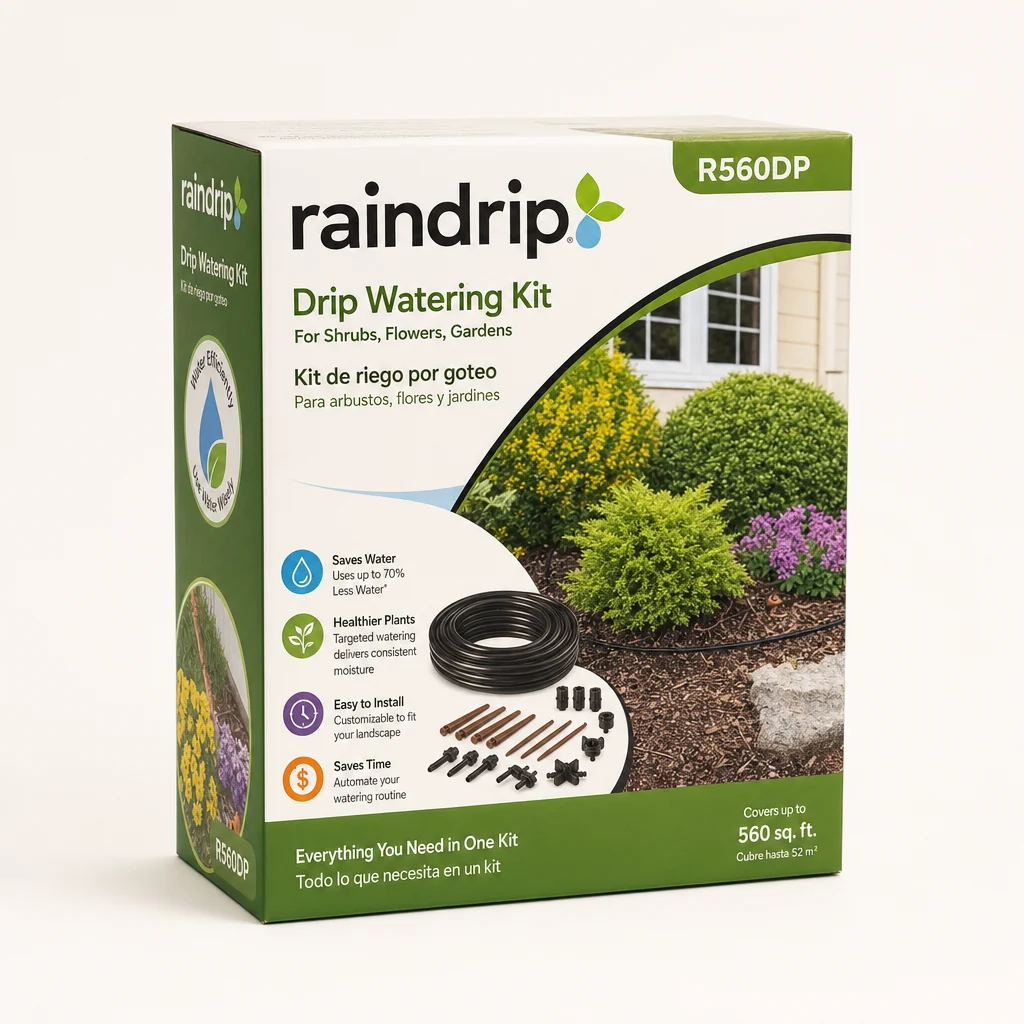
For anyone whose main motivation is automation — the long-weekend-away crowd, in other words — the Raindrip R560DP solves the puzzle by putting everything in one box, timer included. It's described as a kit designed to water up to 20 plants with automatic, scheduled watering, and it's long been treated as something of a benchmark for hobbyist setups and small greenhouses.
The contents are tidy and purposeful. You get Raindrip's own battery-operated timer, 75 feet of 1/4-inch supply tubing plus an adapter, and 20 half-GPH pressure-compensating drippers with 20 stakes and 10 clamps to hold everything in place. Crucially, it also includes the small fittings that catch people out — barbed couplings, elbows, tees and an end plug — so you can actually route the tubing around corners and split it without an extra parts run.
That half-GPH dripper rate is a deliberate choice. It's a gentler delivery than the GE200's 1-GPH drippers, which suits potted plants, hanging baskets and planter beds where you want a slow soak rather than a gush. Raindrip lists potted plants, hanging baskets, planter beds, lawns and shrubs as intended uses, and in practice it's the planter-and-pot scenario where it shines.
Why the included timer matters
Buying a kit with a matched timer removes the single biggest source of beginner frustration: mismatched threads and adapters at the tap. With the R560DP, the timer, supply tubing and adapter are designed to work together out of the box, so your first watering schedule is running within an hour.
On longevity, real-world testing of drip timers in raised-bed setups is encouraging. One tester running drip emitters in a raised bed reported consistent flow with no skipped scheduled waterings, and battery life lasting around three months with daily operation. That tallies with what owners of comparable battery timers report generally — typically two to three months on a set of batteries, with the better units stretching considerably longer.
Pros
- Battery timer included — genuinely automatic out of the box
- Gentle 0.5-GPH PC drippers ideal for pots and baskets
- All the awkward fittings (tees, elbows, couplings, end plug) supplied
- Around three months of battery life with daily watering in testing
- Long-standing benchmark for hobbyist and small-greenhouse use
Cons
- Caps out at around 20 plants — less headroom than larger kits
- Uses 1/4-inch supply tubing rather than a thicker 1/2-inch mainline, which limits very long runs
- No micro-sprayers, so less suited to densely sown seedling beds
Best for Raised Beds: Carpathen Drip Irrigation System Kit
Raised beds have their own quirks. The soil sits proud of the surrounding ground, the planting is usually dense, and you often have several beds in a row that need linking together. The Carpathen kit is built around exactly this scenario, and it's the one I'd reach for if my garden were a tidy grid of timber-edged beds.
This is a 230-foot kit using both 1/4-inch and 5/16-inch tubing with quick-connect fittings throughout. The 5/16-inch mainline is an interesting middle ground — thicker than the 1/4-inch supply tube on simpler kits, so it carries water more confidently along a run, but more flexible and easier to route around bed corners than rigid 1/2-inch poly. A typical configuration gives you 50 feet of 5/16-inch mainline with 50 feet of 1/4-inch drip tubing, supporting up to 30 emitters — which the manufacturer pitches squarely at mid-sized raised beds.
The standout feature is the adjustable drip emitters, which let you fine-tune the flow at each plant's root zone. In a mixed bed where chillies, lettuces and herbs all want slightly different amounts of water, that per-emitter adjustability is genuinely useful rather than a gimmick. The kit also throws in mist nozzles, which earns it a place in greenhouses and propagation areas too.
Operating pressure and quick-connect ease
Carpathen designs this kit for an operating range of 20–45 PSI, which is a comfortable band for most domestic taps and rainwater-pump setups. The quick-connect fittings are the real time-saver here — push-fit connections that don't require clamps or tools, so assembling a multi-bed layout is closer to building with LEGO than plumbing.
Like several kits in this roundup, the Carpathen does not include a timer. Pair it with a battery tap timer to automate, and check your tap's pressure sits within that 20–45 PSI window — if your supply runs higher, a separate pressure regulator will keep the emitters happy.
Pros
- 5/16-inch mainline strikes a great balance of flow and flexibility for beds
- Adjustable emitters let you dial in each plant individually
- Supports up to 30 emitters — plenty for several mid-sized beds
- Quick-connect fittings make assembly fast and tool-free
- Mist nozzles included for greenhouse and propagation use
Cons
- No timer in the box
- Needs a pressure regulator added if your tap exceeds 45 PSI
- 5/16-inch tubing uses less common fittings than standard 1/2-inch systems
Best for Pots and Containers: Orbit & Proven Winners
Not everyone has beds. Plenty of small gardens — and certainly most balconies and courtyards — are entirely container-based, and a sprawling 200-foot mainline kit would be wildly over-specified. For these setups, two compact systems stand out.
Orbit Micro Watering Drip Kit
The Orbit micro kit is purpose-built for pots. It includes eight bubblers along with all the hoses and fittings needed to plumb them into pots and containers, and it's rated for around 250 square feet of coverage. Bubblers are a slightly different beast to drippers — they deliver a small, gentle flood of water at the base of a plant, which suits larger containers where a single point dripper would leave the edges dry. If your patio is a collection of generous terracotta pots, the bubbler approach keeps the whole rootball evenly moist.
Orbit also offers a hose-end hanging basket kit, which deserves a mention for anyone whose summer display is mostly suspended baskets — notoriously the fastest things in any garden to dry out and the most awkward to reach with a can.
Proven Winners WaterWise Drip Irrigation System
The WaterWise system is pitched explicitly at small gardens and can water up to 10 potted plants from a single faucet, expandable to 30 containers with additional drippers. That expandability is the clever part — you start small with the pots you have, then grow the system as your collection grows, without rebuilding from scratch. It carries a strong reputation among owners, scoring 4.5 out of 5 in user reviews with 77% awarding the full five stars.
Pro tip for container gardeners
Pots dry out far faster than beds because they have a tiny soil volume and lose moisture from the sides as well as the top. If your garden is container-heavy, prioritise a kit you can expand (like the WaterWise) and run it more frequently for shorter bursts — little and often beats one long daily soak for pots.
The balcony grower
A handful of pots and a couple of baskets. The Orbit micro kit's eight bubblers or the WaterWise's 10-pot capacity are spot-on without overspending on tubing you'll never use.
The expanding collector
Plans to keep buying pots? The WaterWise scales from 10 to 30 containers, so you add drippers rather than replacing the system.
The big-pot patio
Large containers with sizeable rootballs benefit from Orbit's bubblers, which flood the whole base evenly rather than a single drip point.
Best Budget-Friendly All-Rounders: MIXC & Bonviee 230FT Kits
If you want maximum flexibility for the least outlay, the big "230FT" quick-connect kits — the MIXC DIT-03 and the Bonviee being the most prominent — are the workhorses of the category. These are the kits that come in a single box absolutely stuffed with tubing, emitters, misters, stakes and fittings, designed to let you tackle whatever combination of beds, pots and greenhouse benches you happen to have.
The MIXC 230FT kit connects to the tap via a 3/4-inch connection feeding the main line, and includes quick-connect fittings, adjustable emitters, misters and stakes. The clever bit is the three types of adjustable emitter for different moisture needs — so a thirsty courgette and a drought-tolerant lavender can sit on the same system and each get an appropriate amount. The quick-connect design follows the same tool-free philosophy as the Carpathen, which makes initial assembly and later tweaking refreshingly painless.
These kits aren't fancy, and they don't include a timer, but they represent the most tubing and the widest range of emitter types for the money. For a first-time builder who wants room to experiment, that abundance is a genuine virtue — you can afford to make a mistake, cut a length wrong, or change your layout next season without feeling you've wasted a precious component.
The 230FT class of kits is brilliant value, but the trade-off is that the included fittings and emitters are the most generic. They work well, but if you later want pressure-compensating drippers for very long runs, you may upgrade specific components over time.
Head-to-Head Comparison
Here's how the leading kits stack up on the specifications that matter most for a small garden. I've focused on coverage, what delivery method each uses, whether a timer is included, and the operating pressure where it's known.
| Feature | DIG GE200 | Raindrip R560DP | Carpathen |
|---|---|---|---|
| Best for | Whole small garden | Automated pots & beds | Raised beds |
| Coverage / capacity | Up to 700 sq ft | Up to 20 plants | Up to 30 emitters |
| Tubing supplied | 200 ft (1/2") + 50 ft (1/4") | 75 ft (1/4") | 230 ft total (5/16" + 1/4") |
| Emitters | 20 × 1-GPH PC + 11 sprayers | 20 × 0.5-GPH PC | Adjustable + mist nozzles |
| Timer included | No | Yes | No |
| Tap-end parts | Backflow + 25 PSI regulator | Adapter included | Quick-connect fittings |
| Operating pressure | Water-pressure operated | — | 20–45 PSI |
| Connection | 3/4" faucet/hose | Tap adapter | Quick-connect |
The takeaway from this table is that there's no single "best" — there's a best for your situation. The GE200 dominates on sheer coverage and completeness of the tap-end assembly. The R560DP wins on out-of-the-box automation. The Carpathen is the specialist's choice for a tidy grid of beds. Pick based on what your garden actually looks like, not on which has the biggest spec on paper.
Performance and Reliability in Real Use
Specifications only tell you so much; what matters is whether a system runs reliably through a dry summer without you constantly fiddling with it. Hands-on testing data for this category is thinner than I'd like, but the figures that do exist paint a consistent and reassuring picture.
On the timer side, reliability is the headline. One tester running a drip timer with emitters in a raised bed reported consistent flow with no skipped scheduled waterings, and a battery life of around three months on daily operation. That's the single most important real-world metric for a small-garden owner, because a timer that quietly skips a watering whilst you're away defeats the entire purpose. Owners of comparable battery timers commonly report two to three months of operation per battery set, with the more efficient units stretching well beyond that — some claiming over a year of reliable service.
On the hydraulics, the DIG systems are rated for a maximum operating pressure of 60 PSI and a maximum flow rate of 220 GPH (that's 3.6 gallons per minute) — comfortably more than a domestic small-garden layout will ever demand, which means plenty of headroom and no risk of starving emitters at the far end of a run. The accompanying DIG BO9D timer is rated for a flow rate up to 6.3 GPM with a battery life of up to a year, if you decide to add the matching timer to a DIG build.
Mind your minimum pressure
It's not just maximum pressure that matters. Some systems have a minimum, too — for example, the DripWorks Medium Deck Kit needs at least 15 PSI to operate effectively. If you're running off a rainwater butt with a low-pressure gravity feed, check the minimum before you buy; you may need a pump.
The other reliability story is in the emitters themselves. Pressure-compensating (PC) drippers — found in both the DIG GE200 and the Raindrip R560DP — are worth seeking out for any run longer than a few metres. A non-compensating dripper delivers more water at the start of a line (where pressure is highest) and less at the far end, so plants nearest the tap get drowned whilst those at the end go thirsty. PC drippers level that out, giving you genuinely even watering regardless of position on the line. It's the kind of detail that doesn't show up in a flashy product photo but makes a tangible difference across a season.
How to Plan a System for a Small Garden
This is the part most buying guides skip, and it's the part that actually determines whether you're happy with your purchase. Planning a drip system is genuinely simple if you do it in the right order. Here's the approach I use.
Step 1 — Map and zone your garden
Sketch your garden roughly to scale and group plants by water need. Thirsty annuals and vegetables in one zone, drought-tolerant Mediterranean herbs and established shrubs in another, pots in a third. This grouping decides where your emitters go and which type each plant wants. Mixing wildly different water needs on one un-adjustable line is the classic beginner mistake.
Step 2 — Measure your runs
Walk a tape measure along the route the mainline will take — around bed edges, between containers, into the greenhouse. Add it up. This tells you how much 1/2-inch (or 5/16-inch) mainline you need and whether a 230-foot kit is generous overkill or just right. For most small gardens, you'll be pleasantly surprised how little you actually need.
Step 3 — Count and choose emitters
One dripper per small pot; two or three around the rootball of a large container or shrub. For a seedling bed, a micro-sprayer covers more ground than individual drippers. Total your emitter count and check it sits within your kit's capacity — the Carpathen's 30-emitter limit, the GE200's 20 drippers plus 11 sprayers, the Raindrip's 20 plants.
Step 4 — Check your tap pressure
This is the step everyone forgets. Match your tap's pressure to the kit's range — the Carpathen wants 20–45 PSI; the DIG GE200 ships with a 25 PSI regulator to bring mains pressure down to the right level. Too much pressure blows emitters off the line; too little and the far emitters barely dribble.
Step 5 — Add automation last
Once the physical layout works when you turn the tap on by hand, add a battery tap timer at the spigot. Set it for an early-morning window — that's when evaporation is lowest and plants drink most efficiently. Start with a conservative schedule and adjust after watching how the soil responds over a few days.
Most DIY drip kits cover between 150 and 750 square feet, so there's a kit sized for almost any small garden. Measuring your runs in Step 2 stops you buying a 700 sq ft system for a 40 sq ft courtyard — or worse, running short.
Our Overall Rating
Taking the category as a whole — and weighting it towards the small-garden owner who wants reliable, automated watering of beds, pots and a greenhouse — here's how I'd score the leading kits collectively. The category is mature, the parts are reliable, and the main friction points are planning and the occasional missing timer rather than any failing in the hardware itself.
The score loses its marks mainly on automation, and that's purely because so many of the best kits leave the timer out of the box, forcing a second purchase. Hardware reliability and flexibility are excellent across the board.
Frequently Asked Questions
Who Should Buy What
The whole-garden owner
Beds, borders and a greenhouse to cover? The DIG GE200's 700 sq ft coverage and mix of 20 drippers plus 11 sprayers handles the lot, with the tap-end safety parts already in the box.
The away-from-home gardener
Travel often and want true set-and-forget watering? The Raindrip R560DP includes a battery timer and the fittings to run it, with around three months of reliable battery life.
The raised-bed builder
A tidy grid of beds with mixed planting calls for the Carpathen — 5/16-inch flexible mainline, adjustable emitters and tool-free quick-connect fittings for up to 30 emitters.
The container gardener
All pots, no beds? Orbit's eight-bubbler micro kit or the expandable WaterWise system (10 to 30 pots) keep things appropriately compact and affordable.
The budget builder
Want maximum tubing and emitter variety for the least money? The MIXC or Bonviee 230FT kits stuff the box with quick-connect parts and three adjustable emitter types.
The Verdict
Timer-driven micro-irrigation is one of the genuinely transformative upgrades for a small garden, and the current crop of kits makes it more accessible than it has ever been. The trick is matching the kit to your situation rather than chasing the biggest number on the box.
For most people facing a mix of beds, pots and a greenhouse, the DIG GE200 is the standout all-rounder — 700 sq ft of coverage, a complete tap-end assembly with a 25 PSI regulator, and both drippers and adjustable sprayers in one kit. If automation is your priority and you'd rather not piece together a timer, the Raindrip R560DP bundles everything and proved reliable across roughly three months of daily watering in testing. Raised-bed devotees should look hard at the Carpathen, whilst container-only gardens are best served by Orbit's bubbler kit or the expandable Proven Winners WaterWise. And if you simply want maximum flexibility for the least outlay, the 230-foot MIXC and Bonviee kits are honest, capable workhorses.
Plan your runs, group your plants by thirst, check your tap pressure, and add a timer last. Do that, and you'll spend next summer enjoying your garden instead of dragging a watering can around it.